Top Government Schemes for Women Entrepreneurs in India (2026): Complete Guide to Loans, Subsidies & Startup Support
From Self-Help Groups to StartupsH-ow India's Policy Ecosystem is Rewriting Women's Economic Participation
A woman doesn't need any further motivational speaking if she is to become an entrepreneur; what she does need is access to capital, markets, technology, mentorship, legal assistance, and the confidence that the ecosystem will support her. Luckily, India's policy framework has slowly moved from praising women entrepreneurs to actively facilitating them.
For many years the talks about women running businesses in India focused on social empowerment, but nowadays the discussion has changed a great deal; women's businesses are not any longer seen simply as means of achieving social inclusion since they are now more and more regarded as sources of job creation, innovation, exports, rural development, and economic resilience.
India currently has over 8 million women-owned enterprises, constituting nearly 20% of MSMEs, yet the gender financing gap remains substantial. Studies estimate that women-led businesses face a credit gap exceeding USD 150 billion, while access to formal finance, market networks, technology adoption, and mentorship continues to lag behind that available to their male counterparts.
Recognizing these structural challenges, the Government of India has designed an interconnected ecosystem of schemes not isolated subsidies that collectively address almost every stage of an entrepreneur's journey.
This article explores that ecosystem in depth.
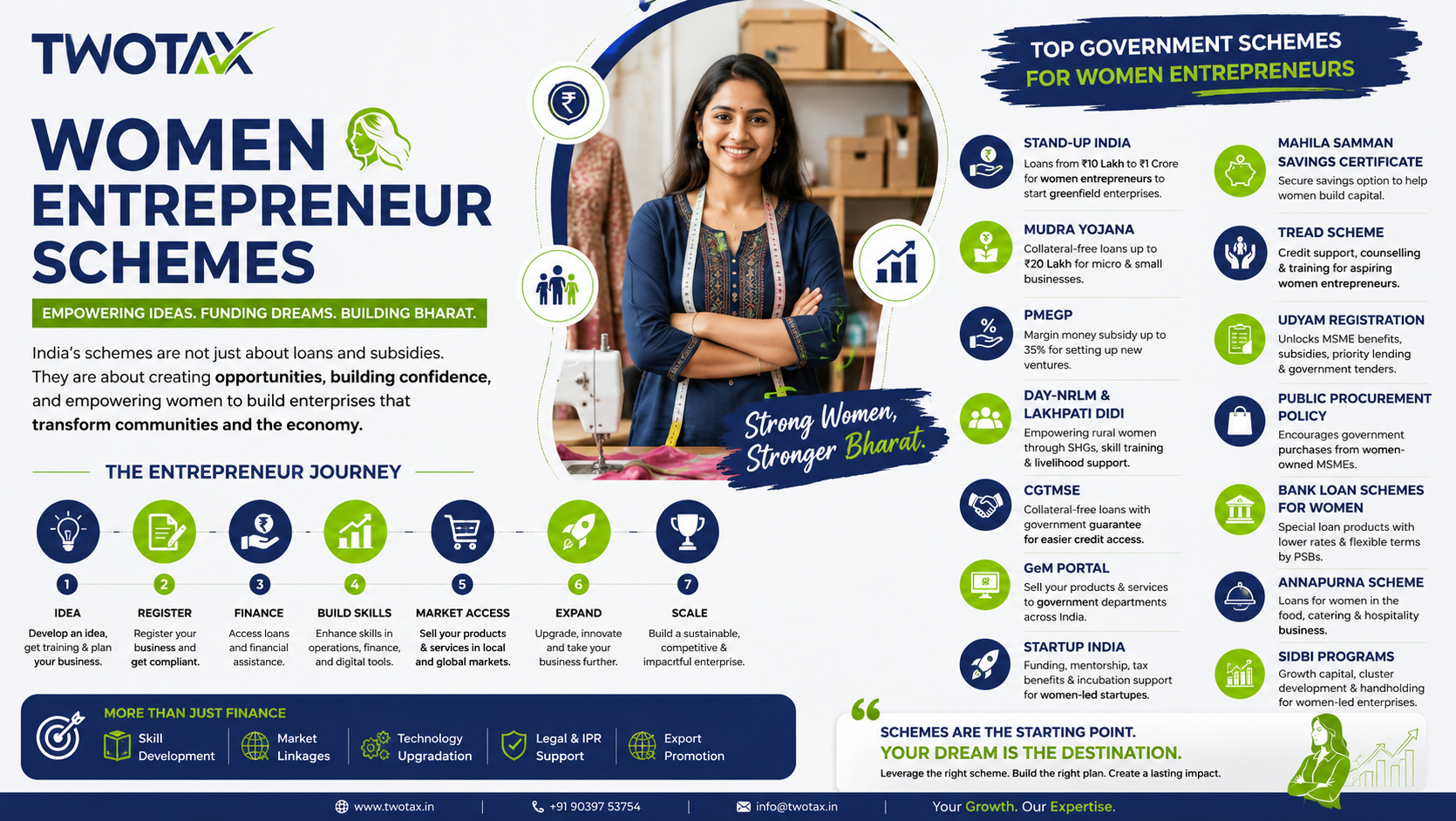
The Journey of a Woman Entrepreneur
Instead of understanding schemes department-wise, it is useful to understand them entrepreneur-wise.
Every business generally passes through seven stages.
Stage 1 – Developing an Idea
Questions begin with:
-
Can I start a business?
-
What business should I choose?
-
How much investment is needed?
-
Where can I receive training?
Stage 2 – Registering the Business
The entrepreneur requires:
-
Udyam Registration
-
PAN
-
GST (if applicable)
-
Bank account
-
Business licenses
Stage 3 – Arranging Finance
Capital requirements include:
-
Machinery
-
Working capital
-
Inventory
-
Office setup
-
Technology
Stage 4 – Capacity Building
Training becomes essential in:
-
Accounting
-
Digital payments
-
Marketing
-
Quality control
-
Export readiness
Stage 5 – Market Access
Businesses need:
-
Government procurement
-
E-commerce
-
Exhibitions
-
International buyers
-
Branding support
Stage 6 – Expansion
Businesses seek:
-
Larger loans
-
Technology upgradation
-
Export financing
-
Cluster development
Stage 7 – Scaling Nationally
Support shifts toward:
-
Venture funding
-
Innovation
-
Manufacturing incentives
-
Global markets
Interestingly, India's schemes now cover almost every one of these stages.
Scheme 1: Stand-Up India Scheme
Perhaps the most significant financing scheme exclusively designed to promote women entrepreneurship.
Objective
To facilitate institutional credit for women and SC/ST entrepreneurs establishing greenfield enterprises.
Administered by:
-
Department of Financial Services
-
SIDBI
-
Scheduled Commercial Banks
Loan Amount
₹10 lakh to ₹1 crore
Applicable for:
-
Manufacturing
-
Services
-
Trading
Eligibility
-
Woman entrepreneur above 18 years
-
Greenfield project
-
Non-individual entities where women hold at least 51% shareholding and controlling stake
Loan Structure
Composite loan covering:
-
Term Loan
-
Working Capital
Banks may finance up to 75% of project cost.
Additional Benefits
The scheme is integrated with handholding agencies that assist in:
-
Project reports
-
Skill training
-
Registration
-
Financial literacy
-
Market linkages
Unlike traditional bank lending, the objective is not merely financing but enterprise creation.
Scheme 2: Mudra Yojana (PMMY)
While Stand-Up India supports relatively larger enterprises, MUDRA caters to micro businesses.
Women entrepreneurs constitute one of the largest beneficiary groups under PMMY.
Three Categories
Shishu
Loans up to ₹50,000
Ideal for:
-
Home businesses
-
Tailoring
-
Food processing
-
Beauty services
Kishore
₹50,000 – ₹5 lakh
Suitable for expanding businesses.
Tarun
₹5 lakh – ₹20 lakh
Supports established enterprises scaling operations.
Why Women Prefer MUDRA
Many public sector banks provide:
-
Lower processing charges
-
Easier documentation
-
Faster approvals
-
Special outreach for women borrowers
MUDRA has become one of the strongest entry-level financing channels for first-generation women entrepreneurs.
Scheme 3: Mahila Samman Savings Certificate – An Indirect Entrepreneurial Tool
Although primarily introduced as a savings instrument, it plays an important role for aspiring entrepreneurs.
Women can accumulate capital safely before launching enterprises.
Benefits include:
-
Government-backed investment
-
Attractive fixed returns
-
Two-year maturity
-
Partial withdrawal facility
Many first-time entrepreneurs use such savings as promoter contribution while applying for institutional loans.
Scheme 4: PMEGP (Prime Minister's Employment Generation Programme)
One of India's oldest and most effective self-employment schemes.
Implemented through:
Financial Assistance
Government subsidy ranges from:
15% to 35%
Women generally qualify for higher subsidy categories.
Eligible Activities
-
Manufacturing
-
Food processing
-
Rural industries
-
Service enterprises
-
Village industries
Maximum Project Cost
Manufacturing:
₹50 lakh
Services:
₹20 lakh
Why It Matters
Unlike a pure loan scheme, PMEGP significantly reduces repayment burden through margin money subsidy.
Scheme 5: DAY-NRLM (National Rural Livelihood Mission)
One of the largest women empowerment programmes globally.
Instead of funding individuals, it creates community-based entrepreneurship.
Over 9 crore women have been mobilized into Self-Help Groups (SHGs), transforming collective savings into local enterprises.
Support Includes
-
Revolving funds
-
Community Investment Funds
-
Skill development
-
Producer groups
-
Rural enterprises
-
Digital bookkeeping
Thousands of businesses in:
-
Dairy
-
Poultry
-
Handicrafts
-
Food processing
-
Agri-business
have emerged through NRLM.
The scheme demonstrates that entrepreneurship is not always individual—it can also be collective.
Scheme 6: Lakhpati Didi Initiative
One of India's fastest-growing women livelihood initiatives.
Objective:
Enable rural women to earn at least ₹1 lakh annual sustainable income.
Support extends to:
-
Food processing
-
Agriculture
-
Livestock
-
Retail
-
Services
-
Digital enterprises
The initiative leverages the extensive SHG network under NRLM, emphasizing entrepreneurship over welfare.
Scheme 7: TREAD Scheme
Trade Related Entrepreneurship Assistance and Development
A lesser-known yet powerful initiative.
Instead of lending directly, assistance is routed through NGOs.
Components include:
-
Credit facilitation
-
Entrepreneurship development
-
Counselling
-
Skill training
-
Capacity building
Especially valuable for economically weaker women lacking formal banking relationships.
Scheme 8: Udyam Registration Benefits
Although not exclusive to women, registration unlocks significant advantages.
Benefits include:
-
MSME priority lending
-
Delayed payment protection
-
Subsidy eligibility
-
Government tenders
-
Technology support
-
Credit guarantee
For women-owned MSMEs, Udyam registration often becomes the gateway to multiple schemes.
Scheme 9: Credit Guarantee Fund Trust for Micro and Small Enterprises (CGTMSE)
One of the biggest hurdles for women entrepreneurs is collateral.
CGTMSE addresses precisely that challenge.
Banks can extend collateral-free loans while receiving government-backed credit guarantees.
Result:
Women without family-owned assets gain better access to formal finance.
Scheme 10: Public Procurement Policy for MSEs
Winning customers is often harder than obtaining finance.
Government procurement helps bridge this gap.
Several public sector undertakings actively encourage procurement from women-owned MSMEs through dedicated vendor development initiatives and outreach programmes.
Benefits include:
-
Stable demand
-
Better payment credibility
-
Business visibility
-
Long-term contracts
Scheme 11: Government e-Marketplace (GeM)
GeM has democratized government procurement.
Women entrepreneurs can directly sell products to:
-
Central Ministries
-
State Governments
-
PSUs
-
Autonomous Bodies
Products range from:
-
Furniture
-
Office supplies
-
IT equipment
-
Textiles
-
Food products
-
Consultancy services
For many women-led MSMEs, GeM has become a nationwide marketplace without requiring expensive distribution networks.
Scheme 12: Startup India Benefits for Women Founders
Women-led startups receive support through:
-
Incubators
-
Seed funding
-
Mentorship
-
Intellectual Property assistance
-
Tax incentives (subject to eligibility)
-
Networking
Several incubators also conduct women-exclusive acceleration programmes.
Scheme 13: SIDBI Support Programmes
The Small Industries Development Bank of India plays a pivotal role in financing women-led enterprises.
Support includes:
-
Growth capital
-
Refinancing
-
Cluster development
-
MSME advisory
-
Venture support
-
Green financing
SIDBI has also launched dedicated initiatives over the years to improve access to finance for women-owned MSMEs through partner institutions.
Scheme 14: Annapurna Scheme
A specialized financing programme supporting women entrepreneurs in the food and catering sector.
Suitable for:
-
Home kitchens
-
Catering businesses
-
Cloud kitchens
-
Food carts
-
Small restaurants
The scheme helps finance:
-
Kitchen equipment
-
Working capital
-
Initial setup
Scheme 15: Cent Kalyani (Central Bank of India)
Several public sector banks operate women-focused loan products.
Cent Kalyani supports:
-
Professionals
-
Self-employed women
-
Existing businesses
-
Expansion projects
Features often include:
-
Competitive interest rates
-
No collateral up to specified limits (subject to bank norms)
-
Flexible repayment
Similar products are offered by other banks from time to time, tailored to women borrowers.
Beyond Finance: The New Generation of Support
Modern entrepreneurship requires more than loans.
Government initiatives increasingly focus on:
Digital Inclusion
-
UPI adoption
-
Digital bookkeeping
-
E-commerce onboarding
Skill Development
-
Entrepreneurship Development Programmes
-
MSME Technology Centres
-
Sector-specific training
Export Promotion
Support through:
-
Export Promotion Councils
-
MSME export facilitation
-
Quality certifications
-
International exhibitions
Intellectual Property
Women innovators can access assistance for:
-
Patents
-
Trademarks
-
Design registration
-
Commercialization
Challenges That Still Need Attention
Despite the wide range of schemes, several barriers persist:
-
Limited awareness, particularly in rural and semi-urban areas
-
Documentation and compliance hurdles
-
Lower property ownership affecting collateral availability
-
Social norms influencing business decisions
-
Limited participation in high-growth technology sectors
-
Gaps in mentorship and investor networks
-
Difficulty in scaling beyond micro-enterprises
The next phase of policy evolution will likely focus less on launching new schemes and more on improving last-mile delivery, convergence, and measurable outcomes.
The Bigger Picture: From Welfare to Wealth Creation
India's approach to women entrepreneurship has undergone a profound shift.
Earlier programmes were largely welfare-oriented, emphasizing self-employment and income support. Today, the emphasis is on building competitive enterprises capable of creating jobs, integrating with global value chains, and contributing meaningfully to GDP.
This transformation is reflected in the diversity of support available: collateral-free credit through CGTMSE, structured finance under Stand-Up India and MUDRA, subsidy-backed ventures through PMEGP, collective entrepreneurship under NRLM and Lakhpati Didi, digital market access via GeM, and innovation support through Startup India. Rather than operating in silos, these initiatives increasingly function as complementary building blocks across the entrepreneurial lifecycle.
The most successful women entrepreneurs are often those who strategically combine these schemes instead of relying on a single programme. For example, an aspiring entrepreneur might begin with skill training under NRLM, formalize the enterprise through Udyam Registration, obtain financing via MUDRA or Stand-Up India, leverage CGTMSE for collateral-free lending, and expand sales through GeM or export promotion initiatives.
The message is clear: government schemes are not substitutes for entrepreneurship—they are catalysts for it. When paired with sound business planning, financial discipline, digital adoption, and market awareness, they can significantly reduce entry barriers and accelerate growth.
For policymakers, financial institutions, and industry stakeholders, the challenge ahead is not merely to increase the number of women-owned businesses, but to enable more women-led enterprises to scale from micro ventures into nationally and globally competitive companies. Because when women entrepreneurs grow, they do not just build businesses—they create employment, strengthen communities, diversify industries, and contribute to a more inclusive and resilient Indian economy.
Key Takeaways
.png)