How Government Subsidies Reach Businesses: Upfront, Reimbursement, PLI & More
How Government Subsidies Reach Businesses: Upfront, Reimbursement, PLI & More
Learn how government subsidies reach businesses in India through upfront, back-ended, reimbursement, interest subvention, credit-linked subsidies and PLI.
By CA (Dr.) Arpit YadavSeptember 01, 2026
How Government Subsidies Actually Reach Businesses in India
Your company qualifies for a government subsidy of ₹25 lakh.
the first thought is usually:
“When will the ₹25 lakh come into my bank account?”
But that is not always how government support works.
A government scheme may provide financial assistance through a bank, reimburse expenditure after verification, reduce the cost of eligible borrowing, adjust a subsidy against a loan, or reward a business only after it achieves specified production or sales targets.
In other words:
A ₹25 lakh government benefit does not necessarily mean ₹25 lakh of immediate cash.
This distinction is particularly important for MSMEs, manufacturers, startups and entrepreneurs preparing a DPR, bank finance proposal or investment plan.
The real value of a government incentive depends on four things:
How much you receive.
How you receive it.
When you receive it.
What conditions you must satisfy to receive and retain it.
This article explains the major ways government support reaches businesses in India and why understanding the payment mechanism is just as important as identifying the scheme itself.
1. Government Subsidy Is Not Always a Direct Cash Payment
The word “subsidy” is often used broadly.
But government support can take several forms.
A scheme may provide:
Upfront financial assistance
Back-ended subsidy
Reimbursement
Interest subvention
Credit-linked subsidy
Production-linked incentive
Tax or duty-related benefits
Credit guarantee support
Interest reimbursement
Capital investment support
Each mechanism has a different impact on the business.
For example:
A reimbursement may reduce the effective cost of a project but may not reduce the initial cash requirement.
An interest subvention may reduce the cost of borrowing but does not eliminate the loan.
A PLI may create a future incentive based on qualifying production, but it does not necessarily provide money to build the factory today.
This is why simply knowing the headline subsidy percentage is not enough.
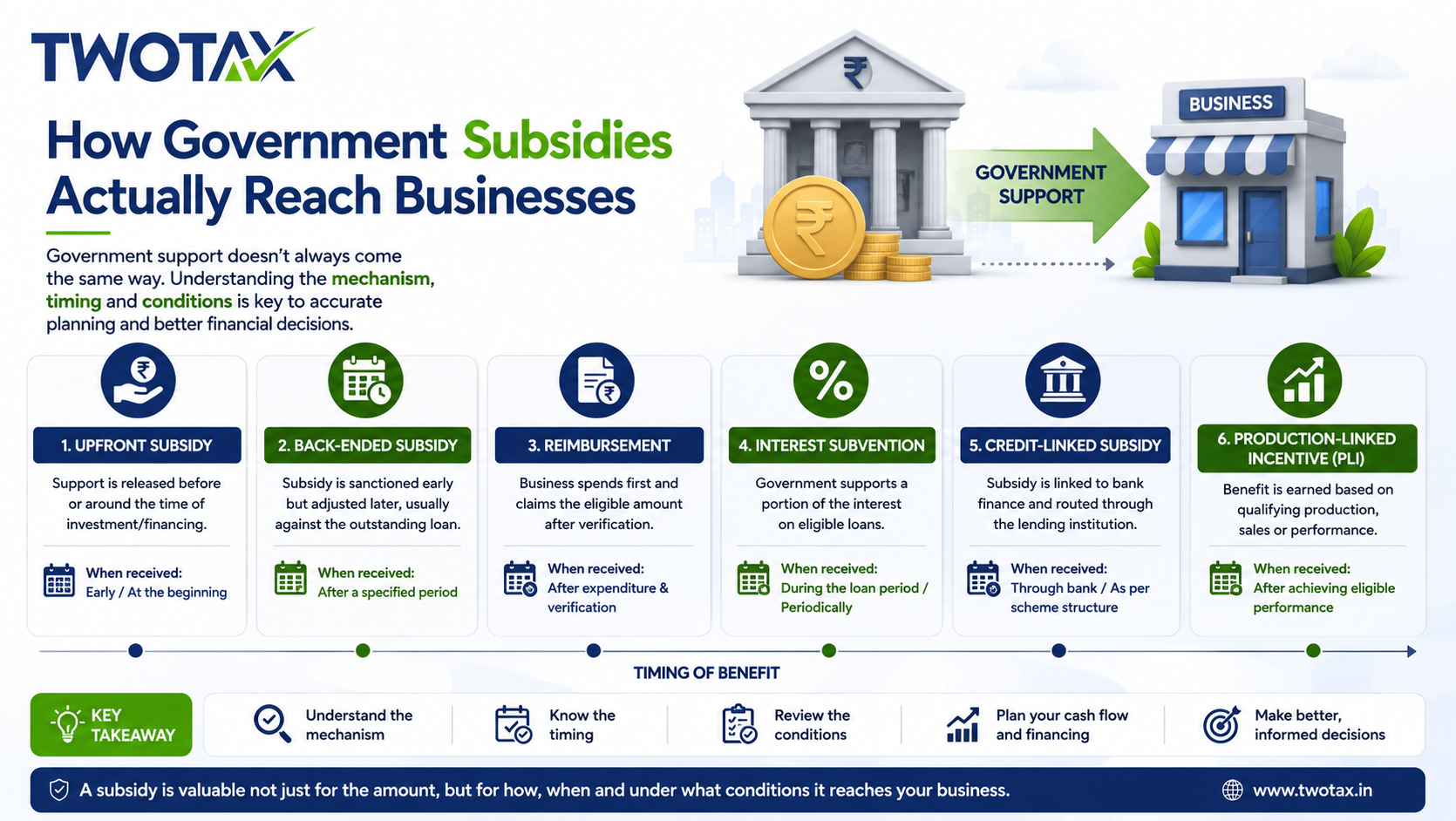
2. The Six Major Ways Government Support Can Reach a Business
For practical understanding, government financial support can broadly be divided into six mechanisms:
1. Upfront Subsidy
Support is provided at or around the time of investment or financing, subject to scheme conditions.
2. Back-Ended Subsidy
The benefit is linked to the project or loan but is retained and adjusted later according to the scheme.
3. Reimbursement
The business spends first and subsequently claims the eligible amount after verification.
4. Interest Subvention
Government support reduces the eligible interest burden on qualifying borrowing.
5. Credit-Linked Subsidy
The subsidy is connected to institutional finance and generally operates through the lending structure.
6. Production-Linked Incentive
The business earns an incentive after achieving specified production, sales or other performance criteria.
These mechanisms may all be casually called “subsidies.”
Financially, however, they are very different.
3. Upfront Subsidy: When Government Support Comes Early
An upfront subsidy is the simplest structure to understand.
The eligible benefit is made available relatively early in the project, subject to the applicable scheme conditions.
Depending on the programme, the support may:
Be paid to the beneficiary
Be routed through a bank
Be adjusted against financing
Be released against eligible investment
Be provided after a prescribed initial verification
But there is an important qualification:
Upfront does not mean unconditional.
The entrepreneur may still have to:
Complete the approved investment
Purchase eligible assets
Use the funds for the approved purpose
Maintain the asset
Meet employment or operational requirements
Submit documents
Complete inspections
Comply with post-sanction conditions
Therefore, an upfront subsidy should never be treated as unrestricted business cash.
4. An Example of Upfront Capital Subsidy
The MSME Ministry's official information on the Credit Linked Capital Subsidy component describes an upfront capital subsidy for eligible MSEs taking institutional credit for approved technology upgradation. The published scheme information describes a 15% subsidy on eligible institutional credit up to ₹1 crore, subject to the scheme's technology and eligibility conditions.
The important lesson is not simply the percentage.
The important lesson is the mechanism:
Institutional finance
↓
Eligible technology investment
↓
Government subsidy
The entrepreneur therefore needs to understand both the investment requirement and the financing structure.
5. Back-Ended Subsidy: Why You May Not See the Money Immediately
A back-ended subsidy is one of the most misunderstood mechanisms.
The Government may sanction or release the subsidy through the lending institution, but the benefit may be retained and adjusted later, rather than being handed to the entrepreneur as unrestricted cash immediately.
This is particularly relevant to credit-linked government programmes.
The entrepreneur may therefore hear:
“Your subsidy has been sanctioned.”
but still not see the same amount sitting in the operating bank account.
The subsidy may instead remain linked to the loan and be adjusted according to the scheme's prescribed mechanism.
6. PMEGP: A Useful Example of Margin-Money Subsidy
PMEGP is an important example of a credit-linked margin-money subsidy programme.
The current PMEGP guidelines provide for margin-money subsidy for eligible new enterprises, with project-cost limits of ₹50 lakh for manufacturing and ₹20 lakh for business/service activities for subsidy purposes. The balance project cost, excluding the beneficiary's own contribution, is financed by banks according to the scheme framework.
The scheme therefore illustrates an important point:
Government subsidy and bank finance can work together.
The subsidy is not simply another loan.
But neither should an entrepreneur assume that it is equivalent to unrestricted cash available on Day 1.
The exact treatment, timing and adjustment mechanism must be understood from the current scheme guidelines and bank implementation process.
7. Why Governments Use Back-Ended Structures
A back-ended structure can help ensure that government support remains connected to the actual project.
It can encourage:
Genuine investment
Proper utilisation of bank finance
Continuation of the business
Asset retention
Compliance with scheme conditions
Verification of the project
The underlying policy idea is simple:
Government support should be linked to the business actually implementing the project for which assistance was sanctioned.
8. Reimbursement: Spend First, Claim Later
Reimbursement works differently.
The basic process is:
Business identifies eligible expenditure
↓
Business incurs expenditure
↓
Business pays the supplier/service provider
↓
Documents are submitted
↓
Government/implementing agency verifies
↓
Eligible amount is reimbursed
This mechanism is common where the Government wants to support actual expenditure rather than simply provide funds before the expenditure takes place.
Depending on the programme, reimbursement may relate to areas such as:
Certification
Testing
Quality improvement
Technology adoption
Training
Export promotion
Market development
Branding
Logistics
Infrastructure
The exact eligible items vary by scheme.
9. Why Reimbursement Can Be Difficult for a Cash-Constrained Business
Consider a project where:
Eligible expenditure = ₹1 crore
and:
Government reimbursement = ₹20 lakh
The entrepreneur may think:
“My project effectively costs ₹80 lakh.”
Economically, that may be true once the reimbursement is actually received.
But initially, the business may still have to arrange:
₹1 crore.
This could come from:
Promoter contribution
Bank loan
Working capital
Internal accruals
Investor funds
Therefore:
Reimbursement can reduce the effective cost without reducing the initial funding requirement.
This distinction is critical.
10. Reimbursement and Cash Flow
Suppose the reimbursement is received six months after the eligible expenditure.
The business may have to finance the six-month gap.
If the business borrows additional money to bridge that period, it may also incur:
Interest cost
Working-capital cost
Processing charges
Additional financial pressure
Therefore, when calculating the actual economic benefit of a reimbursement, consider:
Reimbursement Amount
minus
Financing Cost of Waiting
The net economic benefit may be lower than the headline reimbursement.
11. Interest Subvention: Government Helps With the Cost of Borrowing
Interest subvention is different from a capital subsidy.
Here, the Government supports a specified portion of the eligible interest burden on qualifying borrowing.
The MSME Ministry's Interest Subvention Scheme, for example, provides for interest relief calculated at 2 percentage points per annum on eligible outstanding incremental or fresh credit, subject to the scheme's conditions and eligibility requirements. The scheme's official page states that eligible MSMEs must have a valid GSTN and be registered on the Udyam portal.
The key point is:
The business still has a loan.
The principal does not disappear.
The interest support simply reduces the eligible cost of borrowing according to the scheme.
Tax Partner is India’s most reliable online business service platform, dedicated to helping you in starting, growing, & flourishing your business with our wide array of expert services at a very affordable cost.