Connect with us for all your queries


Both invest ₹20 crore.
Both purchase similar machinery.
Both obtain bank financing.
Both hire the same number of employees.
Five years later, one business has expanded into multiple states, enjoys stronger cash flow, and reports significantly higher profitability.
The other continues to struggle with debt servicing and limited working capital.
What made the difference?
It was not superior machinery.
It was not lower labour costs.
It was not better marketing.
The difference was strategic financial planning.
One entrepreneur understood how to leverage Government subsidies, grants, tax incentives, and industrial promotion schemes before making the investment.
The other discovered these opportunities after the project had already begun.
This is one of the most overlooked aspects of business planning in India.
Every year, both the Central Government and State Governments introduce numerous Government subsidy schemes to encourage manufacturing, exports, technology adoption, employment generation, renewable energy, food processing, infrastructure development, and industrial growth.
Yet, thousands of businesses fail to claim these benefits simply because they are unaware of them or approach the planning process too late.
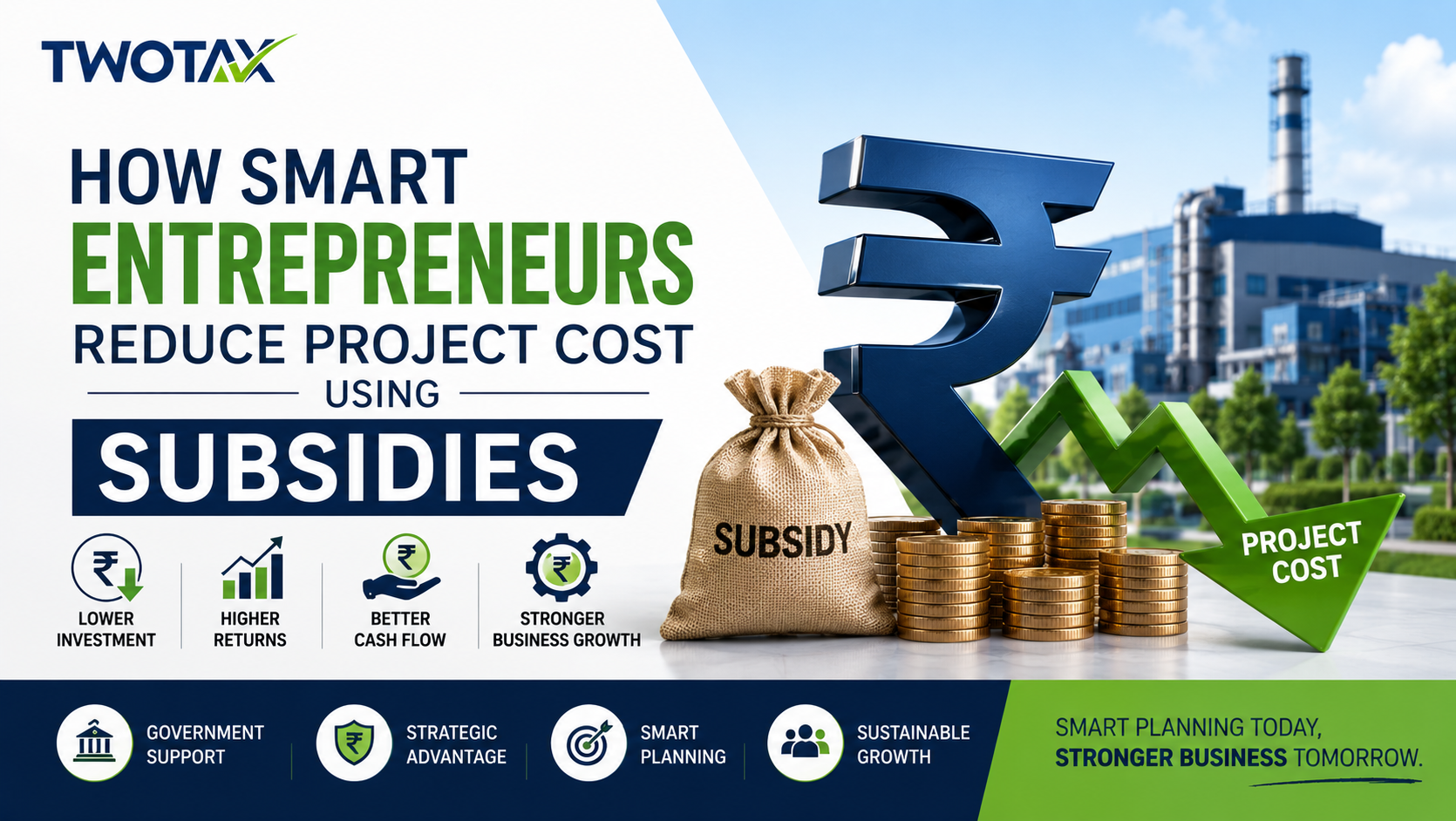
This article explores how smart entrepreneurs strategically reduce project costs using Government subsidies and why incentive planning should become an integral part of every business investment decision.
One of the biggest misconceptions among entrepreneurs is that Government subsidies are merely financial grants provided after completing a project.
In reality, subsidies are strategic economic policy instruments designed to achieve broader national objectives.
The Government introduces subsidy schemes to:
When businesses align their investment strategies with these policy objectives, they become eligible for various forms of financial support.
Rather than viewing subsidies as "free money," successful entrepreneurs treat them as strategic tools that improve project economics.
Most businesses spend months negotiating machinery prices or loan interest rates.
Few spend time identifying applicable Government incentives before investing.
However, subsidy planning can have a far greater impact on long-term profitability than negotiating marginal price reductions.
A well-planned subsidy strategy helps businesses:
The smartest entrepreneurs understand that profitability begins during the planning stage—not after commercial production starts.
Government support is available throughout the entire lifecycle of a business project.
Understanding these opportunities allows entrepreneurs to structure investments more efficiently.
The acquisition of land often represents one of the largest initial investments for manufacturing businesses.
Several State Governments encourage industrial development by offering:
Selecting the right state and industrial region can significantly reduce initial project costs.
Location selection is therefore not merely an operational decision—it is a financial strategy.
Modern manufacturing depends on technologically advanced machinery.
Recognizing this, various Government schemes encourage businesses to adopt modern production technologies.
Support may include:
These incentives enable businesses to improve productivity while reducing capital expenditure.
Access to affordable finance remains one of the biggest challenges for businesses, particularly MSMEs.
Government-supported financing initiatives help entrepreneurs by providing:
Lower financing costs improve liquidity and preserve working capital for operational growth.
Manufacturers expanding production capacities may benefit from performance-linked incentives that reward increased manufacturing and sales.
Such incentives encourage businesses to:
This transforms Government support from one-time assistance into long-term business growth.
Export-oriented manufacturers benefit from several Government initiatives designed to improve global competitiveness.
These incentives may include:
Reduced production costs enable Indian manufacturers to compete more effectively in international markets.
Entrepreneurs should understand that Government support extends beyond direct subsidies.
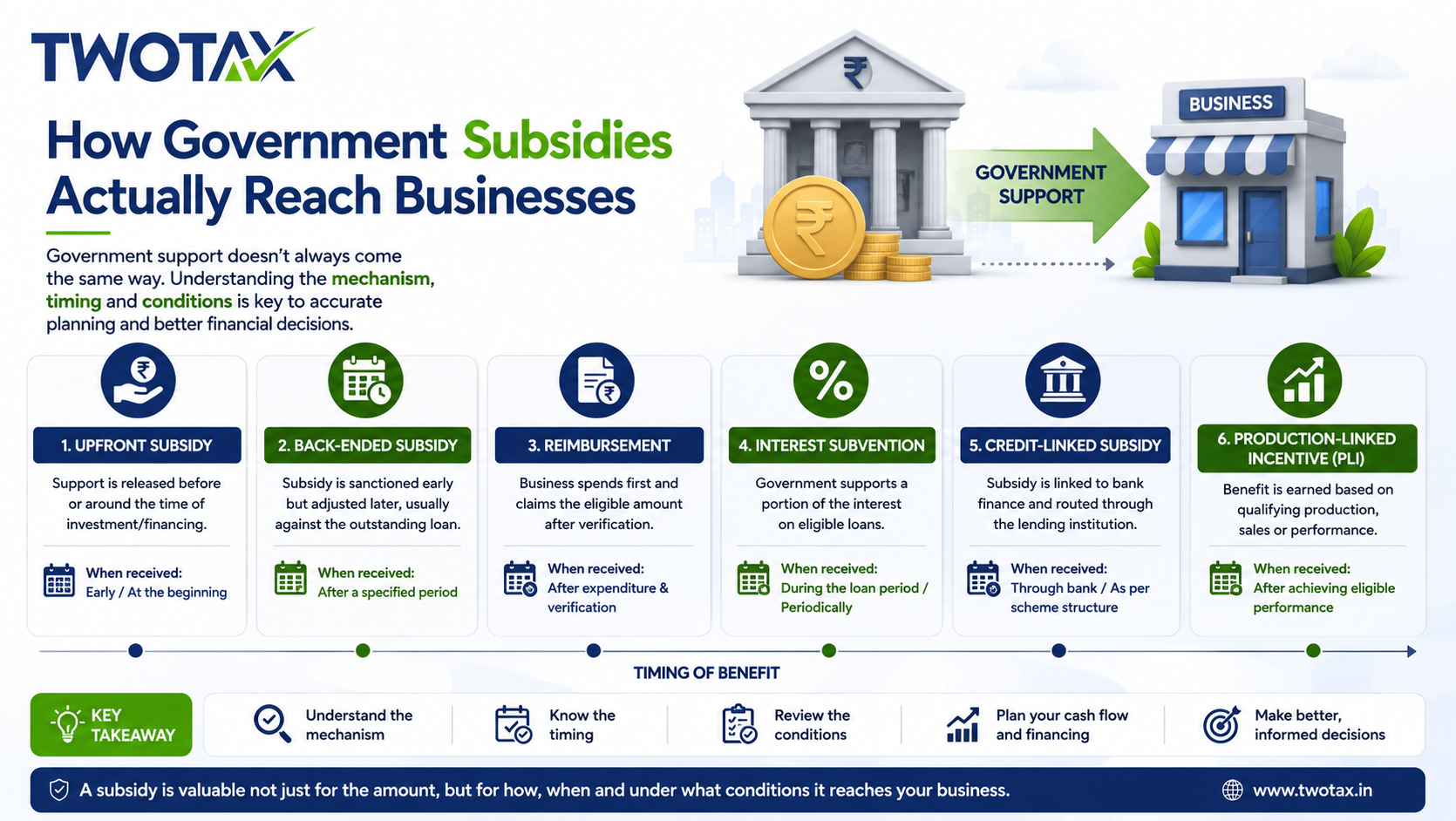
Common forms of assistance include:
Financial assistance linked to investments in fixed assets such as land, buildings, and machinery.
Partial reimbursement of interest paid on eligible loans.
Benefits such as Goods and Services Tax (GST) reimbursement, stamp duty exemptions, electricity duty exemptions, and other fiscal incentives.
Government-backed guarantees that enable easier access to institutional finance.
Financial assistance encouraging modernization and adoption of advanced technologies.
Benefits encouraging businesses to enter international markets and increase exports.
Consider a business planning a manufacturing project worth ₹25 crore.
Without strategic planning, the entrepreneur funds the project entirely through equity and debt.
However, by evaluating applicable Government incentive schemes before investment, the business may become eligible for:
Collectively, these benefits improve cash flow, reduce financing costs, and strengthen project viability.
Instead of treating incentives as an afterthought, smart entrepreneurs integrate them into the project's financial model from the outset.
Many businesses fail to receive Government incentives due to avoidable mistakes.
Some of the most common include:
Many subsidy applications must be submitted before project implementation begins.
Businesses often select factory locations based solely on land prices, ignoring State Government incentive policies.
Incomplete records frequently delay or invalidate applications.
Improper investment planning may reduce eligibility under multiple schemes.
Most Government schemes require formal applications and compliance with prescribed conditions.
Professional guidance during the planning stage can help businesses avoid these errors.
The most successful entrepreneurs no longer evaluate projects solely on expected revenues.
Instead, they ask:
These questions often create a stronger competitive advantage than reducing machinery costs by a few percentage points.
Before making a major investment, businesses should conduct a comprehensive incentive assessment covering:
An incentive assessment should become as routine as financial due diligence.
Reducing project costs is no longer about negotiating lower prices alone.
It is about making informed strategic decisions before investing.
Government subsidies, grants, tax incentives, and industrial promotion schemes provide businesses with opportunities to reduce capital expenditure, strengthen cash flow, improve profitability, and accelerate long-term growth.
Entrepreneurs who incorporate subsidy planning into their investment strategy position themselves for greater financial resilience and sustainable expansion.
Before your next investment, ask yourself one important question:
"Am I financing this project entirely on my own when Government incentives may already be available to support it?"
The answer could transform the economics of your entire project.
Identifying the right Government subsidy is only the first step. Every scheme comes with specific eligibility criteria, timelines, documentation requirements, and compliance obligations.
At TwoTax, we help businesses:
Strategic planning today can significantly improve your business performance tomorrow.
Plan Smart. Invest Wisely. Grow Sustainably.
Tax Partner is India’s most reliable online business service platform, dedicated to helping you in starting, growing, & flourishing your business with our wide array of expert services at a very affordable cost.