Connect with us for all your queries


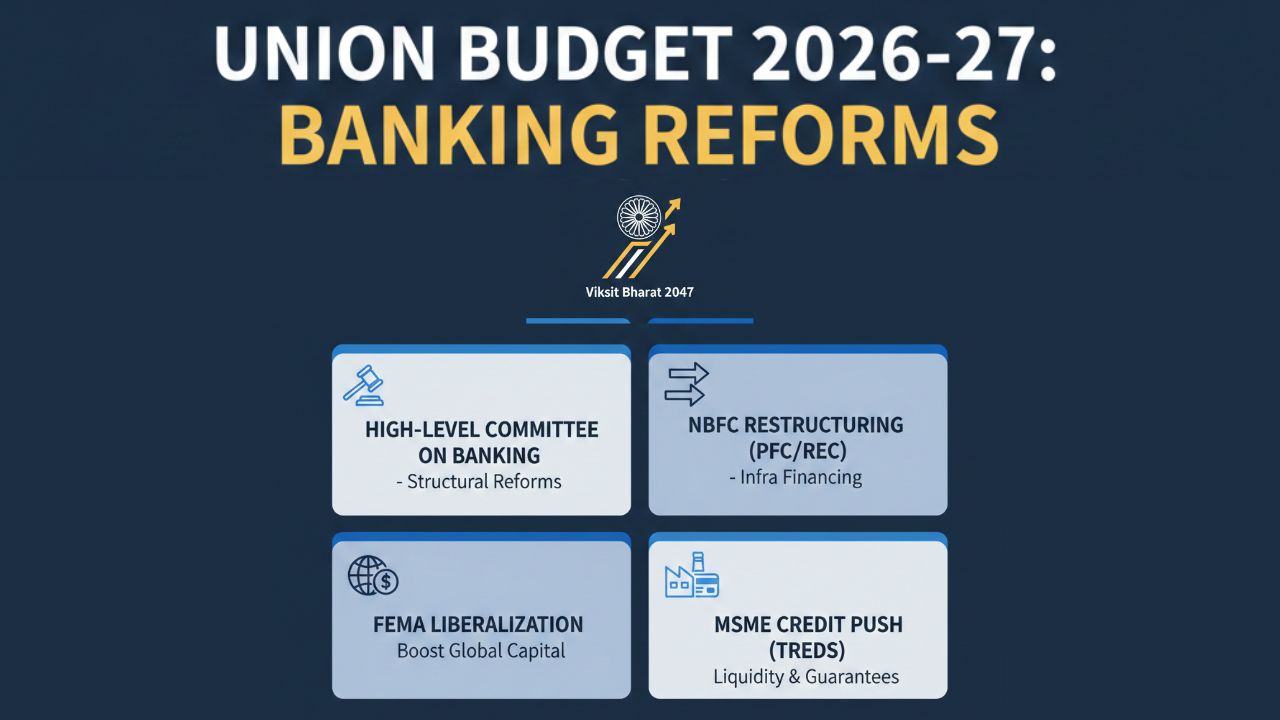
India’s banking sector has entered a position of strength after years of balance sheet clean-up, NPA resolution, and capital restructuring. Recognising this improved stability, the Union Budget 2026 shifts focus from recovery to expansion and reform.
The government’s banking roadmap is now aligned with the long-term Viksit Bharat 2047 vision ,aiming to build globally competitive banks capable of funding India’s infrastructure, industrial, and digital growth story.
This Budget does not merely announce policy tweaks ,it lays down a structural blueprint for how Public Sector Banks (PSBs), NBFCs, and financial institutions must evolve in the coming decade.
One of the most significant announcements is the proposal to set up a High-Level Committee to recommend next-generation banking reforms.
Over the last few years, PSBs have demonstrated:
With stability restored, the next step is structural strengthening.
The committee is likely to review:
This signals a transition from reactive regulation to proactive institutional design.
The Budget also highlights restructuring initiatives among public sector NBFCs, including development finance entities such as PFC and REC.
The goal is to create larger, better-capitalised institutions capable of funding long-gestation infrastructure projects.
This restructuring can:
For banks, this creates a collaborative lending ecosystem rather than concentrated project risk.
A review of FEMA regulations governing non-debt instruments has been proposed to simplify foreign investment inflows.
Easier foreign investments can help banks through:
This move strengthens India’s positioning as a global financial destination.
Another cornerstone reform is the push to expand India’s corporate and municipal bond ecosystem.
India’s infrastructure ambitions require long-term financing ,something traditional bank lending alone cannot sustain.
Bond market development will:
Banks will increasingly act as:
This transition boosts fee income while optimising capital deployment.
MSMEs remain the backbone of India’s economy but often face working capital stress due to delayed receivables.
To address this, Budget 2026 proposes scaling the Trade Receivables Discounting System (TReDS).
For lenders, TReDS expansion means:
This reform improves both MSME survival rates and bank asset quality.
Infrastructure financing has traditionally been high-risk due to long gestation and regulatory uncertainties.
To counter this, the government has proposed an Infrastructure Risk Guarantee Fund.
Banks can now:
This aligns credit growth with India’s capex-led development model.
Beyond policy announcements, the Budget outlines an operational direction for PSBs.
Banks are expected to:
Governance will be central to future regulatory evaluations.
PSBs must recalibrate lending towards:
Risk-sharing via NBFC partnerships and guarantee structures will be key.
Banks should integrate:
This enables faster, documentation-light credit delivery.
Future-ready banks will expand into:
Non-interest income will become a major profitability driver.
Digital transformation priorities include:
Cybersecurity investments will also rise alongside digital lending growth.
Workforce reskilling will focus on:
Banks must evolve culturally from recovery institutions to growth enablers.
Union Budget 2026 signals that India’s banking clean-up phase is over ,and expansion has begun.
Key directional shifts include:
The reforms aim to build banks that are:
The banking reforms announced in Union Budget 2026 represent a structural pivot rather than incremental change. By combining governance reforms, capital market deepening, MSME liquidity frameworks, and infrastructure risk support, the government is preparing India’s financial system for the next growth decade.
Public Sector Banks, in particular, stand at a transformation junction ,where operational agility, technological adoption, and credit discipline will determine their leadership in India’s financial future.
Tax Partner is India’s most reliable online business service platform, dedicated to helping you in starting, growing, & flourishing your business with our wide array of expert services at a very affordable cost.