Connect with us for all your queries


Strengthening Transparency in CIRP: IBBI’s New Safeguard Proposals Explained
The Insolvency and Bankruptcy Code (IBC) has been one of India’s most transformative economic reforms. It was designed to revive financially distressed companies through a time-bound and transparent process. While the framework has delivered many successes, the practical implementation has revealed gaps,especially around disclosures, decision-making, and stakeholder participation.
To address these challenges, the Insolvency and Bankruptcy Board of India (IBBI) has released a new discussion paper proposing strong safeguards to improve transparency, fairness, and accountability within the CIRP ecosystem. These proposals aim to make the process more inclusive, better informed, and aligned with the principles on which the IBC was built.
This article breaks down the proposed changes in a simple, comprehensive manner,helpful for professionals, homebuyers, creditors, and anyone who wants to understand how India’s insolvency framework is evolving.
1. Why Did IBBI Introduce These Proposals?
In recent years, several issues have come to light during corporate insolvencies:
These gaps create uncertainty, reduce value for stakeholders, and lead to unnecessary litigation. The new proposals aim to close these loopholes and build a more robust CIRP environment.
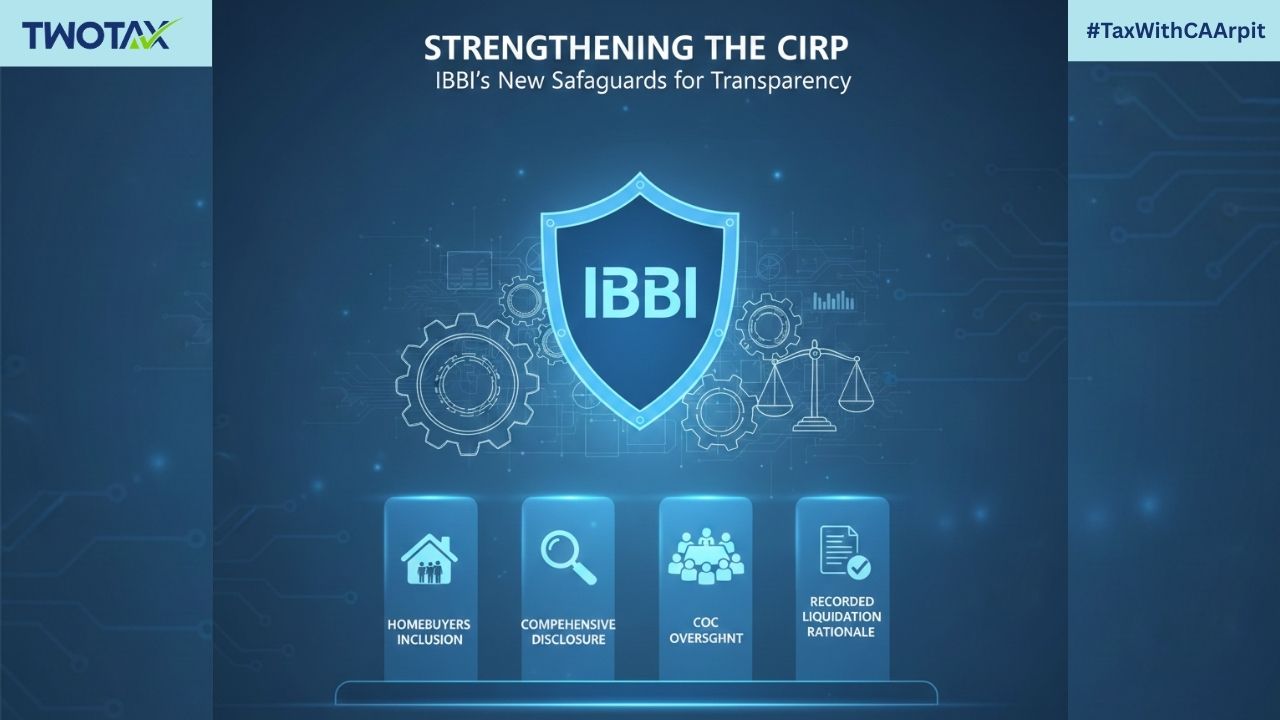
2. Proposal 1: Mandatory Inclusion of All Homebuyers in Real Estate Insolvency
The Issue
Real-estate insolvency cases involve hundreds of homebuyers with varying claim statuses. Many homebuyers fail to file claims, but their details appear in the company’s books. As a result, they get excluded from the Information Memorandum and even from the final resolution plan.
This leads to appeals, delays, and disputes.
The Solution Proposed
The IBBI wants to ensure homebuyers are never ignored.
The proposal requires:
Why This Matters
This provides better protection to homebuyers, reduces litigation, and ensures complete transparency for resolution applicants evaluating real-estate projects.
3. Proposal 2: Comprehensive Disclosure of Receivables, JDAs, and Attached Assets
The Issue
A company’s value is often hidden in details like:
When these items are missing in the Information Memorandum, resolution applicants cannot assess the true financial position. This leads to undervalued bidding or sometimes a complete lack of interest in the company.
The Solution Proposed
IBBI proposes that the Information Memorandum must include:
Why This Matters
When bidders receive complete information, they can:
It is a direct push towards greater transparency and professionalism in CIRP.
4. Proposal 3: Checks & Balances When CoC Has No Bank or Financial Institution
The Issue
In some insolvency cases, especially when banks have no exposure, the Committee of Creditors (CoC) is formed entirely of unrelated or unregulated operational creditors.
If one operational creditor holds a high voting share, they can dominate proceedings,raising concerns of bias or unfair influence.
The Solution Proposed
IBBI proposes that when the CoC does not include any regulated financial institution:
Why This Matters
This ensures:
5. Proposal 4: CoC Must Justify Liquidation When Viable Resolution Exists
The Issue
There have been cases where:
Such decisions harm value maximisation, which is the core objective of the IBC.
The Solution Proposed
When a viable resolution plan exists but the CoC still wants liquidation, they must:
Why This Matters
This brings accountability to the CoC and ensures decisions are not arbitrary.
It also helps creditors, investors, and professionals understand the rationale behind liquidation.
6. Overall Impact of the Proposed Safeguards
The proposals aim to create a CIRP environment that is:
✔ More Transparent
Full disclosures → fewer surprises → more accurate resolution plans.
✔ More Inclusive
Homebuyers and operational creditors will have better participation and representation.
✔ More Accountable
CoC decisions will require explanation, especially when deviating from value-maximising options.
✔ More Stable
Improved trust in the insolvency process enhances investor confidence and reduces litigation.
7. What This Means for Stakeholders
For Homebuyers
Better protection, guaranteed inclusion, reduced delays, and improved recovery prospects.
For Creditors
More transparency, better decision-making data, and a more structured CoC environment.
For Resolution Professionals
A need for greater diligence, proper documentation, and meticulous preparation of the Information Memorandum.
For Investors / Resolution Applicants
Clearer information → reduced risk → realistic bids → higher success rate in resolutions.
For the Insolvency Ecosystem
An evolution towards maturity, discipline, and fairness,core goals of the IBC.
8. Closing Perspective (From the desk of a Finance & Tax Professional)
These proposals show that the IBC framework is not static,it is learning, adapting, and strengthening with every case, every judgement, and every challenge.
By mandating transparency and structured reasoning, the IBBI is trying to bridge the gap between law and implementation.
As CA (Dr.) Arpit Yadav often emphasises, “A transparent insolvency process doesn’t just resolve companies,it restores trust in the entire credit system.”
These proposed reforms carry the potential to reduce disputes, revive stalled projects, protect homebuyers, and bring discipline into corporate distress management.
And that is exactly the direction India needs as it moves into more complex, high-value insolvency cases.
Tax Partner is India’s most reliable online business service platform, dedicated to helping you in starting, growing, & flourishing your business with our wide array of expert services at a very affordable cost.