The Rupee at All-Time Low: Explaining RBI’s Strategic Shift from Price Defense to Market Adjustment
The RBI has changed its currency strategy. Discover why India's central bank is no longer defending the Rupee's price level and is instead focusing on volatility management. Understand the impact on inflation and exports.
By Advocate, Tanvi Thapliyal December 06, 2025
The RBI's New Playbook: Why They're Letting the Rupee Adjust to the Tide, Not Fighting It
The Big Headline That Affects Your Wallet
Every time the Indian Rupee hits an all-time low against the US Dollar ($), alarm bells ring. News channels flash the scary number,for example, ₹90 per dollar,and the question on everyone's mind is the same: "Why isn't the Reserve Bank of India (RBI) doing anything to stop it?"
For years, the public expectation was simple: The RBI, our country's central bank, would aggressively jump into the market, sell billions of dollars from its savings, and stop the Rupee from falling past a certain point.
But if you look closely at the RBI’s actions today, you'll see a fundamental and historic shift in their strategy. They are no longer defending a specific "price level." Instead, they are focused on managing the "speed of the fall" and allowing the currency to find its own level.
This isn't a sign of weakness; it's a strategic, calculated, and long-term move that affects the price of everything from petrol to foreign travel.
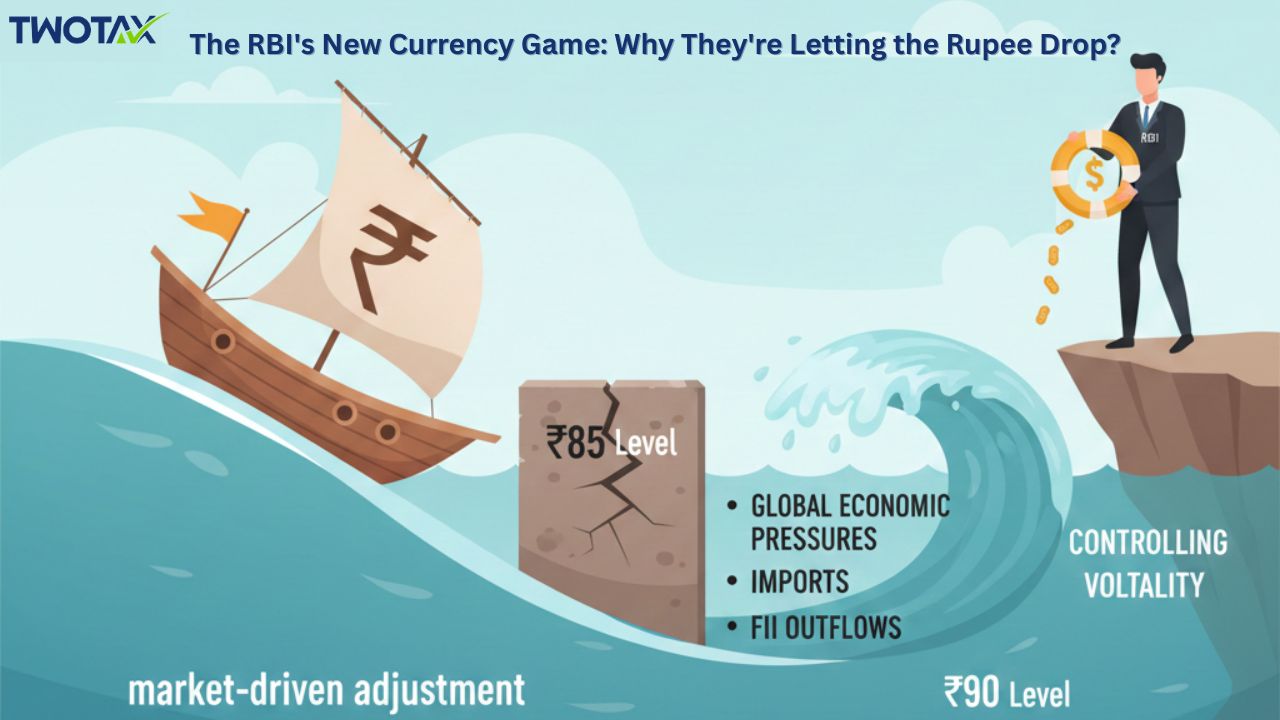
Understanding the Shift: The Boat and the Tide Analogy
To understand this complex financial decision, let's use a simple analogy:
Imagine the Indian Rupee (INR) is a Boat sailing on the global market, and the US Dollar (USD) is the Ocean Level.
The Old Policy: Defending the Dock (The Price Level)
In the past, the RBI’s primary goal was to keep the Rupee Boat docked at a fixed, high point, say ₹85 per dollar.
-
The Problem: Strong global tides,like foreign investors pulling out money or high import bills for oil,were constantly trying to push the boat down.
-
The Intervention: To fight the tide, the RBI would throw massive amounts of their US Dollar Savings (Forex Reserves) into the water to artificially prop up the boat.
-
The Cost: This was unsustainable. It depleted our emergency savings quickly, and if the tide got too strong, the fall would be sudden and chaotic once the savings ran out.
The New Policy: Adjusting to the Tide (The Movement/Volatility)
Today, the RBI is accepting reality: The global tide is strong, and the Rupee needs to weaken to reflect the current economic fundamentals.
-
The Goal: They are no longer fighting the fall itself. They are simply ensuring the boat goes down slowly, smoothly, and in an orderly fashion.
-
The Action: They only intervene (sell dollars) if the fall becomes sudden, panicked, or disorderly (i.e., too much volatility). They don't want the boat to sink in a storm; they want it to settle gently at a new, lower level.
In essence, the RBI is now controlling the process, not the outcome.
Why the RBI Chose This Long-Term Strategy
This shift from defending a level (like ₹90) to managing volatility is a calculated trade-off based on three major financial pillars:
1. Conserving the Dollar War Chest (Forex Reserves)
-
India's Financial Shield: Our Foreign Exchange Reserves (our holdings of dollars, gold, etc.) are the nation’s ultimate financial shield. They stand at a robust level, but they are not infinite.
-
The Strategic Move: With pressures like continuous Foreign Institutional Investor (FII) outflows (foreigners selling Indian stocks/bonds) and a massive oil import bill, the demand for dollars is structural. Fighting this with daily intervention would deplete reserves rapidly.
-
The Benefit: By intervening only to smooth volatility, the RBI conserves its dollars. This ensures that India has plenty of money left to handle a true economic shock or crisis, like a sudden global financial meltdown. They are saving their firepower for a rainy day.
2. Boosting Export Competitiveness
-
The REER Factor: Every currency has a Real Effective Exchange Rate (REER), which is its value adjusted for inflation. If the Rupee is kept artificially high by RBI intervention, it becomes overvalued compared to what it should be.
-
The Exporter's Pain: An overvalued rupee makes Indian goods and services more expensive for foreign buyers. Imagine an Indian textile worker whose cloth costs $100. If the Rupee is too strong, the cloth is unaffordable.
-
The RBI’s Solution: Allowing the Rupee to weaken slightly makes Indian exports instantly cheaper and more competitive in global markets. This encourages more countries to buy "Made in India" goods, eventually bringing more dollars into the country, which helps stabilize the currency naturally in the long run.
3. Letting Fundamentals Take Over
-
Current Account Deficit (CAD): India is a net importer, meaning our import bill (what we pay) is significantly larger than our export earnings (what we receive). This difference is the CAD, and it creates a persistent, structural demand for the US dollar.
-
Market Efficiency: The RBI believes that constantly propping up the Rupee against this strong fundamental demand is inefficient. By stepping back (mostly), they allow the market to determine the "correct" value of the Rupee based on true supply and demand. This leads to a more realistic and sustainable exchange rate.
The Trade-Off: Why You Feel the Pinch (Imported Inflation)
While the RBI’s strategy is financially sound and strategic for the long term, it comes with a painful short-term cost that hits every Indian household: Imported Inflation.
When the Rupee weakens, it doesn't just affect traders; it affects consumers through key imports:
.png)
The RBI has acknowledged this risk, stating that a small percentage of Rupee depreciation does feed directly into domestic inflation. This is the price the economy pays for gaining long-term export competitiveness and preserving its dollar reserves.
Who Wins and Who Loses When the Rupee Weakens?
.png)
A falling Rupee doesn't hurt everyone equally. In fact, it creates clear winners and losers in the Indian economy.
Winners (Those who earn in Dollars)
Losers (Those who pay in Dollars)
.png)
The Road Ahead: What to Watch For
The RBI's new strategy marks a mature step in India's economic journey. The market is being told: the Rupee's value will be determined by real economic forces, not by an artificial support line defended by the central bank.
Here are the key factors that will determine how far the Rupee is allowed to fall and how the RBI manages the situation next:
-
Global Oil Prices: If crude oil prices fall, India's demand for dollars automatically decreases, easing pressure on the Rupee.
-
FII Flows: A sudden, large return of Foreign Institutional Investment into Indian stocks and bonds would inject billions of fresh dollars, strengthening the Rupee.
-
US Federal Reserve Policy: If the US Fed signals that it will cut interest rates, the US Dollar will weaken globally, providing immediate relief to the Rupee.
-
Export Growth: The true success of the RBI's strategy lies in whether the weaker Rupee actually translates into a massive boost in export revenue.
Don't expect the RBI to rush in and set the Rupee back to a comfortable, old level. Expect them to ensure the fall remains smooth, controlled, and strategic. This is the new normal of currency management, prioritizing the preservation of our national financial shield and the long-term competitiveness of Indian exports.