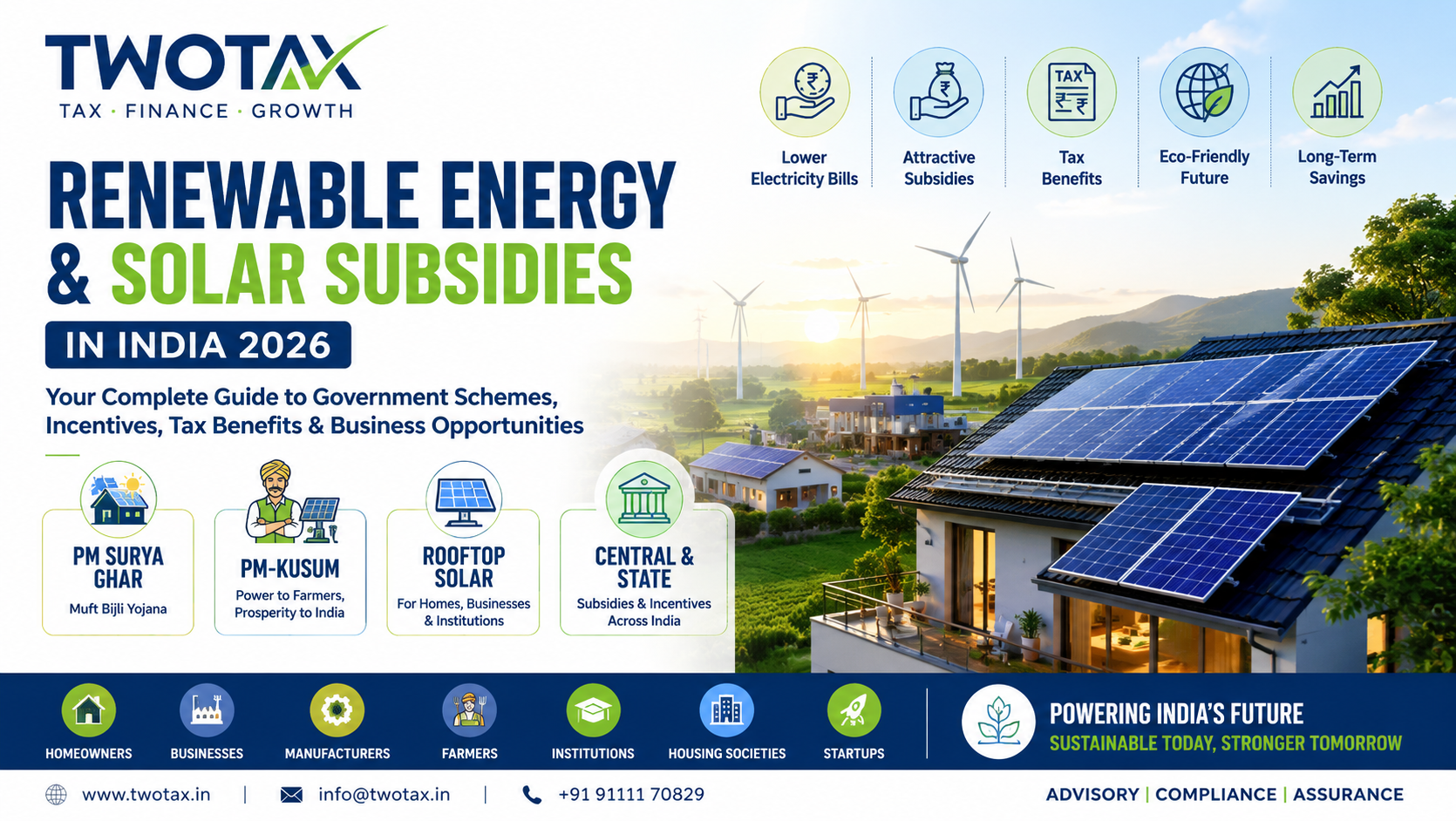
India's Clean Energy Revolution Has Begun
If you visit most Indian cities today, you’ll notice something new: solar panels are now common on houses, factories, schools, warehouses, and even on farmland.
This change isn’t just about caring for the environment. It’s also powered by one of India’s biggest public investments in clean energy.
The Government of India has launched an extensive network of subsidies, financial assistance, tax incentives, concessional financing and infrastructure support to make renewable energy economically attractive for households, MSMEs, farmers, industries and large enterprises alike.
Yet despite these opportunities, a significant number of individuals and businesses continue to miss out, not because support is unavailable, but because the ecosystem is fragmented across multiple ministries, agencies and schemes.
This guide brings everything together in one place.
Rather than simply listing subsidies, we explain who can benefit, how each scheme works, how different schemes complement one another, and how renewable energy can become a long-term financial asset rather than just an electricity-saving investment.
Why Renewable Energy Matters More Than Ever
India has committed itself to becoming one of the world's largest renewable energy economies, with ambitious capacity expansion targets and increasing investment in solar, wind, green hydrogen and decentralized clean energy systems. Government initiatives continue to accelerate distributed renewable energy adoption across households, agriculture and industry.
For businesses, renewable energy is now about much more than sustainability.
It directly influences:
-
Energy cost savings
-
Operational efficiency
-
ESG reporting
-
Export competitiveness
-
Carbon footprint reduction
-
Long-term energy independence
-
Investor confidence
-
Green financing eligibility
For households, it translates into reduced electricity bills, asset creation and protection against rising power tariffs.
Understanding India's Renewable Energy Support Ecosystem
Instead of one umbrella subsidy, India has built multiple support mechanisms, each targeting a different segment.
A Different Way to Think About Solar
Most people ask:
"How much subsidy will I get?"
The better question is:
How much wealth will solar create over the next 25 years?
Solar should be viewed as an infrastructure investment.
Unlike traditional assets:
-
It reduces recurring expenses.
-
Generates predictable savings.
-
Improves property value.
-
Can generate income in specific business models.
-
Supports ESG and sustainability commitments.
That shift in thinking changes investment decisions.
The Major Government Schemes You Should Know
1. PM Surya Ghar: Muft Bijli Yojana
This is India's flagship rooftop solar programme for residential consumers.
The scheme seeks to enable rooftop solar adoption across one crore households through central financial assistance and simplified digital applications. Recent government updates indicate rapid growth in installations, with more than 50 lakh households already covered.
Key Benefits
-
Direct Central Financial Assistance (CFA)
-
Subsidy transferred directly to the beneficiary
-
Online application portal
-
Vendor selection through the national portal
-
Net metering support (subject to state regulations)
-
Opportunity to substantially reduce monthly electricity bills
Subsidy Structure (Indicative)
-
Up to 60% support for eligible systems up to 2 kW
-
Additional support for systems above 2 kW, subject to scheme limits
-
Subsidy capped up to eligible capacity as notified by the Government.
Best For
-
Individual homeowners
-
Residential apartments (subject to applicable provisions)
-
Housing societies
2. PM-KUSUM
Agriculture consumes a significant share of India's electricity.
PM-KUSUM aims to make farming energy-independent while creating additional income opportunities for farmers.
The scheme has three components:
Component A
Farmers can establish decentralized renewable energy plants on barren or fallow land and sell electricity to DISCOMs.
This transforms unused land into an income-generating asset.
Component B
Supports installation of standalone solar-powered agricultural pumps, reducing dependence on diesel and unreliable grid supply.
Component C
Enables solarisation of existing grid-connected agricultural pumps and feeder-level solarisation.
The scheme provides central financial support and is implemented through state agencies and DISCOMs, with varying subsidy patterns depending on the component and state.
Who Can Benefit?
-
Farmers
-
Farmer Producer Organisations (FPOs)
-
Cooperatives
-
Panchayats
-
Water User Associations
3. Grid Connected Rooftop Solar Programme
This programme supports residential rooftop solar deployment through central financial assistance and incentives for distribution companies.
Applications are processed via the National Portal or state DISCOM portals, with subsidy credited after installation and verification.
4. National Solar Mission
One of India's foundational renewable energy initiatives, the National Solar Mission focuses on:
-
Expanding solar capacity
-
Reducing technology costs
-
Promoting domestic manufacturing
-
Encouraging research and innovation
-
Building a robust solar ecosystem
Although newer schemes now drive implementation, the Mission continues to underpin India's long-term solar strategy.
Renewable Energy Support for MSMEs
Many MSMEs believe solar is only for large industries.
In reality, small businesses often experience faster payback because electricity is a significant operating expense.
Potential benefits include:
-
Lower monthly electricity costs
-
Improved cash flow
-
Reduced production costs
-
Better ESG positioning
-
Easier access to green finance in certain cases
Several state governments, SIDBI-supported initiatives and financial institutions also facilitate energy-efficiency and renewable-energy financing for MSMEs, complementing central programmes.
Renewable Energy for Manufacturers
Manufacturing facilities generally consume electricity continuously.
Installing rooftop solar can:
-
Reduce production costs
-
Improve profitability
-
Hedge against tariff increases
-
Enhance export competitiveness
-
Strengthen sustainability reporting
Many industrial parks are also encouraging renewable energy adoption through state-specific incentives.
Solar for Housing Societies
Residential Welfare Associations (RWAs) and housing societies increasingly adopt rooftop solar for:
-
Common area lighting
-
Water pumps
-
Elevators
-
Clubhouses
-
Parking infrastructure
Shared installations reduce maintenance costs for residents.
Renewable Energy for Schools & Educational Institutions
Educational institutions can use solar energy to:
-
Reduce recurring operating expenses
-
Demonstrate sustainability
-
Support environmental education
-
Improve financial resilience
Several state programmes and institutional funding avenues support such installations.
Solar for Hospitals
Hospitals operate around the clock.
Solar energy helps lower operating costs while improving resilience against rising electricity prices.
Critical facilities increasingly integrate solar with battery storage for improved reliability.
Renewable Energy for Startups
Clean energy startups may benefit from:
-
Startup India ecosystem support
-
Incubation programmes
-
Innovation grants
-
Research funding
-
Green technology accelerators
This extends beyond installation businesses to energy analytics, storage, IoT, EV charging and software solutions.
Financing Renewable Energy
One of the biggest myths is that solar requires significant upfront capital.
Today, financing options include:
-
Bank loans
-
Green financing
-
NBFC financing
-
Vendor financing
-
RESCO (Renewable Energy Service Company) models
-
Lease models
-
Pay-as-you-save structures
These models reduce upfront investment barriers.
Tax Benefits & Financial Incentives
Depending on the nature of the project and prevailing tax laws, renewable energy investments may benefit from:
-
Depreciation under applicable Income-tax provisions
-
GST treatment based on supply structure
-
Input tax credit (where eligible)
-
State incentives
-
Green financing support
-
Carbon and sustainability-linked benefits
Professional tax advice is recommended because eligibility varies by entity type, asset use and current regulations.
State Government Solar Policies
In addition to central schemes, many states offer:
-
Additional capital subsidies
-
Net-metering frameworks
-
Property tax incentives (selected jurisdictions)
-
Electricity duty exemptions
-
Faster approvals
-
Industrial incentives
-
Renewable purchase support
State-specific policies should always be reviewed before project implementation.
Common Mistakes Applicants Make
Many applicants lose out on benefits due to avoidable errors.
Typical issues include:
-
Choosing non-empanelled vendors
-
Incorrect documentation
-
Missing DISCOM approvals
-
Improper system sizing
-
Ignoring state policy conditions
-
Failing to understand subsidy eligibility
-
Delayed application submission
Proper planning significantly improves approval timelines.
Beyond Solar: Other Renewable Energy Opportunities
India's renewable transition is not limited to rooftop solar.
Emerging opportunities include:
-
Wind Energy
-
Hybrid Renewable Projects
-
Battery Energy Storage Systems (BESS)
-
Green Hydrogen
-
Bioenergy
-
Waste-to-Energy
-
Floating Solar
-
Offshore Wind
-
Electric Vehicle Charging Infrastructure
These sectors are expected to attract increasing public and private investment over the coming decade.
Challenges That Still Exist
Despite rapid progress, renewable energy adoption still faces challenges such as:
-
High initial investment
-
Financing bottlenecks
-
Land availability
-
Grid integration
-
Net-metering variations across states
-
Consumer awareness
-
Technical capacity
-
Regulatory differences
Addressing these issues remains central to India's clean energy transition.
The Road Ahead
Renewable energy in India is no longer an environmental initiative alone—it is becoming an economic strategy.
Households can reduce electricity bills.
Farmers can generate additional income.
Businesses can lower operating costs.
Industries can strengthen ESG performance.
Investors can participate in one of the country's fastest-growing sectors.
The real opportunity lies not merely in claiming a subsidy, but in building long-term energy resilience and financial efficiency.
For anyone considering a shift to clean energy, understanding the available schemes, eligibility conditions, financing options and tax implications is just as important as choosing the right solar system.


.png)