Connect with us for all your queries


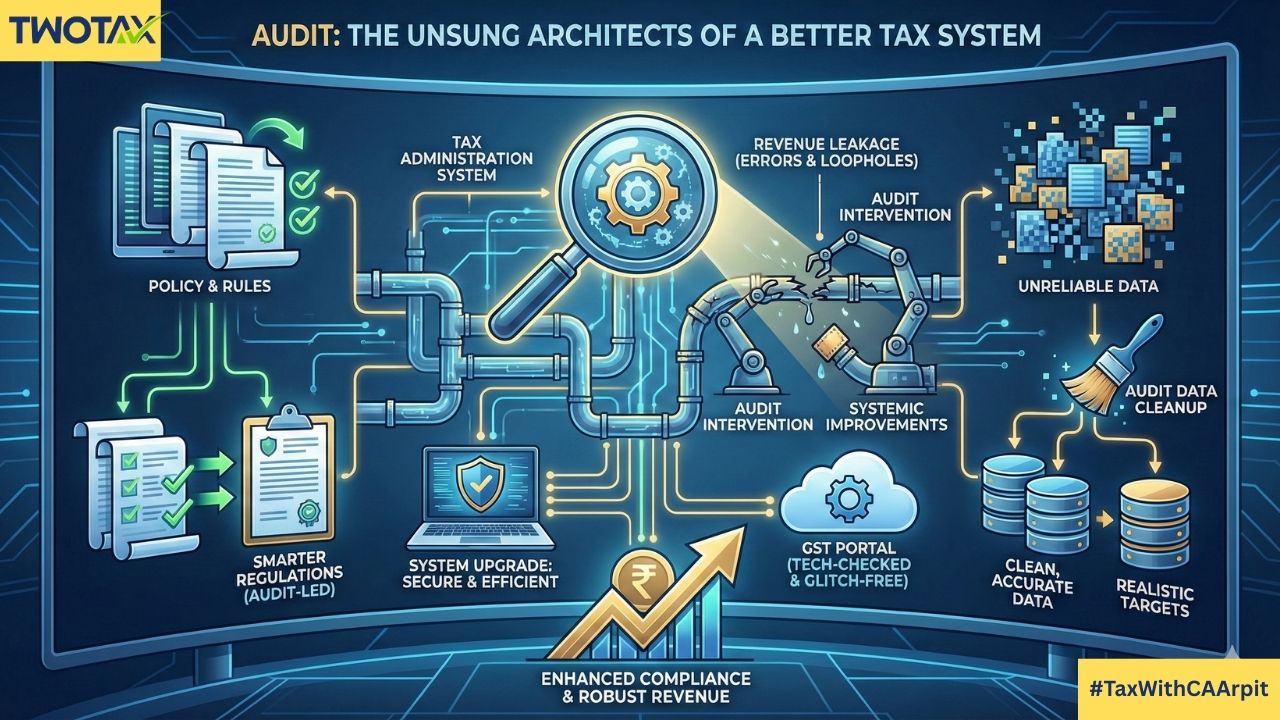
Introduction: Why Audit Matters More Than Ever in India’s Tax System
India’s economy is rapidly evolving. As incomes rise, businesses expand, and digital activity grows, the responsibility on the tax administration also increases. A fair and effective tax system ensures that the government has the resources required for infrastructure, social welfare, healthcare, education, defence, and nation-building.
However, ensuring that every individual or business pays the correct taxes is a complex and challenging task. Mistakes happen, loopholes exist, and intentional tax evasion still occurs. Even small errors repeated across lakhs of taxpayers can result in huge financial losses for the nation.
This is where audit steps in as one of the strongest pillars of the tax administration. Audit brings transparency, accountability, corrective action, and systemic improvements. Whether it is verifying deductions, correcting mistakes, identifying revenue leakages, or strengthening internal controls, audit acts as the backbone of a trustworthy tax framework.
This extensive article explains , in simple and human language , how audits improve direct tax compliance in India and how they ultimately strengthen the entire revenue system.
1. Understanding Direct Tax and the Role of Audit
What Are Direct Taxes?
Direct taxes are those taxes that people and businesses pay directly to the government. Examples include:
These taxes form a major part of India's revenue. Without them, public infrastructure and social schemes would be difficult to fund.
Why Do Direct Taxes Need Strong Oversight?
Direct taxes depend heavily on self-declaration. A taxpayer declares their income, expenses, deductions, and liabilities. The income tax department then processes the return, sometimes conducts scrutiny, and finalises assessments.
Because the system depends on voluntary honesty, the chances of errors , both genuine and deliberate , are high.
Common issues include:
These issues can create substantial revenue loss, if unchecked.
Where Does Audit Come In?
Audit acts as an independent review mechanism. The Comptroller and Auditor General (CAG) examines:
Thus, audit acts as both a corrective and preventive tool.
2. Why Audit Is a Backbone of Strong Revenue Administration
Audit’s impact goes far beyond pointing out mistakes. It fundamentally strengthens the tax ecosystem.
A. Audit Improves Transparency
Transparency is essential in taxation. When actions, decisions, assessments, and collections are audited, the entire system becomes more open and trustworthy. Taxpayers feel confident that:
Audit ensures that all stakeholders , taxpayers, tax officers, policymakers , operate in a transparent environment.
B. Audit Encourages Compliance
Even the knowledge that transactions and returns may be audited motivates taxpayers to:
This behavioural change increases voluntary compliance, reducing the need for harsh enforcement.
C. Audit Detects Revenue Leakages
Revenue leakage occurs when:
Audits identify these issues early, ensuring that additional tax is recovered, and errors do not repeat.
D. Audit Strengthens Internal Processes
Tax administration is a complex chain of activities. Even a small gap can create significant long-term losses.
Audit helps identify:
These insights help the Income Tax Department improve its processes.
E. Audit Builds Trust Between Citizens and the Tax Department
When people see that:
it builds public trust. Trust is the backbone of any voluntary tax compliance system.
3. Key Findings That Audits Commonly Reveal
Over the years, audits have revealed recurring patterns of non-compliance or procedural lapses. These findings help the tax administration improve their practices.
A. Incorrect Allowance of Deductions
Many taxpayers , knowingly or unknowingly , claim deductions they are not entitled to.
For example:
Audits often catch these claims and help recover the correct tax.
B. Errors in Computation of Income or Loss
A common issue is incorrect computation due to:
These errors directly impact the tax to be paid.
C. Mistakes in the Assessment Process
Even tax authorities may make mistakes, such as:
Audit reports highlight such lapses, making the system more accurate.
D. Issues in Special Tax Provisions
Some specialized schemes, such as:
are complex, leading to frequent mistakes. Audit identifies where these provisions are misapplied.
E. Wrong or Excess Refunds
Refunds are sensitive, and errors can cost the government significantly. Audit often detects:
This helps the department prevent large losses.
4. The Corrective Impact of Audit on Revenue Collection
Audit helps the government recover what would otherwise be lost.
A. Identification of Under-Assessed Cases
Audit pinpoints cases where taxpayers should have paid more tax. These cases are revisited by the department, resulting in:
This leads to substantial recovery.
B. Correction of Wrong Refunds
When audit identifies wrong refunds:
This prevents future revenue leakage.
C. Reopening of Assessment in Case of Serious Lapses
If an issue is significant, the law permits the department to reopen assessments within certain time limits.
Audit findings act as the trigger for such action.
D. Training and Sensitization of Tax Officers
When audit reports highlight recurring issues, the department conducts:
This improves the overall quality of assessments and reduces future mistakes.
5. The Preventive Impact of Audit on Tax Administration
Audit doesn’t just help after the mistake , it stops mistakes from happening in the first place.
A. Improvement in SOPs (Standard Operating Procedures)
Audit findings often lead to new SOPs, such as:
This strengthens the system.
B. Development of Digital Tools and Platforms
Based on audit feedback, many digital tools have been built:
These reduce human errors and enhance compliance.
C. More Timely Review of High-Risk Cases
Audit helps identify high-risk areas such as:
The department then prioritizes these cases for scrutiny.
D. Creation of a Culture of Deterrence
When taxpayers see consistent audit activity:
This builds a cleaner tax environment.
6. How Audit Helps Taxpayers Too , Not Just the Government
Many assume audit is only for catching mistakes. In reality, audit can help taxpayers in several ways.
A. Ensures Everyone Is Treated Fairly
Audit prevents:
This gives taxpayers confidence in the system.
B. Encourages Clear and Simple Compliance
When audit exposes complex issues, the tax department often simplifies:
This makes life easier for taxpayers.
C. Increased Clarity on Deductions and Rules
Audit findings lead to:
Taxpayers get better guidance.
D. Reduced Risk of Future Penalties
By understanding recurring issues highlighted in audits, taxpayers can avoid:
Thus, audit indirectly protects taxpayers.
7. Audit’s Role in Improving Governance and Public Confidence
A transparent, fair and consistent tax system improves governance.
A. Better Policy Decisions
Audit highlights loopholes in:
This helps the government make better laws and stronger tax policies.
B. Increased Accountability Among Tax Officers
Audit makes tax officials accountable for:
This improves the quality of service delivery.
C. Reduction in Corruption and Arbitrary Decisions
When everything is audited:
This enhances citizen trust.
D. A More Predictable Tax Environment
Predictability encourages:
Audit plays a central role in achieving this.
8. The Future of Audit in India’s Tax System
Audit is evolving rapidly with technology.
A. Use of AI and Data Analytics
Future audits will use:
This will drastically reduce manual errors.
B. Integration with Digital Platforms
With the growing penetration of:
audits will become more accurate and faster.
C. Streamlined Assessment and Review
Technology will ensure:
D. Stronger Collaboration Between Agencies
Future audits may involve:
This inter-agency collaboration will ensure comprehensive compliance.
Conclusion: Audit Strengthens the Spine of India’s Tax System
Audit is not an adversarial process. It is not designed to trouble taxpayers or increase their burden. Instead, audit ensures:
A robust audit mechanism motivates people to comply voluntarily, improves governance, increases collections, and enhances the credibility of the tax system.
In a growing economy like India, where every rupee counts, audit serves as a watchdog, guide, and corrective tool all at once. It ensures that the tax administration remains efficient, trustworthy, and capable of supporting national development.
A strong audit system means a strong revenue administration. And a strong revenue administration means a stronger, more equitable, and more progressive India.
Tax Partner is India’s most reliable online business service platform, dedicated to helping you in starting, growing, & flourishing your business with our wide array of expert services at a very affordable cost.