EPFO Wage Ceiling Increased to ₹25,000: What Employers and Employees in India Need to Know
For more than a decade, the ₹15,000 wage ceiling has been an important number in India’s EPF compliance framework.
That number has now changed.
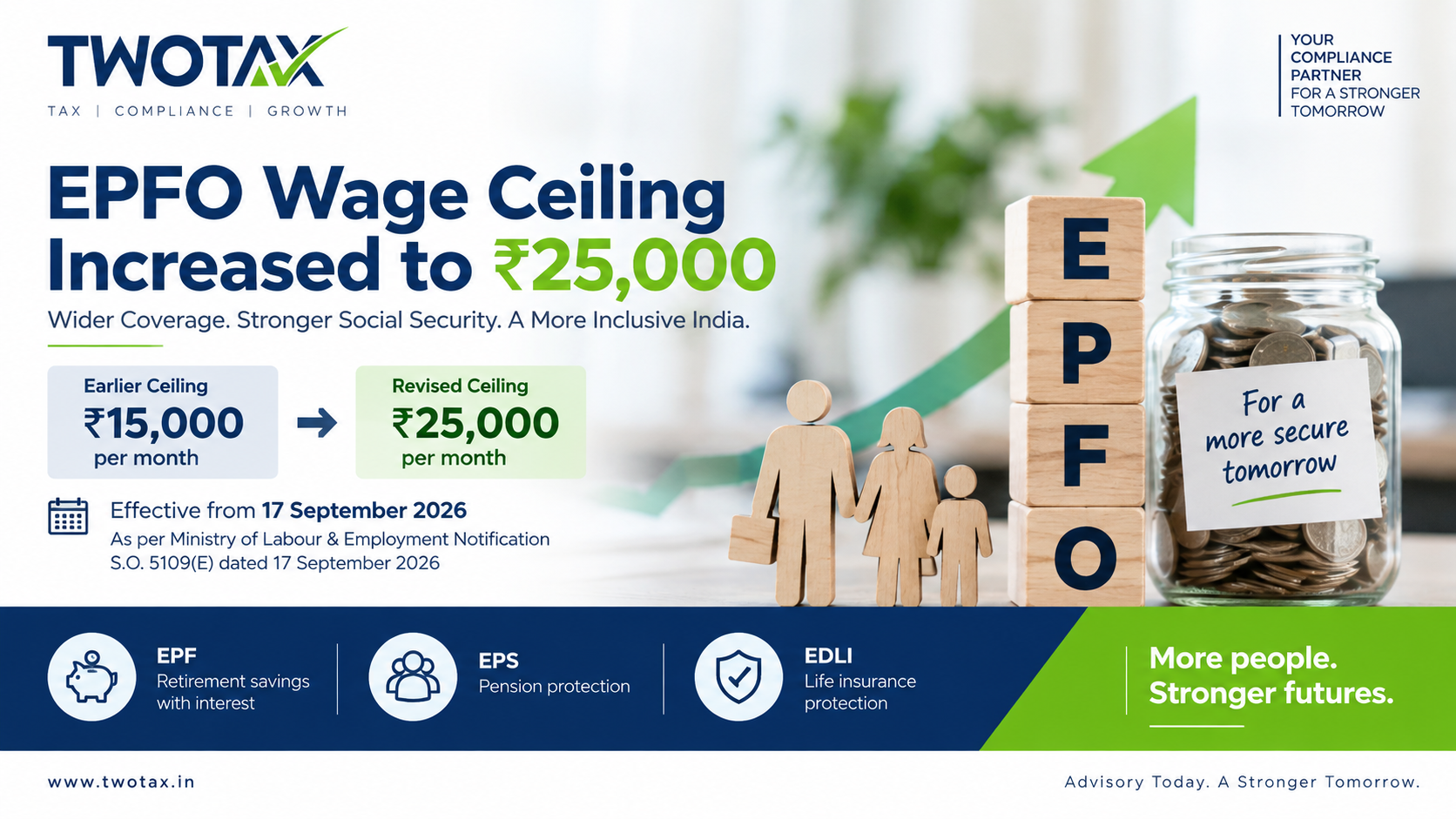
The Government of India has increased the wage ceiling for mandatory coverage under the Employees’ Provident Fund Organisation (EPFO) from ₹15,000 to ₹25,000 per month, effective 17 September 2026.
The change was approved by the Union Cabinet on 16 September 2026 and subsequently notified by the Ministry of Labour and Employment through Notification S.O. 5109(E), dated 17 September 2026, under Section 2(89) of the Code on Social Security, 2020.
For Indian employers, HR teams, payroll professionals and employees, this is not merely a change in one number.
It potentially changes who comes within the statutory social-security framework, the payroll calculations that businesses need to review and the cost structure associated with certain employees.
What Has Changed?
The earlier wage ceiling was:
₹15,000 per month
The revised wage ceiling is:
₹25,000 per month
The earlier ceiling had remained unchanged since September 2014, when it was increased from ₹6,500 to ₹15,000.
The latest revision therefore comes after approximately 12 years.
The Government expects the increase to bring more than 51 lakh additional employees within mandatory EPFO coverage across India.
The stated objective is to expand formal social-security coverage and bring the EPFO framework closer to prevailing wage levels.
What Does the ₹25,000 Ceiling Actually Mean?
This is where employers and employees need to be careful.
The ₹25,000 figure is the revised wage ceiling for the purposes of Chapter III of the Code on Social Security, 2020.
The notification issued on 17 September 2026 supersedes the earlier notification that had retained the ₹15,000 ceiling.
Therefore, employees falling within the relevant wage band of ₹15,000 to ₹25,000 may now come within the mandatory social-security framework, subject to the applicable statutory and scheme provisions.
This is particularly significant for employees who were previously outside mandatory EPF coverage because their wages exceeded the earlier ₹15,000 threshold.
However, one important point should not be overlooked:
₹25,000 should not simply be interpreted as meaning that every employee’s PF contribution will automatically be calculated on exactly ₹25,000.
The actual contribution and membership position must still be examined with reference to the applicable provisions, the employee’s status, the relevant wage components and the applicable EPF/EPS/EDLI framework.
Who Is Likely to Be Most Affected?
The immediate area of attention for employers is the employee population falling between the old and revised ceilings.
Employees earning up to ₹15,000
Employees already covered under the EPF framework generally continue under the existing compliance mechanism.
Employees earning between ₹15,000 and ₹25,000
This is the most important group to review.
Employees who were previously outside mandatory EPFO coverage because they exceeded the ₹15,000 ceiling may now fall within the expanded statutory coverage framework, subject to the applicable provisions.
The Government estimates that more than 51 lakh additional employees could be brought within mandatory EPFO coverage.
Employees earning above ₹25,000
The revised ceiling does not mean that every employee earning above ₹25,000 automatically becomes an EPF member merely because of the new notification.
Their position needs to be examined under the applicable provisions governing EPF membership and voluntary/higher-wage contributions.
This distinction is particularly important while redesigning payroll logic.
What Social-Security Benefits Are Involved?
The expansion is significant because EPFO is not limited to provident fund savings.
The Government has highlighted three major components:
1. Employees’ Provident Fund — EPF
EPF provides a structured retirement savings mechanism through employee and employer contributions, with interest credited according to the applicable notified rate.
2. Employees’ Pension Scheme — EPS
Eligible employees may receive pension-related protection under the applicable EPS provisions.
3. Employees’ Deposit Linked Insurance — EDLI
EPFO membership also provides insurance-linked protection under EDLI, subject to the applicable scheme provisions and limits.
Therefore, the policy change expands access not just to retirement savings but to a broader social-security framework.
What Does This Mean for Employees?
For an employee who was previously outside mandatory EPF coverage and is now brought within the framework, there can be two different effects.
Short-term effect
The employee may see an increase in the amount deducted from salary towards EPF, depending on the applicable contribution base and payroll structure.
This can reduce monthly take-home pay.
Long-term effect
A higher contribution towards EPF can increase accumulated retirement savings over time.
Therefore, the impact should not be viewed only through the monthly salary deduction.
The employee should also understand:
-
how much is being contributed;
-
what portion is going towards EPF;
-
what portion is allocated towards EPS, where applicable;
-
how the contribution affects take-home salary;
-
whether PF is already included in the employee’s CTC; and
-
whether the employer is contributing on the statutory ceiling or on a higher wage base.
What Does This Mean for Employers?
For employers, this is where the compliance implications become important.
Businesses may need to revisit their:
Payroll + HR + CTC + PF compliance + onboarding processes
The Government estimates that the annual Government outgo associated with the enhancement will be approximately ₹11,339 crore, compared with approximately ₹10,250 crore of existing annual budgetary support. The estimated expenditure over five years is approximately ₹56,696 crore.
For individual employers, however, the financial impact will depend on their employee profile and existing contribution practices.
A Simple Illustration
Suppose an employee falls within the newly relevant wage band and the applicable PF contribution is calculated on the statutory ceiling.
Under the earlier ₹15,000 ceiling:
12% of ₹15,000 = ₹1,800
Under a ₹25,000 contribution base:
12% of ₹25,000 = ₹3,000
The difference is:
₹1,200 per month
or
₹14,400 per year
for the employee-side contribution, where the full statutory ceiling is the applicable contribution base.
The corresponding employer-side impact also needs to be evaluated, including the allocation between EPF and EPS and applicable EDLI and administrative charges.
This is an illustration only. Actual payroll treatment must be determined based on the applicable statutory provisions and the employee’s individual circumstances.
Why Payroll Teams Should Not Simply Change ₹15,000 to ₹25,000 in Software
This may be the biggest practical mistake businesses can make.
The change is not simply:
Old payroll formula → Replace ₹15,000 with ₹25,000
Before making changes, employers should identify:
-
Existing EPF members
-
New employees in the ₹15,000–₹25,000 wage band
-
Employees already contributing on higher wages
-
Employees whose PF contribution is restricted to the statutory ceiling
-
Relevant wage components used for PF purposes
-
EPS applicability
-
EDLI implications
-
Existing CTC structures
-
Contract and outsourced workforce
-
Existing UAN status
-
Payroll software configuration
-
Monthly ECR reporting requirements
The employee population needs to be segmented first.
Only then should payroll logic be changed.
September 2026 Payroll Requires Particular Attention
The revised ceiling became effective from 17 September 2026.
That creates a practical question for employers:
How should September payroll be handled where the employee becomes covered or the contribution base changes from 17 September?
This is an area where payroll teams should carefully follow the applicable EPFO/Ministry implementation instructions and ensure that the September ECR and contribution calculations are consistent with the operative rules.
Businesses should avoid making assumptions merely because the Cabinet announcement has been widely reported.
The statutory notification is now in place, but detailed operational treatment should continue to be checked against subsequent EPFO instructions.
What About CTC?
This is another area where employers need to be careful.
Where an employer’s contribution forms part of the employee’s Cost to Company, an increase in the employer’s statutory contribution can affect the overall CTC structure.
However, employers should not treat the additional statutory employer contribution as an amount that can simply be recovered by reducing the employee’s salary.
Payroll restructuring should therefore be undertaken only after reviewing:
-
employment contracts;
-
salary structures;
-
CTC architecture;
-
wage definitions;
-
applicable labour-law provisions; and
-
the employee’s existing PF arrangement.
The objective should be compliant restructuring, not merely shifting the cost from one component of compensation to another.
What Should HR and Finance Teams Do Now?
The announcement should trigger a practical EPFO compliance review.
1. Identify the affected employee population
Prepare a list of employees whose relevant wages fall between:
₹15,000 and ₹25,000
2. Review excluded employees
Check employees who were previously outside mandatory EPF coverage because they exceeded the ₹15,000 ceiling.
3. Review existing EPF members
Do not assume that the same rule applies to every employee.
Separate:
-
existing members;
-
new joiners;
-
higher-wage contributors;
-
employees previously outside coverage.
4. Review the salary structure
Examine the components forming the relevant PF wage base.
5. Recalculate employer cost
Assess:
-
EPF contribution;
-
EPS allocation;
-
EDLI;
-
administrative charges; and
-
overall CTC impact.
6. Update payroll software
Payroll systems should no longer rely on the old ₹15,000 threshold where the revised ceiling is applicable.
7. Review contract labour
Employers should also assess whether the change has implications for their outsourced or contract workforce and the compliance responsibilities applicable to the principal employer and contractor.
8. Communicate with employees
Employees should understand why their PF deduction or CTC may change.
9. Review September 2026 compliance
The effective date of 17 September 2026 makes the September compliance cycle particularly important.
10. Monitor EPFO implementation guidance
The statutory ceiling has changed, but businesses should continue tracking EPFO’s operational directions, portal changes and detailed implementation procedures.
What This Means for Indian Businesses
The bigger story behind this change is formalisation.
India’s employment landscape has changed significantly since the ₹15,000 ceiling was introduced in 2014.
The Government has stated that the revision is intended to align the EPFO framework with rising wages and the expansion of formal employment.
The move also brings a much larger section of India’s workforce into a structured social-security environment.
For employers, however, wider coverage also means wider compliance responsibility.
For employees, it can mean stronger retirement and social-security protection, while potentially affecting monthly take-home pay.
Therefore, the change needs to be looked at from both sides of the payroll.
The Key Takeaway
The important point is not simply:
₹15,000 → ₹25,000
The real change is:
Wider EPFO coverage + larger affected employee population + revised payroll considerations + additional employer compliance
With more than 51 lakh additional employees expected to come within mandatory EPFO coverage, this is a change that HR, payroll, finance and business owners should actively review rather than wait for payroll errors to appear.
The Ministry’s notification dated 17 September 2026 has formally moved the wage ceiling to ₹25,000 for Chapter III of the Code on Social Security, 2020.
The next step for every organisation should be simple:
Identify. Review. Recalculate. Update. Communicate.
Because when a statutory threshold changes, the biggest risk is not knowing that the law changed.
It is continuing to operate payroll as if it did not.