Connect with us for all your queries


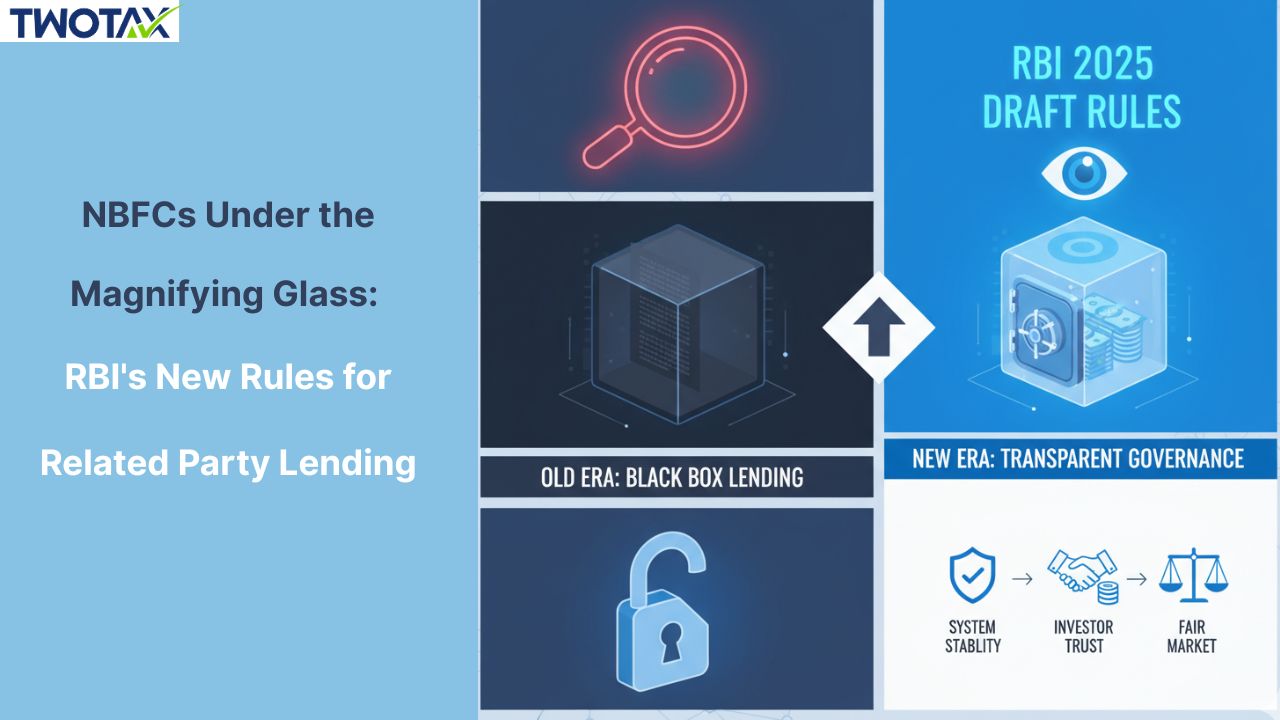
For years, a sensitive area in India’s financial sector has been Related Party Lending,when a Non-Banking Financial Company (NBFC) extends loans, guarantees, or financial favours to its own owners, directors, promoters, or sister entities. This practice, often called Connected Lending, creates a clear conflict of interest. It can lead to 'sweetheart deals',loans that lack proper collateral or carry preferential interest rates,ultimately jeopardizing the financial health of the NBFC and the integrity of the market.
To tackle this systemic risk, the Reserve Bank of India (RBI) has introduced the draft 'Lending to Related Parties Directions, 2025.' This landmark reform, proposed to be effective from April 1, 2026, fundamentally changes the rules for NBFCs. It shifts the regulatory focus from scattered prohibitions to a unified, principle-based system that demands complete transparency and robust governance. This isn't just a new circular; it’s a governance overhaul designed to secure the future stability of the entire NBFC sector.
This detailed analysis breaks down exactly how the RBI is mandating fair play, expanding the circle of scrutiny, and building a stronger firewall against insider abuse.
To grasp the power of the new RBI rules, one must understand the danger they aim to prevent. An NBFC’s primary role is to lend prudently, protecting its investors and depositors. When a promoter directs the NBFC to fund their other, riskier businesses (like a real estate venture or a manufacturing unit) through related-party loans, the following happens:
The 2025 directions enforce credit decisions based on financial merit, not familial connection.
The most impactful change is the radical broadening of the 'Related Party' definition. The RBI has moved beyond simple direct ownership, aiming to capture anyone or any entity that can exert significant economic or managerial influence over the NBFC. The old, narrow rules are out; a comprehensive, global standard is in.
The new, expansive definition explicitly includes:
The takeaway is clear: the scope of scrutiny is now massive. If you have the power to influence the NBFC’s decisions, any loan to you or your related entity will be treated with the highest level of caution and governance.
The cornerstone of the 2025 framework is the absolute requirement to adhere to the Arm’s-Length Principle.
This concept demands that an NBFC must transact with a related party exactly as it would with an unrelated, independent third party. There can be no special terms, no hidden subsidies, and no preferential treatment whatsoever.
The application of this principle mandates compliance in several areas:
To embed this, all NBFCs must create a formal, board-approved Related-Party Lending Policy that codifies these standards and integrates them into the day-to-day credit decision-making process.
Recognizing that large, systemically important NBFCs pose a greater risk to the economy than smaller ones, the RBI has implemented a tiered approval system based on the NBFC’s size and risk layer (as defined under the Scale-Based Regulation framework).
For large, systemically important NBFCs (the Upper/Top Layer), the threshold for mandatory board approval on a related party loan is set very low, at only ₹10 crore. For medium-sized NBFCs in the Middle Layer, the limit is ₹5 crore. Even the smallest NBFCs (the Base Layer) must obtain prior approval for loans exceeding just ₹1 crore.
This proportionality ensures that every material related party loan is brought to the attention of the highest governance body,the Board of Directors.
Perhaps the most crucial governance safeguard is the rule of mandatory recusal. If a loan request requires Board approval, any director or Key Managerial Personnel (KMP) who is related to or interested in the borrowing party must step out of the meeting. They cannot participate in the discussion, nor can they cast a vote. This ensures that the decision to lend is made solely by neutral, independent members of the Board, eliminating direct conflicts of interest in the approval process.
A rule is only as effective as its enforcement. The RBI has built several overlapping layers of monitoring and disclosure to ensure the new framework is strictly followed.
NBFCs will be required to submit detailed, semi-annual reports to the RBI via the advanced DAKSH supervisory portal. These reports must provide granular data, including:
In addition to regulatory reporting, the new rules mandate enhanced public transparency. NBFCs must disclose much more detail about their related party exposures in their annual financial statements. This includes the aggregate amount of such loans, the terms and conditions, and any special provisionings set aside against potential losses.
This floodlight of transparency empowers investors and market analysts to accurately assess the quality of the NBFC’s loan book, enforcing market discipline and protecting stakeholders.
The new directions demand a significant investment in technology, training, and institutional culture. NBFCs must undertake a thorough transformation:
This holistic approach moves NBFCs from a system of minimal legal compliance to one where ethical conduct and robust corporate governance are non-negotiable foundations of the business.
The RBI’s Draft Lending to Related Parties Directions, 2025, is a landmark move that strengthens the NBFC sector and enhances the stability of the broader Indian financial system. By broadening the definition of a related party, enforcing the arm’s-length principle, and mandating tiered approvals and full disclosure, the RBI has effectively constructed a financial firewall against the risks posed by insider dealings.
While the immediate need is for NBFCs to overhaul their systems and compliance mechanisms by the April 2026 deadline, the long-term benefit is a credit market where resources are allocated based purely on merit and commercial viability. This revolutionary framework ensures that trust, integrity, and prudence,not personal influence,guide every lending decision.
Tax Partner is India’s most reliable online business service platform, dedicated to helping you in starting, growing, & flourishing your business with our wide array of expert services at a very affordable cost.