Connect with us for all your queries


https://www.twotax.in/blog-details/what-happens-if-you-miss-the-itr-filing-deadline-of-31-july-
An Income Tax Return (ITR) is a form used by taxpayers to report their income, claim deductions, disclose taxes paid, and calculate their final tax liability or refund for a financial year.
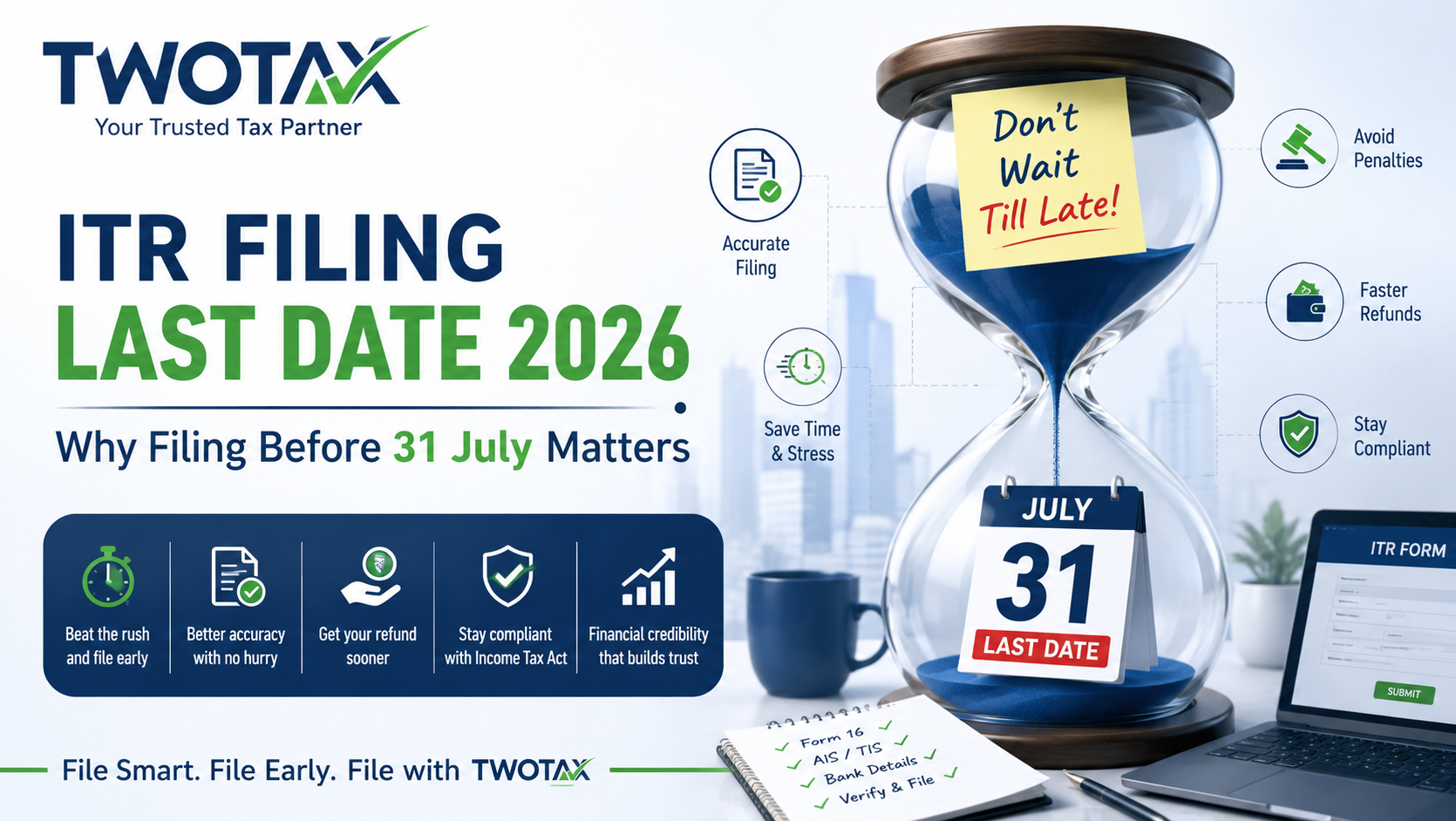
For most individual taxpayers who are not required to get their accounts audited, the due date is 31 July 2026, unless extended by the Government.
Filing an ITR helps you comply with tax laws, claim refunds, carry forward eligible losses, establish proof of income, and support loan or visa applications.
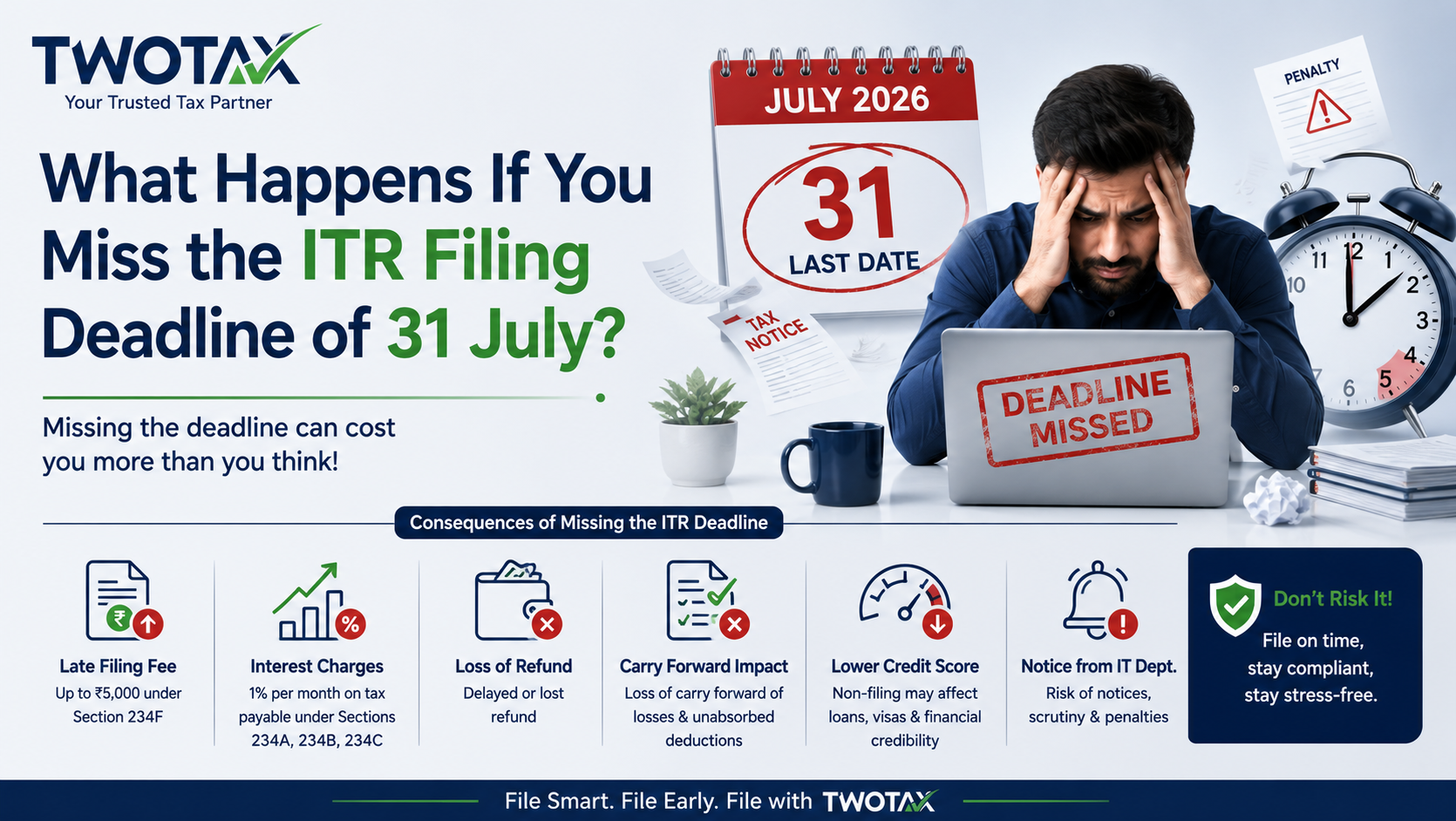
You may face late filing fees, interest on unpaid taxes, delays in refunds, restrictions on carrying forward certain losses, and possible notices from the Income Tax Department.
Yes, you may be able to file a belated return within the time permitted under the Income-tax Act, though certain consequences may apply.
Yes, if you discover an error, you can generally file a revised return within the prescribed time limit.
It depends on your income, financial transactions, and the conditions prescribed under the Income-tax Act.
Individuals whose income exceeds the applicable exemption limit or who satisfy specified filing conditions should file an ITR. Even where not mandatory, filing may still be beneficial.
Yes. Individuals can file their returns online through the Income Tax e-Filing Portal. However, professional assistance can help in complex cases.
For a taxpayer with all documents ready and straightforward income sources, the filing process may take less than an hour.
Yes, if they meet the prescribed filing conditions.
Yes. Freelancers and consultants are required to report their professional income as applicable.
Yes.
Students with taxable income or who meet specified filing conditions may need to file an ITR.
Yes, if they satisfy the applicable filing requirements.
Yes, subject to the provisions and conditions applicable to them.
Depending on the nature of their income and applicable provisions, NRIs may be required to file an ITR in India.
If they have taxable income or meet specified conditions, they may need to file an ITR.
In certain cases where income is taxable or reportable, provisions relating to minors may apply.
Yes, if they have taxable income, wish to claim a refund, or choose to maintain a financial record.
Typically PAN, Aadhaar, Form 16 (if applicable), Form 26AS, AIS, TIS, bank statements, investment proofs, and other relevant financial records.
Yes.
Aadhaar-related requirements apply as prescribed under the law.
Form 16 is a certificate issued by an employer showing salary paid and tax deducted at source.
Form 26AS is a consolidated statement showing taxes deducted, collected, and other tax-related information.
The Annual Information Statement (AIS) contains a comprehensive view of your reported financial transactions.
The Taxpayer Information Summary (TIS) provides a summarized view of information relevant to tax filing.
Yes. Reviewing AIS helps identify any income or transactions that need to be reported accurately.
Yes. If you have all the necessary income and tax details, Form 16 is not the only basis for filing.
You can file your return, but reviewing AIS is recommended to avoid discrepancies.
By filing your ITR and ensuring all information is accurate.
The timeline depends on the processing of the return by the Income Tax Department.
Possible reasons include incorrect bank details, pending verification, mismatches in information, or processing delays.
Yes, refund status can generally be tracked online.
Differences may arise due to adjustments made during processing or inaccuracies in the return.
A belated return is an Income Tax Return filed after the original due date but within the time permitted by law.
A revised return is filed to correct mistakes in an already submitted ITR.
Subject to the applicable provisions and timelines, a belated return may also be revised.
Non-filing may result in penalties, interest, notices, and other consequences under the Income-tax Act.
Only within the time limits and provisions permitted under the law.
The correct ITR form depends on your sources of income, residential status, and other applicable factors.
It is the process of electronically verifying your filed Income Tax Return.
Yes, a filed return generally needs to be verified within the prescribed time.
The Income Tax Department provides multiple verification methods, such as Aadhaar OTP and net banking, subject to availability.
You may generally file a revised return within the prescribed time limit.
Yes, taxpayers can access the Income Tax e-Filing Portal using a mobile device.
Filing through the Government portal does not involve a government filing charge, though professional service providers may charge a fee for their assistance.
Yes. Many taxpayers file independently, while others prefer professional guidance for accuracy and convenience.
Early filing gives you more time to review your information, avoid portal congestion, correct mistakes, and receive refunds sooner.
If your income includes multiple sources, business income, capital gains, foreign assets, or other complexities, professional assistance can help ensure accurate compliance.
The old tax regime allows taxpayers to claim various deductions and exemptions such as those for investments, insurance premiums, and home loan interest, while the new tax regime offers lower tax rates but limits the availability of many deductions and exemptions. The better option depends on your income structure, investments, and eligible deductions.
There is no one-size-fits-all answer. Salaried employees with significant eligible deductions may benefit from the old tax regime, whereas those with fewer deductions may find the new tax regime more advantageous. Comparing tax liability under both regimes before filing your Income Tax Return is advisable.
The ability to switch between tax regimes depends on the nature of your income and the applicable provisions of the Income-tax Act. Salaried individuals generally have greater flexibility than taxpayers with business or professional income.
The regime that results in greater tax savings depends on factors such as your salary, investments, deductions, exemptions, and other sources of income. It is recommended to compare both options before making a choice.
During the ITR filing process, taxpayers can select the applicable tax regime based on the rules governing their category of income. Ensure that your selection is consistent with any declarations made to your employer, where applicable.
The possibility of changing your selected tax regime after filing depends on the applicable legal provisions and timelines. Review the relevant rules before attempting to make changes.
No. The applicability of the new tax regime depends on the provisions in force and the taxpayer's circumstances. Eligible taxpayers may have the option to choose the regime that best suits them.
The new tax regime generally restricts many common deductions and exemptions that are available under the old regime. However, certain benefits may still be available depending on the applicable provisions.
Most deductions under Section 80C are generally not available under the new tax regime. Taxpayers should review the current provisions before filing their return.
The choice depends on pension income, interest income, investments, and eligible deductions. Comparing both regimes can help determine the more beneficial option.
If you changed employers during the year, collect Form 16 or equivalent salary details from each employer. Report your total salary income, verify TDS credits in Form 26AS and AIS, and ensure no income is omitted.
Combine the salary details from both Form 16s and report the total income in your ITR. Also verify that the TDS deducted by both employers appears correctly in Form 26AS.
Yes. Salary slips are helpful but not mandatory if you have Form 16 and other supporting records. If Form 16 is unavailable, bank statements and salary credit details may assist in preparing your return.
Yes. A bonus received from your employer is generally treated as part of your salary income and should be reported while filing your Income Tax Return.
The tax treatment of leave encashment depends on whether it is received during employment or at retirement, as well as the applicable provisions and exemptions.
Gratuity may be fully or partly exempt depending on the nature of employment, the amount received, and the relevant provisions of the Income-tax Act.
Salary arrears should be included under salary income in the relevant financial year. Where applicable, taxpayers may explore relief provisions available under the Income-tax Act.
Form 12BA is a statement issued by employers showing the value of perquisites, benefits, or amenities provided to employees in addition to salary.
Perquisites are non-cash benefits provided by an employer, such as accommodation, a company car, or other facilities. Depending on the nature of the benefit, they may form part of taxable salary.
If the TDS deducted is lower than your actual tax liability, you may need to pay the balance tax before filing your return to avoid interest and other consequences.
Yes. Interest earned on savings bank accounts is generally taxable, although eligible taxpayers may claim deductions under the applicable provisions of the Income-tax Act.
Yes. Interest earned on fixed deposits is generally taxable and should be reported in your Income Tax Return, regardless of whether TDS has been deducted.
Yes. Interest earned on recurring deposits is generally taxable and must be disclosed while filing your ITR.
Yes. Taxability depends on the income earned, not on whether TDS has been deducted. All taxable interest income should be reported.
Add the interest earned from savings accounts, fixed deposits, recurring deposits, and other bank accounts under the appropriate income head while filing your return.
Form 15G is a declaration that may be submitted by eligible individuals requesting that tax not be deducted at source on certain incomes if specified conditions are satisfied.
Form 15H is a declaration available to eligible senior citizens to request non-deduction of TDS on specified income, subject to the prescribed conditions.
Yes. Eligible senior citizens may claim deductions on specified interest income as permitted under the Income-tax Act, subject to applicable conditions.
The tax treatment depends on the type of post office scheme and the applicable provisions. Taxpayers should review the rules relevant to their investment.
Interest earned on Public Provident Fund (PPF) accounts is generally exempt from tax under the prevailing provisions.
Yes. Income from the sale or trading of shares should be reported under the appropriate head of income, depending on the nature of the transactions.
The tax treatment of mutual fund gains depends on the type of fund, the holding period, and the applicable provisions of the Income-tax Act.
Investing through a Systematic Investment Plan (SIP) is not taxable by itself. Tax implications generally arise when units are redeemed or sold.
Capital gains should be calculated using the applicable rules and disclosed under the capital gains schedule in the relevant ITR form.
A short-term capital gain arises when a capital asset is transferred within the prescribed holding period specified for that asset.
A long-term capital gain arises when a capital asset is held for more than the specified holding period before being transferred.
Income arising from virtual digital assets, including cryptocurrencies, is subject to taxation as per the applicable provisions of the Income-tax Act.
Taxpayers should disclose cryptocurrency transactions in the relevant schedules of the applicable ITR form and report income in accordance with the law.
If you hold or derive income from foreign shares, reporting requirements may apply depending on your residential status and the provisions of the Income-tax Act.
Capital gains are generally calculated by deducting the cost of acquisition, cost of improvement (where applicable), and eligible transfer expenses from the sale consideration, subject to the relevant tax provisions.
Salary income arises from an employer-employee relationship, while business or professional income is earned through independent business or professional activities.
Yes. If you earn income from both employment and business or profession, both must be reported under the respective heads of income in your ITR.
Eligible taxpayers may claim deductions for interest paid on education loans subject to the applicable provisions of the Income-tax Act.
Yes. Dividend income is generally taxable and should be reported in the Income Tax Return under the appropriate head.
Yes. Certain exempt incomes may still need to be disclosed in the appropriate schedules of the ITR form.
Yes. Both salary income and freelance income should be reported under their respective heads while filing your Income Tax Return.
Self-assessment tax is the tax paid by a taxpayer before filing the ITR when the taxes already paid through TDS, TCS, or advance tax are insufficient to cover the total liability.
Yes. If additional tax is payable after computing your total liability, it should generally be paid before submitting your Income Tax Return.
Advance tax is the payment of income tax in instalments during the financial year instead of paying the entire amount at the time of filing the return, where applicable.
A Chartered Accountant can help ensure accurate reporting of income, selection of the correct ITR form, optimal claim of eligible deductions, review of AIS and Form 26AS, and compliance with applicable tax provisions. Professional guidance is especially valuable for taxpayers with business income, capital gains, foreign assets, multiple income sources, or complex tax situations.
Yes. Eligible taxpayers can claim a deduction for home loan interest subject to the conditions and limits prescribed under the Income-tax Act. Ensure you have the annual interest certificate issued by your lender before filing your return.
Principal repayment may qualify for deduction under the applicable provisions of the Income-tax Act, subject to prescribed conditions and limits. Keep repayment proof for your records.
Yes, provided you satisfy the applicable conditions. For example, if you live in rented accommodation while repaying a home loan for another property, both benefits may be available depending on your circumstances.
The availability of tax benefits depends on the stage of construction and the relevant provisions of the Income-tax Act. Tax treatment differs before and after possession.
Yes. If both co-owners are also co-borrowers and contribute towards repayment, each may claim eligible deductions separately, subject to the prescribed limits.
Stamp duty and registration charges may qualify for deduction under specified provisions, subject to conditions and overall limits.
Typically, you'll need:
Yes. Depending on your circumstances and the applicable tax provisions, deductions may be available for more than one home loan.
Yes. The tax treatment depends on whether the property is self-occupied, let out, or deemed to be let out, along with the applicable provisions.
You may need to report the sale in your ITR and calculate any capital gains or losses arising from the transaction. Supporting documents should be retained for future reference.
Yes. Income earned from renting out a property is generally taxable under the head "Income from House Property."
Income is generally computed after considering factors such as gross annual value, municipal taxes paid, and eligible deductions under the Income-tax Act.
Yes. Municipal taxes paid by the owner during the relevant financial year may be deductible while computing income from house property, subject to the applicable provisions.
The tax treatment of maintenance charges depends on the facts of the case and the applicable tax provisions.
A refundable security deposit is generally not treated as taxable income merely because it is received. However, any amount adjusted or retained may have tax implications.
Vacancy can affect the computation of taxable income from house property. The applicable treatment depends on the relevant provisions of the Income-tax Act.
Rental income should be reported under the schedule relating to "Income from House Property" in the applicable ITR form.
Yes. Subject to the applicable provisions, interest on a home loan for a let-out property may be considered while computing taxable income.
Yes. Rental income from commercial property is generally taxable under the relevant head of income.
Tax Partner is India’s most reliable online business service platform, dedicated to helping you in starting, growing, & flourishing your business with our wide array of expert services at a very affordable cost.