Connect with us for all your queries


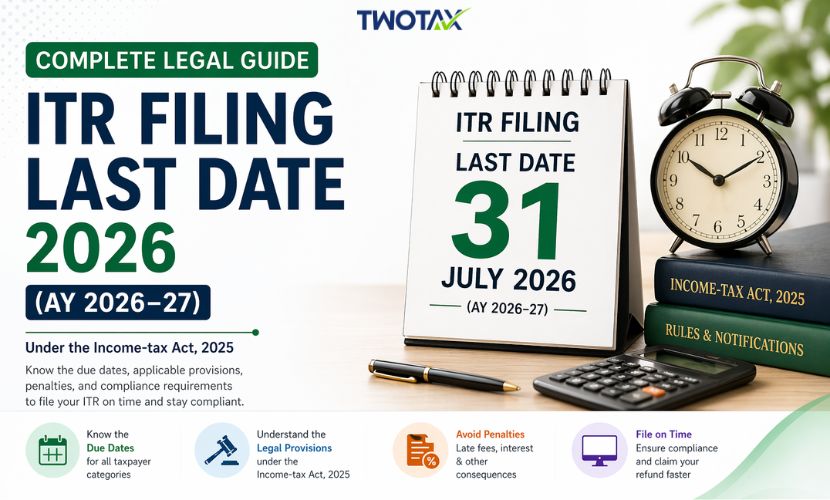
Filing your Income Tax Return (ITR) is no longer a routine compliance activity,it has evolved into a data-driven legal obligation backed by automated validation systems. With the transition to the Income-tax Act, 2025, taxpayers must now understand not only the deadlines but also the legal and technological framework governing those deadlines.
For Financial Year 2025–26 (Assessment Year 2026–27), the concept of “last date” carries deeper implications. It determines eligibility for benefits, exposure to penalties, and even the likelihood of scrutiny.
This comprehensive guide by TwoTax is designed to go beyond surface-level information and provide a legally grounded, strategically insightful, and SEO-optimized understanding of ITR filing deadlines for 2026.
India’s direct tax framework has undergone a structural transition with the introduction of the Income-tax Act, 2025, replacing the decades-old Income-tax Act, 1961.
The biggest shift is not in the law,but in how the law is enforced.
Earlier,compliance depended on declaration.
Now, compliance depends on data consistency.
The due date continues to be notified by the CBDT, and the structure remains largely consistent.
Expected Due Dates
.png)
Interpretation
These deadlines are not just administrative,they are compliance segmentation tools:
The timeline reflects risk-based tax administration
Under the new regime:
|
Income Level |
Penalty |
|---|---|
|
Above ₹5 lakh |
₹5,000 |
|
Up to ₹5 lakh |
₹1,000 |
This is now system-enforced, leaving minimal room for discretion.
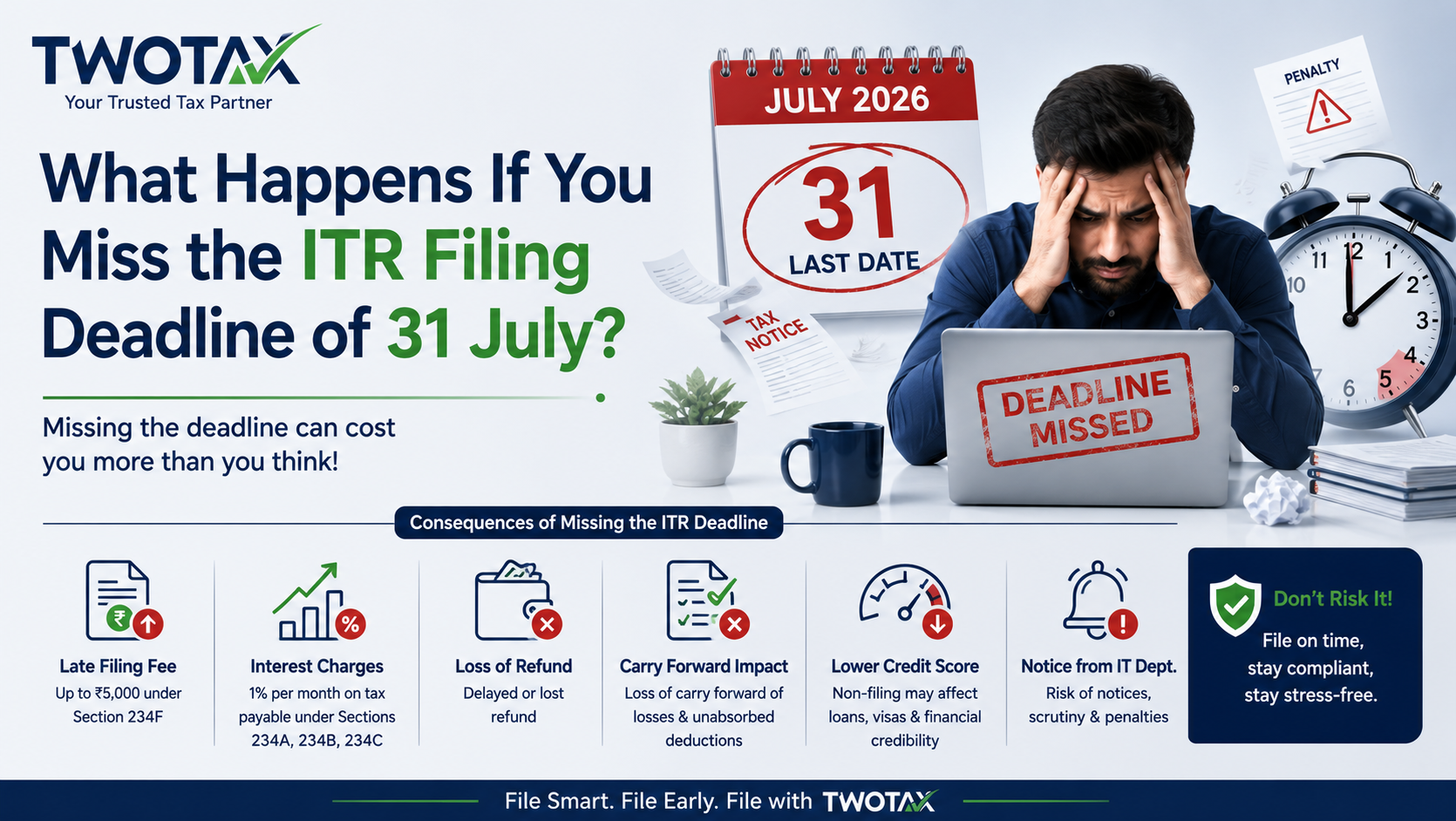
One of the most critical yet ignored consequences:
.png)
Late filing is not just a penalty issue,it is a tax planning failure.
Filed within due date
Filed after due date but before 31st December 2026
Correction allowed till 31st March 2027
Can be filed within 48 months with additional tax
The updated return mechanism reflects a shift from punishment to voluntary compliance, but at a cost.
.png)
Confusing AY and FY leads to:
Selecting the wrong form can invalidate your return.
.png)
Wrong form → Defective return → treated as non-filing
Return is not valid unless verified
Under the 2025 regime:
You are no longer filing your income,you are reconciling government data
“The real risk today is not non-filing,it is incorrect filing in a data-matched environment.”
The ITR filing last date for 2026 (AY 2026–27) is more than a deadline,it is a legal trigger point in a system-driven tax regime.
With the Income-tax Act, 2025, the focus has shifted to:
Filing late is no longer just risky,it is digitally recorded non-compliance.
At TwoTax, we ensure:
✔️ Legally compliant filing
✔️ AIS reconciliation
✔️ Error-free returns
✔️ Strategic tax optimization
✔️ Notice handling support
File smarter. File with TwoTax.
Tax Partner is India’s most reliable online business service platform, dedicated to helping you in starting, growing, & flourishing your business with our wide array of expert services at a very affordable cost.