Connect with us for all your queries


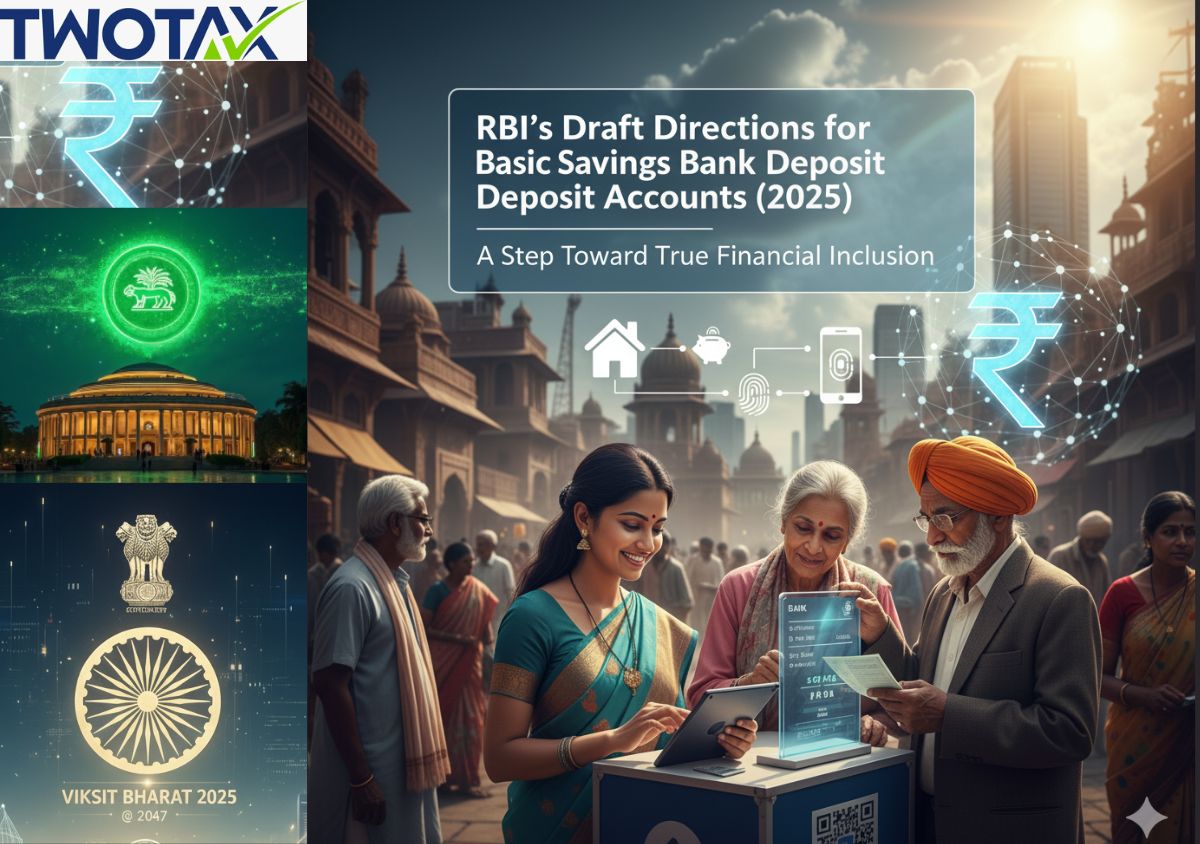
Draft RBI (Basic Savings Bank Deposit Account) Directions, 2025
A Simple Guide for Everyone
For many years, a large part of India’s population didn’t have access to basic banking. People found it difficult to open accounts because banks demanded a minimum balance or charged extra fees for small services.
To make banking accessible to everyone ,especially the poor, students, daily wage earners, and rural families ,the Reserve Bank of India (RBI) introduced the concept of a Basic Savings Bank Deposit Account (BSBDA).
This account ensures that no Indian is denied basic banking services just because they can’t maintain a minimum balance. The RBI made it mandatory for all banks to offer this facility.
The 2025 Draft Directions are RBI’s attempt to simplify rules, expand digital access, and strengthen consumer protection for people who use such accounts.
A BSBDA is a zero-balance savings account that allows you to do essential banking without worrying about maintaining a minimum balance or paying heavy charges.
Let’s understand its simple features:
Think of it as your starter bank account ,simple, safe, and made for everyone.
Earlier, banks offered what were known as “no-frills” accounts, meant for low-income individuals. However, different banks had different rules, and sometimes people were still charged unfairly.
To bring uniformity and protection, RBI replaced “no-frills” accounts with Basic Savings Bank Deposit Accounts (BSBDAs) in 2012.
The goal was threefold:
Over time, as digital payments grew, RBI updated the rules several times ,and now, the Draft 2025 Directions aim to make these accounts more modern and digital-friendly.
One of the best things about the BSBDA is that almost anyone can open it.
This means anyone ,from a farmer in a remote village to a college student in a metro city ,can use this account to manage their money.
When you open a bank account, you need to provide KYC (Know Your Customer) documents ,identity and address proof ,so that banks can verify who you are.
But what if you don’t have all those documents yet? RBI has made a special category for such people called “BSBDA Small Accounts.”
If you open a small account with simplified KYC:
Once you submit complete documents later, your account becomes a full-KYC BSBDA, and all these limits are removed.
This is a smart system ,it allows you to start using a bank account immediately, even if you don’t have every document in hand yet.
Every bank that offers BSBDA must provide certain free facilities as per RBI’s directions.
These include:
Banks may offer additional facilities like more withdrawals, cheque books, or SMS alerts. They can charge a small amount for these, but only after informing you clearly.
To maintain simplicity and avoid misuse, certain rules apply:
Your account can change its status or be closed in certain cases:
To avoid any problem, it’s best to use your account at least once every few months ,even a small deposit or withdrawal keeps it active.
Here’s a simple comparison:
.png)
So, a BSBDA is perfect for people who want simple, low-cost banking with essential features.
The Draft RBI (Basic Savings Bank Deposit Account) Directions, 2025 introduce several proposed updates to make these accounts more relevant and user-friendly. Here are the main highlights:
RBI proposes to make digital banking services like online fund transfers, UPI, and internet banking free for BSBDA holders.
This means even a person with a zero-balance account can use online payments, transfers, and mobile banking without extra cost.
Banks may be allowed to close long inactive or zero-balance accounts after giving proper notice. This is to prevent misuse and maintain data hygiene.
The draft clarifies that at least four free withdrawals must be provided every month ,including ATM, branch, and transfer transactions.
Banks must inform customers clearly about all charges, and cannot force customers to buy extra services or maintain a balance.
Banks will need to report compliance regularly and ensure their staff properly explain BSBDA features to customers.
These changes aim to make the BSBDA system more transparent, modern, and digital-friendly.
Here are practical tips to help you manage your BSBDA effectively:
Q1: Can I have a BSBDA in two different banks?
Yes. You can have one in Bank A and another in Bank B, but not two in the same bank.
Q2: Can I get a cheque book for my BSBDA?
Some banks offer it as an optional paid facility. You can ask your branch.
Q3: If I withdraw more than four times in a month, what happens?
The bank can charge a small fee for extra withdrawals.
Q4: Can a BSBDA go negative because of bank charges?
No, banks are not allowed to make your balance negative due to regular fees.
Q5: Can I upgrade my BSBDA to a regular savings account?
Yes. You can do so anytime by contacting your bank and completing full KYC.
Q6: Will my BSBDA earn interest?
Yes, it earns the same interest rate as a regular savings account.
Q7: What happens if I don’t use the account for a long time?
It may become dormant, and under the 2025 draft, could be closed after proper notice.
Example 1: Ramesh, a vegetable vendor
Ramesh opens a BSBDA with simplified KYC. He saves ₹500–₹1,000 a week and withdraws twice a month. He never keeps more than ₹10,000 at a time. This account is perfect for him ,no balance pressure, free withdrawals, and safe savings.
Example 2: Priya, a college student
Priya opens a full-KYC BSBDA. Her parents transfer ₹5,000 monthly for expenses. She uses her debit card and UPI for payments. She enjoys free digital banking and doesn’t worry about maintaining ₹10,000 balance like her friends.
Example 3: Ahmed, a construction worker
Ahmed opens a small account but later deposits ₹60,000. The bank informs him to upgrade to full-KYC BSBDA. After submitting his Aadhaar and PAN, his limits are removed, and he continues using the same account freely.
Here’s a quick list to help you stay compliant and protected:
Even though BSBDA is a progressive scheme, some challenges still exist:
To truly achieve financial inclusion, both banks and citizens need to spread awareness and follow these rules sincerely.
The Basic Savings Bank Deposit Account is one of the most important initiatives of the RBI toward financial inclusion. It empowers every Indian ,rich or poor ,to enter the formal banking system.
The Draft RBI Directions, 2025 are a step forward to make these accounts more digital, transparent, and consumer-friendly.
By understanding how the BSBDA works, completing KYC, and using the account regularly, anyone can enjoy safe banking without worrying about hidden charges or minimum balance.
This isn’t just about opening an account ,it’s about building financial confidence for millions of people who were once outside the system.
Tax Partner is India’s most reliable online business service platform, dedicated to helping you in starting, growing, & flourishing your business with our wide array of expert services at a very affordable cost.