Connect with us for all your queries


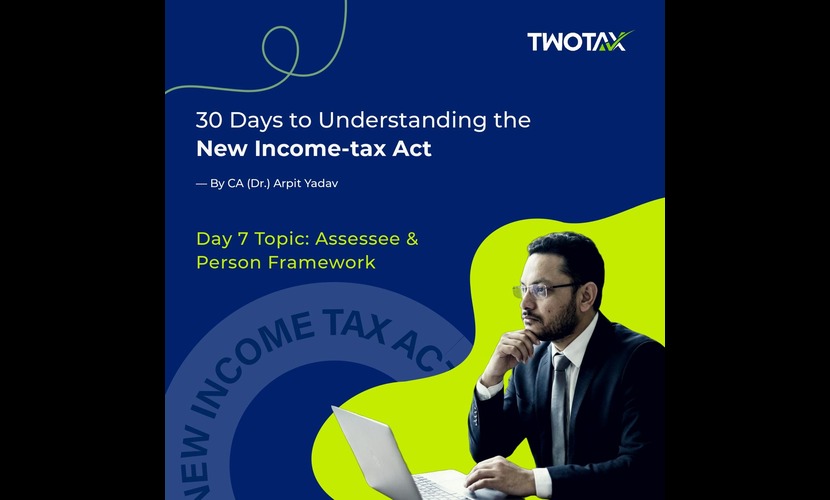
The foundation of any taxation system lies not only in defining taxable income but also in identifying who is liable to pay tax. Under the Income-tax Act, 2025, this responsibility is determined through two critical concepts: “Person” and “Assessee.”
While these terms may appear similar in common parlance, they have distinct legal meanings and implications. The Act adopts a structured framework to ensure that every taxable entity is covered, whether individual, artificial, or representative in nature.
Understanding this framework is essential for:
The Act defines:
These provisions establish the taxable universe and the entities responsible for compliance.
The term “Person” is defined inclusively and covers a wide range of entities.
It includes:
Importantly, the definition applies whether or not the entity is formed for profit.
The definition ensures that:
Even entities formed:
can still be treated as persons under tax law.
4.1 Individual
4.2 Hindu Undivided Family (HUF)
4.3 Company
4.4 Firm
4.5 Association of Persons (AOP) / Body of Individuals (BOI)
4.6 Local Authority
Includes:
4.7 Artificial Juridical Person
Residual category covering:
An assessee is defined as:
A person by whom any tax or any other sum of money is payable under the Act.
It further includes:
1. Liability-Based Definition
2. Includes Deemed Assessees
Even if:
That person becomes an assessee.
3. Covers Default Cases
Failure to:
leads to classification as assessee in default
.png)
Every assessee is a person, but not every person is an assessee.
Only a person can be taxed, and only when liable does that person become an assessee.
All provisions relating to:
apply to assessees.
Ensures:
Example 1
Mr. A earns salary →
✔ Person + Assessee
Example 2
Company registered but no income →
✔ Person
❌ Not an assessee
Example 3
Employer fails to deposit TDS →
✔ Assessee in default
Example 4
Trust receiving donations →
✔ Person + Assessee
The Act ensures:
❌ Only individuals are taxed
✔ Multiple entity types are covered
❌ Person and assessee are same
✔ They are distinct
❌ No income means no compliance
✔ Some obligations may still apply
With evolving structures like:
the definition ensures:
The 2025 Act:
The concepts of “Person” and “Assessee” under the Income-tax Act, 2025 form the legal backbone of taxation in India. By clearly distinguishing between the existence of an entity and its tax liability, the Act ensures a structured, inclusive, and enforceable taxation system.
From a professional standpoint, the key takeaway is:
Tax liability arises not merely from existence but from legal obligation—transforming a person into an assessee.
This understanding is critical for:
Tax Partner is India’s most reliable online business service platform, dedicated to helping you in starting, growing, & flourishing your business with our wide array of expert services at a very affordable cost.