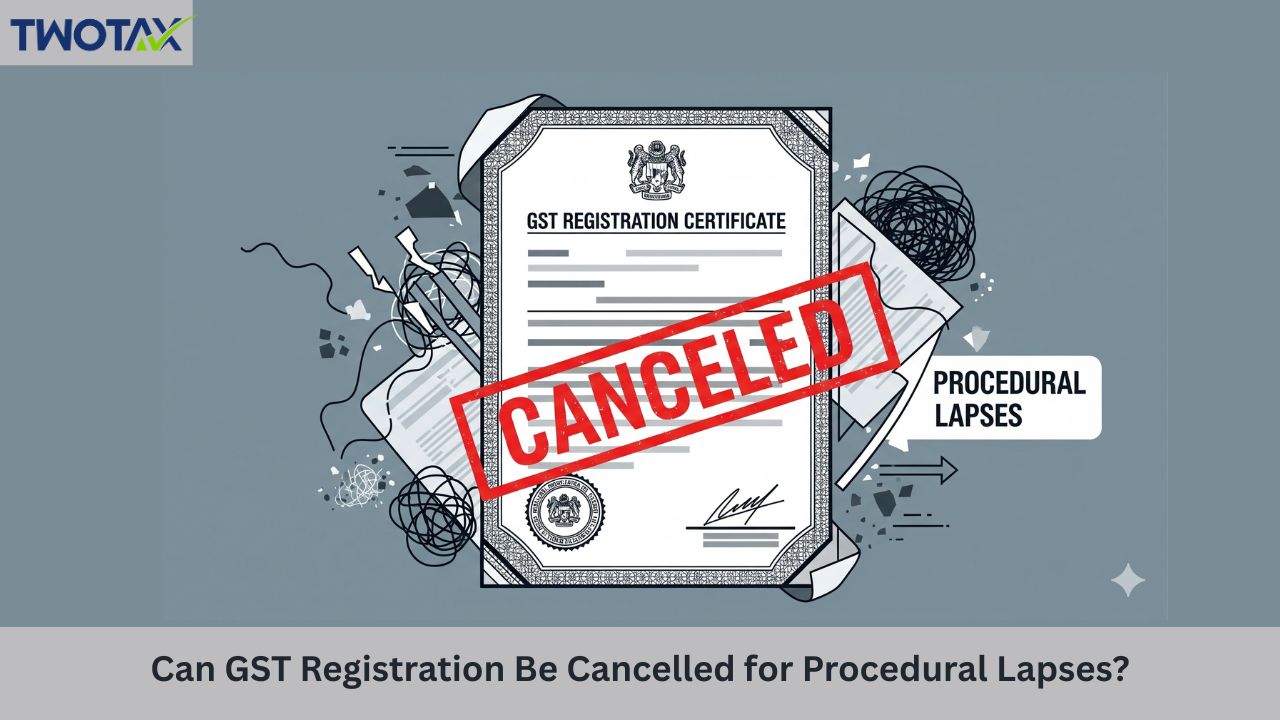
When Can GST Registration Be Cancelled for Procedural Lapses?
The Madras High Court’s 2025 judgment in Velu Ramakrishnan vs Commissioner of Commercial Taxes reaffirmed that GST registration should not be permanently cancelled for procedural lapses. This detailed guide explains when GST registration can be cancelled, how to revive it after compliance, and what the Suguna Cut Piece Centre precedent means for taxpayers and businesses under the GST Act, 2017.
By Advocate, Tanvi Thapliyal November 12, 2025
Insights from the Madras High Court’s 2025 Judgment in Velu Ramakrishnan v. Commissioner of Commercial Taxes
Introduction
In November 2025, the Madras High Court, in the case of Velu Ramakrishnan Proprietor vs Commissioner of Commercial Taxes (W.P. No. 28928 of 2025, decided on 8 November 2025), reaffirmed a vital principle: GST registration should not be cancelled permanently for mere procedural lapses if the taxpayer is willing to comply.
The Court disposed of the writ petition at the admission stage, noting that the matter was already covered by the landmark 2022 case Tvl. Suguna Cut Piece Centre vs Appellate Deputy Commissioner (ST) (GST), Salem. Relying on that precedent, the Court reiterated that:
-
Legitimate business should not be crippled by technical non-compliance.
-
Revival of registration must be permitted once the taxpayer clears all dues and fulfills procedural obligations.
-
Directions from Suguna Cut Piece Centre would apply mutatis mutandis (in the same manner).
This ruling reinforces a consistent judicial approach , that GST law is meant to regulate, not ruin, business. Let’s understand in simple terms how GST registration can be cancelled for procedural lapses, and what remedies exist.
What Are Procedural Lapses Under GST?
Procedural lapses are technical or formal mistakes in following GST compliance rules. They are not deliberate tax evasions, but failures to meet timelines or formats. Common examples include:
-
Failing to file periodic GST returns (like GSTR-1, GSTR-3B) on time.
-
Not updating business details such as address, bank account, or constitution.
-
Ignoring department notices or not responding within deadlines.
-
Filing errors or missing documentation during registration verification.
Such lapses can invite penalties or even cancellation notices , but as the courts have clarified, they should not automatically lead to loss of business identity.
When Can GST Registration Be Cancelled?
Under Section 29 of the CGST Act, 2017, a proper officer may cancel a registration when:
-
The taxpayer no longer conducts business.
-
There is non-filing of returns for a continuous period.
-
Registration was obtained by fraud or misstatement.
-
Business premises are found non-existent or inactive.
However, the law also requires due process before cancellation. Authorities must:
-
Issue a show cause notice clearly stating the reasons.
-
Give the taxpayer a fair opportunity to respond.
-
Pass a reasoned order only after considering the reply.
The Madras High Court, in both Suguna Cut Piece Centre (2022) and Velu Ramakrishnan (2025), stressed that cancellation cannot be mechanical , it must follow fair procedure.
What Did the Courts Say?
Tvl. Suguna Cut Piece Centre vs Appellate Deputy Commissioner (ST) (GST), Salem (2022)
-
Held that revival of cancelled GST registration is possible when the taxpayer completes pending compliance.
-
Directed authorities to reopen cancelled registrations if dues are cleared.
-
Stated that the GST system is meant to ensure compliance, not punish traders into extinction.
Velu Ramakrishnan vs Commissioner of Commercial Taxes (W.P. No. 28928 of 2025)
-
The petitioner’s registration had been cancelled due to procedural defaults.
-
Both parties agreed that the issue was already settled by the Suguna Cut Piece Centre precedent.
-
The Court applied the same reasoning, holding that:
-
Legitimate trade must not be crippled.
-
Revival is allowed subject to compliance.
-
The Suguna directions apply mutatis mutandis.
-
This ensured quick justice , the Court avoided repetitive hearings, maintaining judicial efficiency and consistency.
Significance:
This 2025 judgment shows continuity and maturity in GST jurisprudence , focusing on fairness, compliance, and economic practicality rather than technical rigidity. It sends a strong message: the goal of GST law is compliance, not cancellation.
What To Do If Your Registration Is Cancelled for Procedural Lapses
If you receive a cancellation order, follow these steps:
-
Read the cancellation order carefully , Identify the reason (non-filing, address mismatch, etc.).
-
Check whether a hearing was offered. If not, cancellation may be challengeable.
-
File pending returns and pay dues, interest, or penalties immediately.
-
Apply for revocation of cancellation through the GST portal (Form REG-21).
-
If denied, approach the jurisdictional officer or file a writ petition citing Suguna and Velu Ramakrishnan.
-
Maintain communication records , responses, acknowledgments, and payment proofs.
Remember: Courts have repeatedly held that registration should be revived once compliance is done. So, prompt action is your best remedy.
Practical Takeaways for Businesses
-
Keep a monthly compliance calendar to avoid missed filings.
-
Update business details (address, contact, bank) immediately after any change.
-
Respond promptly to notices and departmental queries.
-
Avoid ignoring non-filing warnings , small negligence can trigger cancellation.
-
If registration is cancelled, don’t panic , compliance and revival are possible.
-
Seek professional assistance (like The Tax Partner) for documentation, filing, and representation before authorities.
Why These Judgments Matter
The twin rulings , Suguna Cut Piece Centre (2022) and Velu Ramakrishnan (2025) , together form a strong shield for taxpayers. They establish that:
-
Procedural mistakes should not cripple genuine businesses.
-
Authorities must allow revival after compliance.
-
GST law must be interpreted with a balanced, business-friendly approach.
By applying precedent swiftly and fairly, the judiciary has ensured that ease of doing business remains central to GST enforcement.
Conclusion
The Madras High Court’s 2025 decision in Velu Ramakrishnan vs Commissioner of Commercial Taxes reaffirms a simple but powerful truth: every business deserves a fair chance to comply before being shut down. GST registration cancellation is a corrective tool, not a punishment.
For businesses, the takeaway is clear , stay compliant, act swiftly when lapses occur, and know that the law provides space for rectification. With proper guidance and timely action, procedural lapses need not end your GST journey; they can simply be stepping stones toward better compliance.