Simplified GST Registration Scheme 2025 – Eligibility, Process & Benefits
Understand the Simplified GST Registration Scheme 2025 in simple terms – eligibility, ₹2.5 lakh threshold, step-by-step process, benefits, and withdrawal rules.
By Advocate, Tanvi Thapliyal November 12, 2025
1. What is the Simplified GST Registration Scheme?
The Simplified GST Registration Scheme (opt-in) is a voluntary, faster registration route for certain taxpayers under the GST regime. It has been introduced to make life easier for small taxpayers by reducing formalities, streamlining registration, and cutting down wait time.
In simple words: if you are a small supplier of goods or services (especially B2B supplies) whose tax liability is modest each month, this scheme lets you register under GST via a simpler route.
2. Why was this introduced?
Some of the key motivations:
-
To ease the compliance burden on small businesses and service providers who are not high-risk.
-
To encourage voluntary registration so more businesses come into the formal GST system.
-
To speed up the registration process and reduce delays. For many businesses earlier it could take days/weeks; now the objective is much faster turnaround.
-
To align with the overall “ease of doing business” objective of the tax authorities.
3. Who can opt for this scheme? (Eligibility)
Here’s a breakdown of eligibility in layman’s terms:
You can opt in if:
-
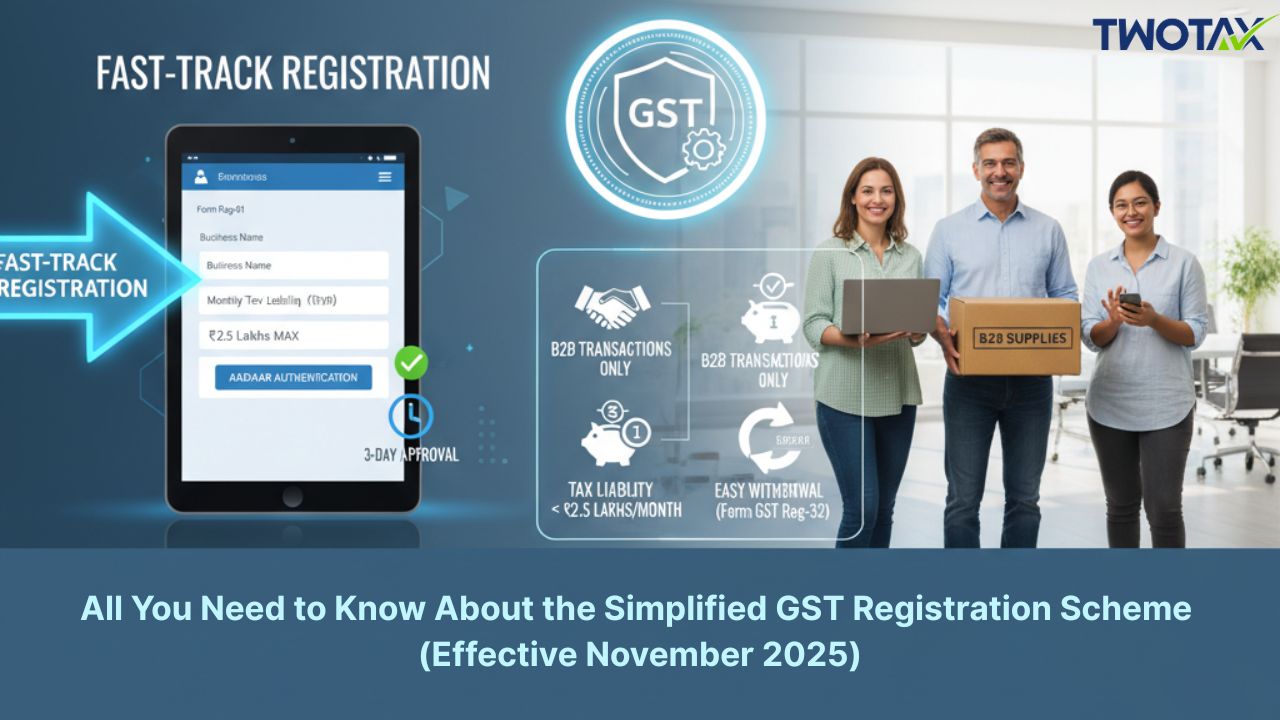
You are applying for GST registration under the normal route (Rule 8 of CGST Rules) and you estimate that your monthly output tax liability (on supplies to registered persons) will not exceed ₹2.5 lakh (inclusive of CGST + SGST/UTGST + IGST + Compensation Cess).
-
Your supplies are primarily to registered persons (B2B) rather than unregistered persons (B2C). That’s because the threshold is evaluated based on your B2B output tax liability.
-
Aadhaar-authentication (or the e-KYC mechanism) is done for the Primary Authorised Signatory and at least one Promoter/Partner (or the applicable person).
-
You do not already have another registration under this simplified route in the same State or Union Territory for the same PAN. (The idea is: one simplified registration per State/UT per PAN under this scheme.)
Conditions that disqualify or require caution:
-
If your monthly output tax liability (on B2B supplies) is going to exceed ₹2.5 lakh, you shouldn’t opt in; you can take the standard registration route.
-
If you are among the persons notified under Section 25(6D) of the CGST Act who require enhanced verification, you may not be eligible for this simpler scheme.
4. What does “monthly output tax liability ≤ ₹2.5 lakh” mean?
This is perhaps the key number and also something that small businesses need to correctly assess. Here’s how to think about it:
-
“Output tax liability” means: the tax you charge (and owe) on supplies you give to registered persons (B2B) including the combined CGST + SGST/UTGST + IGST + Compensation Cess.
-
It does not include supplies made to unregistered persons (B2C) for this threshold test (though they may still be taxable supplies). The threshold is specifically about B2B supplies.
-
Example: Suppose you supply services to registered customers and you estimate your taxable supplies to registered persons will incur total GST of around ₹2.0 lakh in a month , you could opt in. If you estimate your output tax (on B2B) will be ₹3.0 lakh, then you would not qualify for that simplified route.
-
The scheme expects you to monitor this number; if later your output tax liability exceeds the threshold, you may need to withdraw from the scheme. (See exit/withdrawal section later.)
5. What is the process for registration under this scheme?
Here’s the step-by-step in simple terms:
-
On the GST portal (via FORM GST REG-01) you begin registration under the normal registration route (Rule 8).
-
During filling of Part B of REG-01, you will see an option: “Option for registration under Rule 14A” (or similar wording for the simplified scheme). If you choose “Yes”, you’re opting for the simplified route.
-
You need to declare your estimated monthly output tax liability (on B2B supplies) and confirm that it will be ≤ ₹2.5 lakh. A field has been inserted for that.
-
Aadhaar authentication (e-KYC) has to be done for the Primary Authorised Signatory and at least one Promoter/Partner.
-
Once submitted and Aadhaar/auth is successful and no red flags are found, then under the simplified scheme the registration could be granted electronically within 3 working days.
-
After registration, you proceed as a normal GST registrant (file returns, pay tax, issue invoices, etc). The only difference is the registration route and simplified formalities.
6. Benefits of opting for this scheme
Why this scheme is a good idea for eligible small taxpayers:
-
Speed: Registration in 3 working days (instead of the longer timeline in the standard route) for eligible persons.
-
Simplified formalities: Fewer checks, minimal documentation (in many cases) and the system is geared for low-risk registration.
-
Ease of doing business: Less delay means you can start your business operations (opening bank account, issuing invoices, etc) faster.
-
Flexibility to exit/withdraw: If you outgrow the threshold or choose to move to the normal registration route, there is a withdrawal process (see next section) instead of abrupt cancellation.
7. Important things to watch out (Cautions & Limitations)
No scheme is perfect; here are some specific caveats and areas where one must be careful:
-
The threshold of ₹2.5 lakh monthly output tax liability is based on tax amount, not just turnover. Small businesses must estimate carefully. If you mis‐estimate and cross the threshold, complications may follow.
-
If you supply a mixture of B2B and B2C, the scheme may be less helpful because the threshold is specifically about B2B supplies. Some businesses with significant B2C might still technically qualify but the business model may make monitoring tricky.
-
You cannot have another registration in the same State/UT for the same PAN under this simplified route. If you have multiple business verticals in the same State/UT under the same PAN, this could be a constraint.
-
Withdrawal / exit has conditions: you cannot simply leave the scheme any time without meeting return-filing/other conditions.
-
While the 3-day turnaround is a major benefit, it doesn’t mean that no verification or checks will ever happen. If flagged, physical/biometric verification could still be required.
8. How to exit or move out of the scheme (Withdrawal)
If later your business grows, your monthly output tax liability (on B2B supplies) exceeds ₹2.5 lakh, or you find the simplified route no longer suits you, you need to withdraw from the simplified scheme and switch to the normal registration route. Here is how it works:
-
You file FORM GST REG-32 online (application for withdrawal from the scheme) once you satisfy the eligibility to withdraw.
-
Conditions before applying withdrawal:
-
All pending returns from the date of registration up to the date of withdrawal must be filed.
-
If you withdraw before 1 April 2026, you should have filed returns for at least three months. If you withdraw on or after 1 April 2026, you need to have filed returns for at least one tax period.
-
No amendment application pending for registration details; no cancellation proceedings under Section 29 of the CGST Act should be pending.
-
Once the withdrawal is approved (via Order in Form REG-33), from the first day of the month following the withdrawal you can operate under the normal registration lane and report output tax beyond the threshold.
-
Important: you cannot back-date to exceed the threshold before the date of withdrawal , the switch applies prospectively.
9. What stays unchanged despite this scheme
Even though the registration route is simplified, many core GST obligations remain the same:
-
You still need to file GST returns (GSTR-3B, GSTR-1, etc) as applicable. The scheme doesn’t waive standard return obligations.
-
You must issue proper tax invoices, maintain records, pay tax on time, follow auditing/ITC rules (if applicable), etc.
-
The legal framework (Rules 8 & 9 of the CGST Rules, 2017) continues to apply; the scheme overlays on the existing system.
-
If you make false declaration, evade tax etc, then consequences (penalties under Section 122 of CGST Act) apply.
10. Practical tips for small business / service providers
Here are some actionable tips to make best use of this scheme if you are eligible:
-
Estimate carefully: Before opting for this scheme, estimate your B2B supplies and compute approximate monthly output tax liability to check if you fit under the ₹2.5 lakh cap.
-
Choose the right route: If you anticipate your business will grow fast (and cross the threshold soon), think whether the simplified route is best or whether you should opt for the normal registration route from the outset.
-
Keep documentation: Although registration is faster, maintain all records properly (invoices, B2B supplies list, tax liabilities, etc) , these will help if you are audited or if you need to withdraw.
-
Monitor monthly tax liability: Once registered under the simplified scheme, track your monthly output tax for B2B supplies. If you see you are likely to exceed ₹2.5 lakh, plan for withdrawal before the threshold is breached.
-
Know the exit process: Understand the withdrawal steps so that if your business outgrows the simplified lane, you switch in a timely manner and avoid complications.
-
Check the business model: If you supply mostly to unregistered persons (B2C) rather than registered ones (B2B), the benefit may be limited because threshold is on B2B supplies.
-
Avoid multiple registrations: Be aware of the restriction , under this scheme you cannot take multiple registrations in the same State/UT under the same PAN for distinct business verticals. If you operate multiple verticals, plan accordingly.
-
Stay up-to-date: The scheme is fairly new (effective 1 November 2025) and guidelines may evolve. Stay abreast of notifications from Central Board of Indirect Taxes & Customs (CBIC) or the GST portal.
11. Why this matters for you (especially if you are small business/service provider)
If you are running a small enterprise, providing services, or selling goods primarily to other registered businesses, this scheme could help you:
-
Get GST registration faster, start operations earlier (makes your business appear formal & professional).
-
Reduce the waiting period and paperwork stress.
-
Align with compliance early on, which enhances credibility and helps you claim input tax credits (if applicable) and deal with B2B clients who typically want suppliers to be GST-registered.
-
For start-ups and micro-businesses, it lowers one barrier in entering the formal sector.
12. Conclusion
The Simplified GST Registration Scheme is a positive step towards making the GST system more user-friendly for smaller taxpayers. It sends a clear message: the tax administration is recognising that not all taxpayers are big risk, and therefore a lighter registration process is justified.
However, as with all tax-compliance schemes, the key lies in correct self-assessment, accurate record-keeping, abiding by deadlines, and monitoring your business growth. If you opt for the simplified route and then mis-estimate your tax liability, you may face complications in switching out of the scheme or dealing with scrutiny.
If I were to draw a concluding point: if you are a small business whose B2B output tax is modest (below around ₹2.5 lakh/month), and you want to register under GST quickly with fewer hassles , this scheme makes good sense. But you should plan ahead , monitor your growth, and ensure you are comfortable with the obligations that come with it.