Connect with us for all your queries


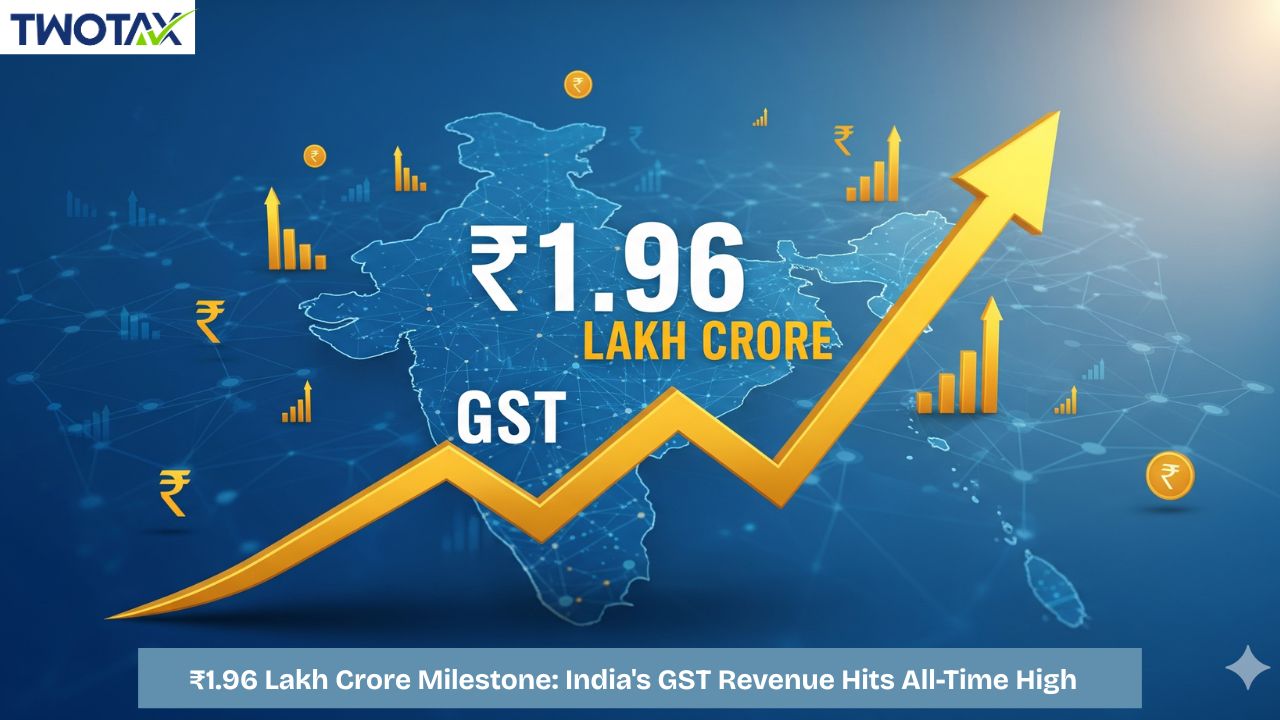
India’s Goods and Services Tax (GST) collections have once again crossed impressive levels, signaling stability and resilience in the economy.
For October 2025, the gross GST collections touched ₹1,95,936 crore, marking a 4.6% year-on-year growth compared to October 2024. This figure demonstrates that despite ongoing rate rationalisation and global economic fluctuations, India’s domestic demand and compliance systems continue to strengthen.
What’s particularly encouraging is that net revenue (after refunds) stood at ₹1,69,002 crore, showing a 7.1% year-on-year growth. These numbers are not just indicators of tax collection but mirror broader trends in consumer spending, trade activity, and compliance efficiency.
The breakup among different components stood as:
This composition reflects how imports and state contributions continue to drive the GST structure.
October traditionally coincides with India’s major festivals like Navratri and Diwali, leading to a natural spike in consumer spending. Higher sales across sectors , from consumer durables to apparel and electronics , directly translate to higher GST collections. Even though rate cuts were recently introduced, demand during this period offset any revenue loss per unit.
A 12.9% rise in GST on imports suggests that India’s trade activity has picked up pace. Imports of raw materials, intermediate goods, and finished products all saw a jump, pointing toward higher industrial activity and consumer demand.
This is a positive sign for the economy, indicating that supply chains are functioning efficiently and industries are ramping up production.
India’s GST system has matured significantly since its inception in 2017. With e-invoicing, digital filing systems, and stricter audits, tax evasion has reduced considerably. The October figures highlight that an expanding tax base , with more businesses now under GST , is a key driver of consistent revenue growth.
The rate rationalisation announced in September 2025 adjusted tax rates for several items, including consumer goods like shampoo and small cars. Typically, rate cuts tend to reduce tax revenue; however, October’s data indicates that volume growth and better compliance offset this impact, showing the health of India’s consumption pattern.
Major industrial and consumption-heavy states like Maharashtra, Karnataka, Gujarat, Tamil Nadu, and Haryana together contributed over 40% of the total GST collections.
However, a deeper look reveals an interesting trend , while large states continued to perform steadily, around 20 of 36 states and Union Territories recorded a dip compared to the previous year.
This divergence shows that growth is not uniform across India. Urban and industrial regions are seeing faster recovery, while smaller states and UTs may still be catching up post-pandemic disruptions.
Refunds grew by almost 39.6% in October compared to last year , with domestic refunds up by over 26% and import refunds by 55%.
This surge indicates:
For businesses, this highlights the importance of accurate documentation, ITC reconciliation, and timely refund claims, as authorities are speeding up settlements while maintaining strict verification checks.
If your business deals in goods affected by the September rate rationalisation, it’s essential to review product pricing. Anti-profiteering rules mandate that tax rate benefits be passed on to consumers, so pricing adjustments must reflect compliance and market strategy simultaneously.
Businesses must ensure timely and accurate reconciliation between GSTR-1, GSTR-3B, and GSTR-2B. With increasing enforcement and system intelligence, mismatches are likely to trigger scrutiny. Regular vendor compliance checks can prevent denial of Input Tax Credit.
Since GST growth patterns differ across states, companies with multi-state operations should track state-wise demand and tax settlement cycles. This can help optimize inventory, logistics, and working capital.
The increase in refunds and overall collections signals a stronger enforcement cycle. Taxpayers should be prepared for random scrutiny or audit selection by keeping records transparent and reconciled.
The October GST data shows a measured but positive growth trend. India’s fiscal stability continues to strengthen as monthly collections remain well above ₹1.90 lakh crore. However, businesses should be prepared for the following:
Overall, India’s tax collection trajectory reflects a maturing GST system that’s balancing rate cuts with stronger compliance and digital enforcement.
“October’s GST numbers demonstrate India’s economic stability and the strength of its compliance ecosystem. Businesses must not only ensure timely filing but also use these insights strategically.
At TwoTax, we believe GST isn’t just a tax , it’s a mirror reflecting consumption patterns, trade flows, and business discipline.
Staying compliant, optimizing ITC, and understanding rate impacts can turn GST from a liability into a competitive advantage.”
The October 2025 GST figures mark another strong month for India’s indirect tax framework. A blend of festive demand, improved compliance, and resilient trade has pushed collections close to ₹2 lakh crore.
While rate rationalisation and uneven regional performance will influence future months, the overall direction remains positive.
For taxpayers and businesses, the focus must now shift from just filing to strategic tax management , leveraging compliance, technology, and expert guidance to stay ahead.
Q1. Why did GST collections rise despite rate cuts?
Because higher volumes (festive demand), stronger imports, and better compliance offset the per-unit rate reduction in many categories.
Q2. Is the growth broad-based across states?
Not entirely. While large states contributed the bulk, many states/UTs saw a dip in October, so demand is uneven.
Q3. What’s the key risk to watch next?
If post-festive demand normalises faster than expected, rate-cut gains may not fully carry forward. Keep an eye on refund scrutiny and vendor compliance.
Tax Partner is India’s most reliable online business service platform, dedicated to helping you in starting, growing, & flourishing your business with our wide array of expert services at a very affordable cost.