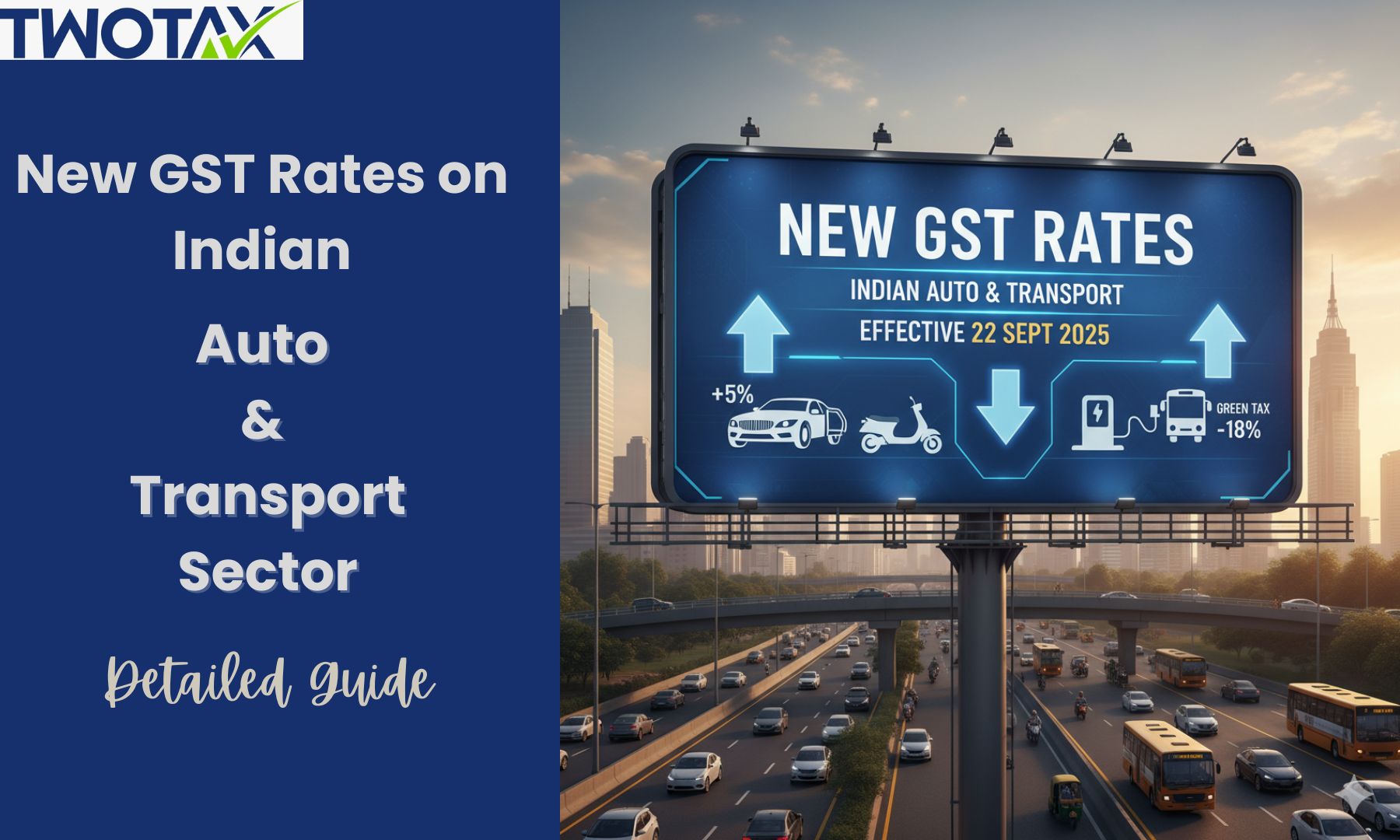
New GST Rates for Indian Auto and Transport Landscape effective 22 Sept 2025
Explore the latest GST rate changes for the Indian auto and transport sector effective from 22 September 2025. Know how the new GST slabs impact cars, commercial vehicles, EVs, and passenger transport services in India.
By Advocate, Tanvi Thapliyal September 20, 2025
India’s automobile and transport sector is huge and woven into the lives of millions of people. Every day, millions of Indians ride two-wheelers to work, drive small cars on city streets, or depend on buses and trains for daily commutes. On the commercial side, trucks, lorries, and buses carry goods and people across the country, forming the backbone of trade and connectivity. The industry supports a vast network of manufacturers, dealers, mechanics, drivers and gig workers, and contributes significantly to the economy, from steel and rubber suppliers to finance companies. In recent years, India became one of the world’s largest vehicle markets, with sales of cars and two-wheelers consistently in the millions. The transport sector (trucks, buses, pipelines, freight services) carries over 60% of India’s freight by road and plays a key role in supply chains that deliver everything from farm produce to electronics. Together, the auto and transport ecosystem impacts job creation, rural and urban mobility, and even inflation (since fuel and vehicle costs affect prices of goods).
Yet this sprawling sector has been facing challenges: rising production costs, slowing exports, and the need for cleaner mobility (electric vehicles, for example). At the same time, high taxes on vehicles and transport services had kept prices elevated for consumers and businesses. Recognizing this, the Indian government embarked on a second wave of tax reform known informally as “GST 2.0.” Slated to take effect from 22nd September 2025, these reforms dramatically overhaul how vehicles and transport services are taxed, with the aim of simplifying the system and boosting demand.
What Is GST 2.0 and Why Was It Introduced?
GST 2.0 refers to the second major round of reforms to India’s Goods and Services Tax, a unified tax system launched in 2017 that replaced a web of old taxes (like VAT, excise, octroi, etc.). While the original GST simplified many things, it still kept four main tax slabs (5%, 12%, 18% and 28%) plus additional “cess” on certain luxury and sin goods. Over time, this multi-rate system grew complicated and sometimes discouraged spending.
The government announced in August 2025 that it would collapse these slabs into just two standard rates, effective September 22. In broad strokes, the idea is to have one low rate (for daily essentials) and one standard rate (for most other goods and services), plus a higher rate for luxuries. Specifically, much of the economy will see either a 5% or 18% tax, and a single 40% rate will cover the highest end of the market (luxury vehicles, aircraft, tobacco, etc.). Alongside this, the GST Council agreed to scrap most of the compensation cess, which was a surcharge that used to be added on top of the 28% rate for items like big cars, aerated drinks, and tobacco.
The reasons for GST 2.0 are manifold. The government wanted to simplify the tax structure to make compliance easier for businesses and clearer for consumers. By reducing multiple high tax rates, the hope is to spur consumption: cheaper taxes on goods (including vehicles) leave more money in people’s pockets, which can lead to higher sales. In the case of the auto sector, this comes at a time when manufacturers and retailers are eager to revive demand. Cutting vehicle taxes also helps control inflation, as cars and transport costs weigh into the overall price index. Finally, the reform is part of a broader push to “Make in India”, encouraging companies to produce more here by creating a stable and predictable tax regime. In summary, GST 2.0 is marketed as a pro-growth, pro-consumer move: it lightens the tax burden on everyday goods (including family cars and bikes) and clarifies the tax code, while keeping taxes high on luxuries.
Major GST Changes in the Auto and Transport Sector (From Sept 22, 2025)
Under GST 2.0, the tax rates on nearly all vehicles and related services have been recast. The most important changes affecting the auto and transport sector are:
-
Two-Wheelers and Scooters:Bikes and scooters (up to 350cc engine size) move from 28% GST down to 18%. This means popular commuter motorcycles and scooters are taxed at a much lower rate, making them significantly cheaper for buyers.
-
Small Cars:Compact cars (petrol cars ≤ 1200cc, diesel ≤ 1500cc, and less than 4 meters long) also drop from 28% to 18%. These are the entry-level hatchbacks and sedans that first-time buyers often purchase.
-
Large Cars and SUVs:Larger passenger cars (with bigger engines and sizes) shift to a flat 40% tax. Previously, such vehicles paid 28% GST plus up to 22% in compensation cess (for a total tax burden of around 50%). Under the new system, the tax rate is 40% with no extra cess, which turns out to be a lower effective tax than before.
-
Two-Wheeler (>350cc) and Large Motorcycles:Bigger bikes that were taxed at 28% are now at 18%.
-
Three-Wheelers:E-rickshaws and petrol/diesel three-wheelers (used for passenger or goods transport) move to 18%.
-
Tractors and Farm Vehicles:Small tractors (<1800cc) and their parts are cut from 12% to 5%. Larger “semi-trailer” tractors (for trailers) go from 28% to 18%. This is a big tax cut aimed at farm mechanization.
-
Buses and Commercial Vehicles:Buses (10+ seaters) and commercial trucks that were taxed at 28% are now at 18%. This covers goods trucks, delivery vans, and charter buses.
-
Auto Components:Parts and components for vehicles , tires, batteries, engine parts, etc. , are standardized at 18% (down from a mix of 28% and other rates). This helps the manufacturers in the supply chain.
-
Insurance for Goods Carriers:Premiums for insuring trucks and commercial vehicles fall from 12% to 5%.
-
Transport Services (Freight and Passenger):Here the change is more nuanced. Transporters can now choose either a flat 5% GST without claiming tax credits, or 18% with input tax credit. In practice, this means a trucking company or a ride-hailing platform can charge customers just 5% GST (but then forgo claiming credits on fuel and expenses) or opt to pay 18% and claim credits. This preserves the option that existed (5% tax on road freight) while aligning it with the new 18% rate if companies want credit. Container rail and multimodal transport services get a similar 5% option.
Overall, the net effect is a much simpler structure: most vehicles and their parts now fall into an 18% bracket, with a handful of important goods at 5% (tractors, small essentials) and luxury vehicles at 40%. The old separate cess on cars and SUVs has been eliminated completely.
How Vehicle Prices Change Under GST 2.0
The shift in rates directly changes the on-road price tags for vehicles. Here’s how different segments are affected:
-
Budget Bikes and Scooters:A common motorcycle or scooter that used to carry 28% GST will now see its tax drop to 18%. In practical terms, a bike that cost ₹100,000 before taxes might have had ₹28,000 GST; now it will have ₹18,000. Retailers are passing most of this saving to customers. Buyers of small bikes (often young people and rural families) get immediate relief — estimates suggest tens of thousands of rupees savings on popular models.
-
Entry-Level Cars:This is the segment with most volume in India. Popular hatchbacks (Maruti Swift, Hyundai i20, etc.) moved from 28% to 18% in tax. Since the manufacturers had to add a large cess before, the drop in price is significant. Many brands have cut showroom prices by about ₹20,000,₹50,000 or more on these models. First-time car buyers and budget-conscious families benefit heavily: their monthly EMI or loan burden comes down. Dealers across India are promoting these price cuts, and the hope is that more middle-class buyers, especially in small towns, will start purchasing vehicles now.
-
Mid-Range Cars (Sedans and SUVs):Compact sedans and SUVs also see the 28 →18% change. Models like the Hyundai Creta, Honda City, and similar midsize cars are now cheaper by tens of thousands of rupees. Automakers expect this to spur demand in urban and semi-urban areas where these cars sell well. In fact, even buyers who had been considering higher-end models might trade down to find the best deals now.
-
Luxury Cars and Large SUVs:This is where things get interesting. Previously, a luxury car (say, a Mercedes or BMW sedan) had to pay 28% GST plus up to 22% cess, making the effective tax near 50%. Under GST 2.0, those cars pay a flat 40% with no additional cess. That means on a ₹50 lakh (5 million rupees) car, tax liability is about ₹20 lakh instead of ₹25 lakh or more. In absolute terms, luxury car prices have dropped by a few lakhs of rupees. To illustrate, early reports said a Mercedes SUV or BMW sedan could be ₹3,5 lakh cheaper than before. Automakers in this segment have responded by trimming their price lists. The net result is that aspirational buyers of big sedans and SUVs see a sizable saving, making India a slightly more competitive market for premium cars.
-
Commercial Vehicles (Trucks, Vans, Buses):Goods carriers and buses become much more affordable. A 28% →18% cut on trucks means logistics companies pay roughly 10% less tax upfront on a new truck. Given that trucks are often financed by loans, this can translate into tens of thousands of rupees saving per vehicle. For bus operators (including private tour buses, school buses, etc.), lower upfront costs make it easier to add new vehicles to fleets. Industry leaders are optimistic ,they note that making trucks cheaper while demand for goods transport rises (due to cheaper consumer prices) will create a “virtuous cycle” boosting the trucking business.
-
Tractors:Small farm tractors going from 12% to 5% GST is a big deal for the agricultural sector. It pushes down the sticker price of tractors , perhaps a saving of a couple of tens of thousands on a medium tractor. This is intended to drive mechanization in farming, as more farmers may now afford to buy or upgrade tractors. Given that India is a major tractor manufacturer and exporter, this cut also strengthens that industry globally.
-
Two-Wheeler (>350cc):Larger motorcycles and scooters (above 350cc) also drop from 28% to 18%. Enthusiasts buying performance bikes or big scooters see a direct price cut, encouraging sales in that segment as well.
-
Insurance and Parts:Commercial vehicle insurance premiums for trucks fell from 12% to 5% tax. This slightly lowers operating costs for transport companies. Auto spare parts and accessories are now at 18% instead of 28%, which reduces aftermarket costs for vehicle owners (tires, batteries, engine parts, etc., are cheaper by about 10 percentage points in tax).
In sum, almost every category of vehicle has become cheaper under GST 2.0. Retailers and manufacturers have updated their price tags accordingly, and many have proactively announced new lower prices. Some of the major carmakers (Maruti Suzuki, Hyundai, Mahindra, Tata, Toyota, etc.) quickly passed the tax savings to buyers by cutting ex-showroom prices. Luxury brands too have slashed prices by hundreds of thousands of rupees. Even before September 22, companies like Mahindra had announced price cuts on upcoming models to prepare the market.
Implications for Transport Services
The impact of GST changes isn’t limited to just buying vehicles , it extends to transport services that move people and goods. Here’s how:
-
Road Freight and Logistics:Transportation of goods by truck or other commercial vehicle now has a more flexible tax choice. Companies can charge 5% GST on freight (without claiming full input tax credit) or pay 18% GST and claim credit on their inputs. In practice, many transporters will stick to the low 5% rate for customer bills, keeping freight costs roughly in line with before (freight costs include that 5% tax). However, because new trucks were cheaper to buy, some of that saving can seep into lower freight rates over time. The government hopes that overall shipping costs (per tonne-km) will fall, making India’s supply chain more competitive. Lower taxes on trucks and related services reduce inflationary pressure on goods prices as well.
-
Public Transport (Buses):Since buses and minibuses are taxed at 18% down from 28%, purchasing new buses is cheaper for operators. Over time, this can enable bus companies and state transport corporations to buy more vehicles. In theory, cheaper buses could translate to more fleet and possibly lower fares, though fare decisions also depend on fuel prices and local regulations. For passengers using city or intercity buses, any tax saving is indirect. But the policy aim is to encourage fleet expansion and modernization (for instance, buying cleaner or electric buses) by lowering acquisition costs. In bullet points:
-
City buses or school buses (10+ seats) go from 28% tax to 18%.
-
Urban public bus fares are typically unaffected by GST because local transit fares are often exempt.
-
However, state government bus services might eventually pass some savings if they fund vehicles locally.
-
Rail and Multimodal Transport:Freight by rail (container trains) and combined multi-modal shipments (truck + rail) also see reduced tax rates. Now such services can be taxed at effectively 5% (non-air multimodal) or remain 18% if an air leg is involved. This encourages shifting some freight to rail or mixed transport, because the tax savings (especially on large shipments) make multimodal routes slightly cheaper than before.
-
Ride-Sharing and Taxis:App-based taxi services (Uber, Ola, etc.) and cab rentals include fuel in the fare. Under GST 2.0, these services have the same options as other passenger transport: either 5% GST (without input credit) or 18% with input credit (limited to fuel costs). In practice, ride-hailing firms already charged 5% GST on fares under the older system, and they will likely continue that, meaning customers probably won’t see any abrupt change in taxi fares due to GST. One small effect: since small petrol cars (like the Tata Tiago, Maruti Alto, etc.) are now cheaper to buy, some commuters might consider buying their own vehicles instead of using cabs. But for existing ride-share customers, fares remain mostly unchanged by the GST side.
-
Logistics and Warehousing:A broader consequence is that the overall cost structure of moving goods around is trimmed. If freight costs ease, logistics companies can offer better rates. Cheaper auto parts (tires, engines, batteries at 18%) also cut the maintenance costs of fleets. Over time, this could mean cheaper delivery of goods, benefiting retailers and consumers. Moreover, companies engaged in e-commerce or third-party logistics have long complained about high GST on transport. Now, with lower taxes on trucks and logistic services, the logistics industry expects more efficient supply chains. For example, firms may consolidate warehousing in fewer hubs (a trend started in 2017) and move goods faster across states. In fact, logistics experts note that eliminating certain tax barriers should shorten delivery times and reduce duplication, making Indian transport and warehousing more agile.
In everyday terms: You might not notice the tax line on your bus ticket or online delivery bill, but the knock-on effects mean cheaper goods, faster deliveries, and more choices in transport. Cheaper trucks eventually translate to cheaper freight of food, clothing and electronics to stores. Taxi and car hire rates remain stable, but your own fuel and maintenance bills (for personal vehicles) will be a bit lower since parts are taxed less.
Industry Response and Challenges
Unsurprisingly, the auto and transport industry has welcomed the tax cuts, since they directly stimulate demand. Manufacturers, dealers, and fleet operators responded quickly:
-
Price Pass-Through:Almost all big automakers announced they would pass along the tax savings to buyers. Companies like Maruti Suzuki, Tata Motors, Hyundai, Toyota, and even luxury brands such as BMW and Mercedes publicly cut their prices by the full or majority of the tax reduction. Dealers have updated car price lists, often putting up charts or posters showing “Old Price vs New GST Price.” In fact, the government even asked carmakers to display comparison posters at showrooms (in local languages, with the PM’s photo) to show customers the benefit of GST 2.0. This level of transparency is unprecedented, aiming to ensure consumers actually see the difference. Even Mahindra & Mahindra offered dealers special incentives to offset any losses from the abolished cess, helping them clear out stock without taking a hit.
-
Stock Management:Many dealers had bought vehicles in August in anticipation of higher demand, expecting price cuts. Some even halted new purchases in late August, waiting for the new regime. Conversely, some logistics and retailers held back inventory until after September 22, expecting consumers to start buying more after prices fell. Automakers are juggling ramp-up plans , some factories paused dispatches for a few days around the changeover to re-label price tags and comply with the new rules. Overall, industry sources say the auto sector went into a “simmering” mode in early September: demand inquiries were high, but final purchases were on hold.
-
Festive Season Preparations:With the reforms coming just before India’s festival season (Navratri, Diwali), companies are aggressively preparing. Automakers and two-wheeler makers predict a big surge in sales over the next few months. They have geared up production schedules, ensured service centers are ready, and even lined up special loan and discount offers to capture the pent-up demand. Logistics firms are racing to add truck capacity and arrange warehouses. Retailers in electronics, appliances, and other sectors are also stocking up faster than usual, anticipating a major sales bump once GST 2.0 kicks in. In short, everyone from car CEOs to warehouse managers is on high alert to handle a possible surge in activity.
-
Communication and Clarification:The government has been active in clarifying the new rules to industry. Officials and industry bodies have held workshops and issued guidelines about how to implement the tax cuts, how to handle existing stock, and how to treat input tax credits. For example, the National Pharmaceutical Pricing Authority (NPPA) gave detailed instructions on relabeling drug prices (though not auto-related) to ensure compliance. In the auto industry, associations like SIAM (for vehicles) and dealers’ groups (FADA) are liaising with ministries to smooth any glitches. One challenge has been managing the transition of input tax credits (ITC). Under the old system, dealers and transporters might have booked high credits (for instance, through the cess ledger). Now they need clarity on how to carry forward or reverse those credits. Discussions continue, especially on making sure dealers don’t suffer cash-flow issues from losing cess balances.
-
Challenges , State Revenue Concerns:A non-industrial challenge stems from the fiscal aspect. State governments used the compensation cess on cars and liquor as a stream of revenue. With that gone, states worry about meeting promised GST compensations. Industry insiders mention that some parties have raised concerns about whether central or state budgets will make up the shortfall. This is more a macroeconomic issue, but it could lead to debate in the GST Council in coming months. For manufacturers and consumers, however, the focus remains on the immediate price benefits.
In summary, the industry response has been proactive. Companies have cut prices, sorted their inventories, and are gearing up for higher sales. Dealers are eager to sell and capitalize on consumer enthusiasm. On the flip side, transitioning quickly to a new tax structure is operationally complex, and businesses have spent late August and early September on re-pricing, IT updates, and compliance checks.
Impact on Consumer Demand, Margins, and Market Behavior
With vehicle prices dropping, consumer behavior is set to shift noticeably:
-
Spurred Demand:Lower taxes mean smaller monthly payments for buyers. Industry analysts and executives uniformly expect a sharp rise in vehicle purchases. Early estimates suggested passenger vehicle sales could jump 10,15% above normal during the first quarter after the change (roughly October,December 2025). In fact, car companies reported a flood of inquiries as soon as the tax cuts were announced, and surveys show many consumers who had been postponing purchases (hoping for exactly such relief) are returning. This pent-up demand is especially strong in segments like small cars and two-wheelers. One car executive noted that Navratri dealers prepared to do 60,000 truck trips in three weeks , far more than last year , to rush vehicles to showrooms.
-
Festive Season Buying:The festive season likely sees an unusual spike. Historically, many Indians prefer to buy new vehicles or durable goods during festivals, and this year the shift is more intense because of GST 2.0. Reports from retailers of electronics and appliances also talk about shopping only from Sep 22 onward, as lower GST applies to items like TVs and smartphones too. In vehicles, dealers reported flat or modest sales growth in August 2025, attributing the lull to customers waiting for GST 2.0. Automakers now expect September onward to be a record quarter for sales. This pattern , a temporary delay followed by a surge , will dominate market behavior in the short term.
-
Manufacturer Margins:Automakers’ pricing strategies vary. Most have said they will pass on the full tax cut to keep competitive, meaning their per-unit margins should stay roughly the same. However, some may choose to keep part of the savings to bolster profitability after a year of rising costs. Luxury brands might trim prices partly to stimulate demand but still maintain some buffer. Given the fierce competition, market watchers believe the bulk of tax cuts will indeed reach customers. In the bus and truck segments, fleet operators expect that some manufacturers might quietly absorb a portion of the cut to maintain prices, since buyers in those segments are cost-conscious and price-sensitive.
-
Market Dynamics:The tax reform is reshuffling the competitive landscape. Small and mid-size cars become pricier rivals against entry-level variants. Electric and hybrid vehicles, which historically had a price advantage due to their 5% GST, now face stiffer competition from cheaper petrol/diesel models in the mass market (though EVs still enjoy the 5% rate, their nearest petrol competitors are now 18%). Dealers also expect trade-offs: for example, some city-dwellers who considered motorbikes might now opt for a small car since prices narrowed. On the flip side, commercial vehicle (truck/bus) makers see fierce demand from logistics and infrastructure firms, potentially even higher than anticipated, which could push up production and hiring.
-
Credit and Financing:Lower vehicle prices also improve credit affordability. Banks and non-bank lenders report an uptick in auto loan inquiries as consumers see their preferred model drop in price. Financing a car or bike is effectively cheaper now, boosting demand further. The government expects that more borrowing for vehicles could also channel more funds into rural and semi-urban areas, as two-wheelers become more accessible to gig workers, students, and farmers. In parallel, commercial financing (for trucks, tractors) should see growth as buyers refinance or purchase new fleets.
-
Behavioral Effects:Psychological factors are at play. Media and dealers are framing the tax cut as a “government-driven discount.” In consumer surveys, this narrative has created excitement. The immediate savings on the sticker price feels like a one-time windfall , something many buyers have been waiting for. Of course, prudent buyers also keep an eye on other costs (fuel, insurance, maintenance), but the headline drop in GST has captured public imagination. Social media buzz and showroom foot traffic have increased. Many families might choose to upgrade an older car or add another vehicle to the family fleet thanks to the lower taxes.
In summary, consumer demand is expected to be buoyant. Lower prices and easier financing should attract new buyers. Businesses will see higher sales and can potentially expand output. At the same time, the quick spike in demand presents a temporary challenge of supply (which we’ll discuss next). Margins for manufacturers will largely hold steady as they compete on price, and overall market behavior is shifting towards a brighter short-term outlook for auto sales.
Implementation Challenges and Early Hurdles
Rolling out such a big tax reform over a short window has its bumps:
-
System Updates:All vehicle manufacturers, dealers, insurance companies and transport firms had to update their billing systems overnight (on September 21) to reflect the new rates. That means software patches, reprogramming tax codes, and training staff. Such hurried changes risk glitches like incorrect invoicing. Reports surfaced of some confusion in September when parts of the system weren’t fully synced (for example, dealers clarifying which cars qualify as “small cars” exactly). Over the days immediately after the change, tax authorities had to issue clarifications for edge cases.
-
Rollover Inventory:Cars and bikes produced before September 22 were marked with the old (higher) price. Automakers and dealers needed to re-label these with new tags or offer additional discounts at the dealership to match the lower tax. The government advised that recalling and re-sticking labels wasn’t mandatory if final retail price compliance is ensured, but many dealers still physically updated stickers to avoid confusion. This was labor-intensive for large inventories. One example: a pharmaceutical ruling said old stock needn’t be relabeled, but auto industry players noted dealers preferred re-labeling to avoid mistakes at the showroom.
-
Freight and Logistics Bottlenecks:As noted, trucks have been in high demand. Logistics companies added trucks and booked containers to prep for the surge. However, in early September there were anecdotal reports of a temporary truck shortage and even some freight operators hiking rates due to the sudden demand for shifting goods to stores. In some regions, farmers and manufacturers also rushed to ship goods. If supply can’t meet the rush, that could lead to short-term spikes in freight costs. The government and industry are keeping a close eye on this, encouraging freight operators to ramp up capacity.
-
Transitional Rules:One tricky issue is the old “input tax credit” (ITC) balances on the now-abolished cess. Dealers and manufacturers had accumulated credit on cess amounts that they now can’t use in the same way. The Automotive Dealer Federation (FADA) petitioned the government to transfer remaining cess credits into the regular GST credit ledger to ease the pain on festival-season sales. The finance ministry indicated it would address this (often by allowing balances to be utilized for stock). Some manufacturers like Mahindra even voluntarily offered dealers compensation. Such measures were necessary because otherwise some dealers would have faced a cash crunch (selling cars and collecting lower taxes without access to their old credits).
-
Public Awareness:Ensuring consumers know about these changes is a challenge. The government’s poster campaign, media coverage and dealer communication all try to spread the word that prices are lower. But it will take time for average shoppers, especially in smaller towns, to fully register the change. Until customers see the new price tags, there may be a lag before they rush to buy. Financial inclusion is also a factor: buyers often wait for payday or festival bonuses. So, retailers expect a gradual uptake as people learn about the cuts.
-
Legal and Accounting Adjustments:Transport companies had to decide between the 5% no-credit option and the 18% credit route for each service. Their accountants had to quickly calculate which was better for cash flow. (As per clarifications, even if a company charges 5%, it can still claim credit on certain “input services” up to 5% of the freight value, but must forego credit on fuel and other expenses. Managing these rules is complex.) Also, companies engaged in ride-sharing were digesting new advice on how to handle fuel costs and driver commissions under the new slab.
Overall, the rollout went relatively smoothly given the magnitude, but it has meant a lot of frantic work behind the scenes. The biggest risk was simply timing: implementing on the cusp of peak season meant there was little wiggle room for delays. The government and industry were largely synchronized, but minor hiccups (some confusion on service tax, mixed messages in the press) have required quick clarifications. Most issues are being ironed out in the weeks following the changeover.
Broader Economic and Policy Implications
The GST 2.0 changes ripple beyond just the auto showrooms:
-
Boost to Consumer Spending:One aim is to revive consumption. Cars and motorbikes are among the most expensive everyday purchases for many households. By cutting their taxes, the government essentially gives consumers a cash-like boost. With the broader economy facing headwinds (like slowing exports or tight foreign demand), stimulating domestic spending is a policy priority. If successful, cheaper vehicles will not only sell themselves but also stimulate spending in related sectors — more spending on services (gas, insurance, maintenance), and more purchases of goods (since easier transport lowers some costs).
-
Inflation and Monetary Policy:Vehicle prices feed into inflation measures. In the past, high taxes on cars had been an inflationary force; lowering them can temper headline inflation. The government has signaled that this pre-emptive tax cut can help keep inflation on target, possibly allowing the central bank more room to support growth. Lower taxes on vehicles, auto parts, and transport (like cheaper logistics) will gradually filter into consumer price index (CPI) calculations, likely subtracting a small amount of inflation.
-
Rural Economy:Tractor tax cuts and cheaper two-wheelers directly target rural and lower-income consumers. Since bikes are common in villages and on semi-urban roads, the drop from 28% to 18% GST is very noticeable , for example, a rural self-employed worker buying a commuter bike will have a smaller loan. Similarly, cheaper tractors help farmers upgrade. A modern tractor boost farm productivity, which in turn can aid rural incomes. These targeted benefits align with government goals to support farm mechanization and bolster rural demand.
-
Industry and Manufacturing:The auto industry in India is vast, including big manufacturers and millions of small suppliers (tyre makers, glass factories, electronics). By easing tax on a flagship sector, the government is indirectly supporting these industries. Cheaper vehicles could also make Indian factories more competitive globally , if a car assembled here costs less because of lower taxes, exporters or foreign investors might view India more favorably compared to countries with higher tariffs. Analysts say this could accelerate the Make in India push, perhaps even attracting new models of foreign cars to assemble in India. Moreover, with demand rising, ancillary industries (MSMEs making car parts) expect more orders, which can create jobs and investment in those clusters.
-
Fiscal Considerations:GST revenues are split between the central and state governments. The compensation cess used to go into a fund to reimburse states for any loss of revenue from GST (and also fund some national schemes). With that cess gone, states will theoretically earn less. The central government has promised that overall GST collections (central + state) will be adequate by adjusting the sharing formula. Still, some states may feel shortchanged if actual growth doesn’t offset the lost cess. This could become a political issue if states demand additional compensation or higher central transfers. For now, however, the message is that the boost to the economy will raise taxable incomes broadly, compensating states in the medium run.
-
Environmental Impact:While not the headline, the reform has environmental angles. Making it cheaper to replace old vehicles with new (through lower taxes) can accelerate the turnover of polluting old cars and trucks. The government mentioned that lower taxes will incentivize people to upgrade to more fuel-efficient or electric models. On the flip side, cheaper ICE (internal combustion engine) cars do make driving more attractive compared to public transport, which could worsen congestion and emissions. The GST changes also keep the GST on EVs at a low 5%, confirming that the policy still favors cleaner vehicles. EV makers publicly welcomed the retention of the 5% rate. Over time, as more EVs become available, this stable tax advantage might help adoption , though smaller ICE cars becoming cheaper could slow EV growth if price is the main factor for buyers. The net effect on pollution and fuel consumption will depend on future policies and market choices.
-
Consumer Behavior & Social Equity:There’s an argument that cheaper vehicles could encourage more people to own a second car or bike, which might increase traffic congestion and energy use. However, the government also framed the cuts as enabling more people to afford modern vehicles (like giving a lift to the middle class). From an equity standpoint, reducing high taxes on affordable vehicles helps those with modest means. Luxuries and big vehicles still carry heavy taxes, so the policy still targets the wealthy (to an extent).
-
Compliance and Transparency:A simpler two-slab system with fewer special cases makes life easier for businesses. It reduces paperwork and chances of error. For consumers, the straightforward rates mean less confusion and (ideally) less room for hidden charges. The mandatory GST posters at dealerships are an effort to keep things transparent. If the system works smoothly, evasion and tax disputes should fall, and the government will lose fewer rupees to uncollected taxes. That strengthens the tax base in the long term.
In broader economic terms, GST 2.0 is a fiscal stimulus disguised as tax reform. By cutting taxes on autos, the government is betting on a multiplier effect: cheaper vehicles lead to more production, more jobs, and more spending, which in turn boosts GST receipts on other items. If this works, it could help India maintain strong growth. Critics might say it’s just shifting tax burdens (charging more elsewhere, or higher deficit), but most commentary is positive: at worst, it’s a modest revenue sacrifice for potentially higher growth and GDP.
Future Outlook for the Sector Under GST 2.0
Looking ahead, what can we expect?
-
Continued Demand Growth:In the near term (late 2025 through 2026), vehicle sales are likely to remain robust. Automakers are already ramping up, and new models will attract buyers taking advantage of the tax cut. It’s plausible that the fourth quarter of FY2026 and the early part of FY2027 will see record sales compared to the previous year. After that initial surge, demand might normalize but could stay above pre-GST levels if economic growth holds steady.
-
Industry Expansion and Investment:With better affordability and tax predictability, manufacturers may accelerate expansion plans. The fact sheet from the finance ministry expected global automakers to expand assembly operations in India. Indeed, companies like Suzuki (Maruti), Tata, and others might add capacity. Ancillary parts makers will likely boost production. Employment in the auto sector could grow as production picks up and new plants come online. Even auto-tech startups (EVs, ride-sharing, battery swapping) might see indirect benefits from a bigger auto market.
-
Shift in Market Shares:Small and midsize car segments could gain market share versus larger, more expensive models. Two-wheeler brands offering commuter bikes may see larger growth than those focusing on high-end bikes. Among passenger vehicles, micro-SUVs and compact crossovers (under 4 meters) might steal the show, since they now become relatively more economical. Luxury carmakers might encounter slightly weaker growth after the initial bump (since much of their advantage was one-time). But they may still sell more units than before, given the sheer cut in effective tax.
-
Focus on Electric and Hybrid:EV and hybrid carmakers will be watching closely. For now, EVs enjoy the 5% rate and the industry is relieved it’s retained. However, as small petrol cars get cheaper, EVs must compete on non-price factors (like fuel savings, technology). The government still appears committed to supporting EVs through tax policy, but future GST Council meetings may revisit the structure. For consumers, hybrid models (especially strong hybrids) face changes: some hybrids that were taxed like luxury cars are now on par with ICE. This makes the hybrid advantage smaller. Manufacturers of hybrids and EVs will tailor their strategies (e.g., focusing on models that are competitive under the new GST slabs).
-
Used Car Market:The second-hand market often follows the new price levels. As new cars become cheaper, used cars of similar models might also drop in price. This makes car ownership accessible to lower-income buyers too. Used car dealers and refurbishers may see a spike in business as some owners trade in old vehicles for new ones (with good depreciation). This could breathe life into the entire vehicle lifecycle , financing, servicing, etc. Overall, total vehicle population on roads might climb more quickly.
-
Transport Services Evolution:With lower costs, expansion of bus services, trucking, and logistics is likely. One expected outcome is more fleet orders: e-commerce companies (like Amazon, Flipkart) announced they are booking more freight capacity in anticipation. Cold chain, FMCG, and farm export segments will benefit from slightly lower shipping costs. Freight aggregation platforms and 3PL providers might find new opportunities to offer efficient routes. In public policy, cheaper bus fleets might encourage city and state governments to step up public transit (or at least ease the pressure to raise fares).
-
Consumer Behavior Shifts:Over the long run, people may delay car purchases less if they trust taxes will remain low. Right now GST 2.0 seems permanent (unlike one-time scrapping of cess). If households see stability, they might buy when they need rather than gamble on future cuts. Also, cheaper two-wheelers and small cars might mean more people join India’s motorized middle class. This has broader social effects: improved mobility, access to jobs/education for rural youth, etc.
-
Potential Pitfalls:No reform is without risks. One possibility is that lowering vehicle taxes could gradually increase traffic congestion and pollution, though replacing very old vehicles with more efficient new ones may offset that. Also, if domestic demand overheats, it could pressurize supplies of microchips or rare materials (many cars still use imported chips, and EVs need batteries). Another issue is keeping GST system stable , if debates over state revenues intensify, the tax framework might face tweaks in future council meetings. But for now, the outlook is optimistic.
-
Global Context:The world is watching. India’s move to slash GST rates makes it an even more cost-competitive destination for car manufacturing compared to many neighbors. Exporters of vehicles and parts may find new opportunities. At the same time, this tax reform happens amid global uncertainties (trade tensions, tariff wars). By boosting domestic auto demand, India aims to insulate itself from external shocks. Analysts say it could help the country weather slowing global trade, by relying on its large internal market.
In essence, GST 2.0 sets the stage for a growth spurt in India’s auto and transport sector. By lowering the tax hurdle, it unleashes pent-up demand and makes expansion viable. Policymakers hope that simpler GST rates will lead not just to cheaper cars today, but to a more vibrant industry tomorrow , one that produces more jobs, more exports, and cleaner transportation options. For everyday Indians, the message is straightforward: you can buy a bike, car, or truck for less tax from late September, which should translate to some savings in your pocket and perhaps better choices on the showroom floor. The final impact will unfold over the next few years, but the immediate effect is clear: cheaper mobility and a jolt of energy in the roads and factories of India.