Connect with us for all your queries


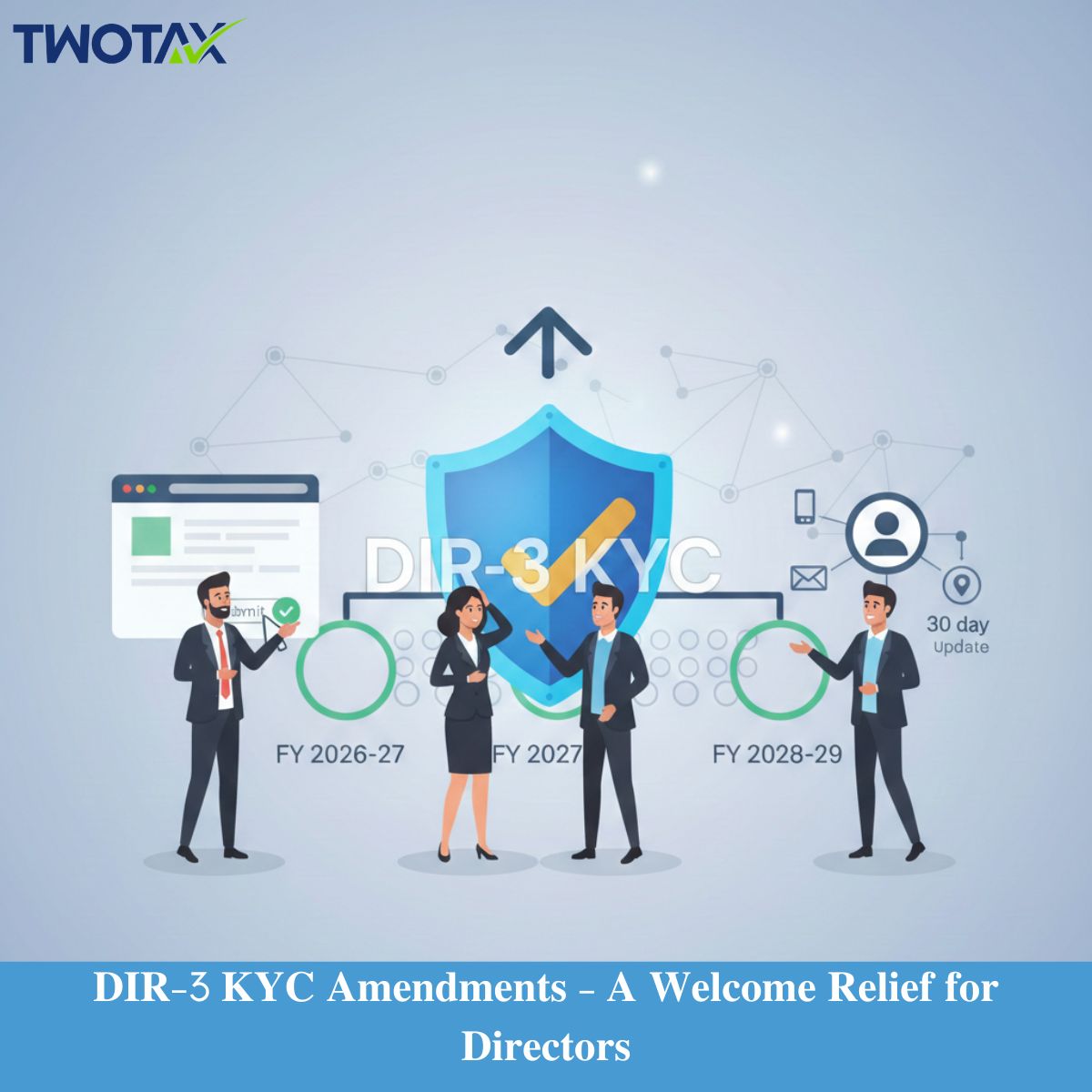
The Ministry of Corporate Affairs (MCA) has introduced a major compliance reform in director KYC requirements by amending the DIR-3 KYC rules effective from Financial Year 2026-27.
Earlier, every director was required to file DIR-3 KYC annually. The new framework replaces this with a 3-year filing cycle along with event-based updates, reducing repetitive compliance while ensuring accurate director records.
In this article, we explain the amended DIR-3 KYC rules in simple language , covering applicability, due dates, filing process, penalties, and practical compliance tips.
DIR-3 KYC is a mandatory compliance form filed with MCA by every individual holding a Director Identification Number (DIN).
It verifies and updates the director’s:
The objective is to maintain an updated and authenticated MCA director database.
.png)
This amendment significantly reduces recurring compliance burden on directors.
1. 3-Year Filing Requirement Introduced
Directors are now required to file DIR-3 KYC once every three financial years instea d of annually.
Example:
If DIR-3 KYC is filed in FY 2026-27 → Next due in FY 2029-30.
This provides major compliance relief, especially for salaried and independent directors.
2. DIR-3-KYC-Web Becomes Primary Filing Mode
MCA has simplified the process through a web-based interface.
Features:
This aligns with MCA’s digital compliance transformation initiative.
3. Event-Based KYC Updates Now Mandatory
Even though periodic filing is reduced, directors must update details within 30 days of any change.
Changes requiring update:
Failure to update may attract penalties or DIN deactivation.
4. Reduced DSC & Professional Certification Requirement
Under amended rules:
This lowers compliance cost and dependency on professionals for routine filings.
Directors who have already completed DIR-3 KYC up to FY 2025-26 will automatically migrate to the new regime.
Key points:
This avoids duplication of filings.
While MCA will notify specific timelines, the broad structure is:
Directors should maintain an internal compliance tracker.
Non-compliance consequences remain stringent.
Risks include:
Hence, relaxation in frequency does not mean relaxation in accountability.
Scenario 1 – No Change in Details
Director files KYC in FY 2026-27 → Next due after 3 years.
Scenario 2 – Email ID Changed
Update required within 30 days → Event-based filing triggered.
Scenario 3 – Change Not Reported
Risk of DIN deactivation + penalties.
For Directors
For Companies
For Professionals
To stay compliant under the new regime:
Keep PAN, Aadhaar & MCA data aligned
Use permanent email & mobile number
Report changes immediately
Maintain DIN compliance calendar
Avoid last-minute updates
From a governance perspective, this amendment is a progressive reform.
It reduces repetitive filings while placing responsibility on directors to maintain real-time accuracy of their records.
The new regime works best when compliance is:
Directors who remain vigilant will benefit the most from this simplified structure.
The amended DIR-3 KYC rules effective FY 2026-27 mark a shift toward ease of doing compliance in India’s corporate ecosystem.
By introducing a 3-year filing cycle and event-based updates, MCA has balanced compliance relief with data accuracy.
For directors and companies, this is an opportunity to reduce routine burden , provided they remain proactive about change reporting.
Tax Partner is India’s most reliable online business service platform, dedicated to helping you in starting, growing, & flourishing your business with our wide array of expert services at a very affordable cost.