Connect with us for all your queries


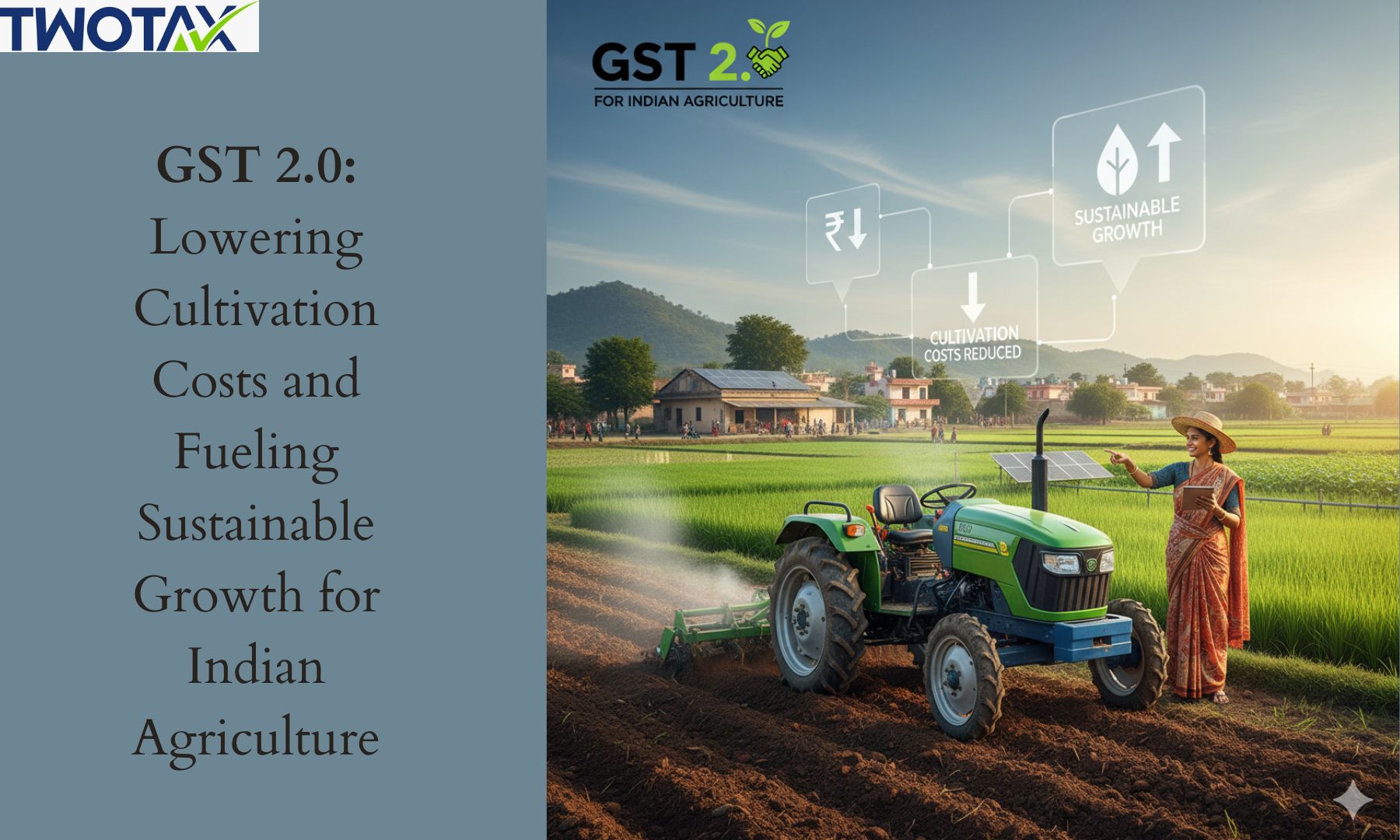
The introduction of the Next-Generation Goods and Services Tax (GST) reforms, frequently termed ‘GST 2.0,’ represents the most significant structural evolution of India’s indirect tax framework since its inception in 2017. Announced by the Prime Minister on August 15, 2025, from the ramparts of the Red Fort, these reforms are framed not merely as technical corrections but as a strategic, citizen-centric policy shift aimed specifically at enhancing the quality of life, boosting economic efficiency, and providing targeted relief to fundamental sectors, particularly Farmers and Agriculture.
The core of GST 2.0 is the profound rationalization of the tax structure. It moves decisively away from the complex, four-tiered framework (5%, 12%, 18%, 28%) to a streamlined two-rate system: the 5% Merit Rate for essential goods and critical inputs, and the 18% Standard Rate. A special De-merit Rate of 40% has been introduced for a select few luxury and sin goods. This structural change, largely implemented from September 22, 2025, signals a clear governmental priority: reducing the tax burden on items essential for common citizens, labor-intensive industries, and the entire agricultural production cycle.
This comprehensive analysis identifies three primary impacts through which GST 2.0 will fundamentally alter the economics of Indian agriculture:
Reduction in Cultivation Costs: By lowering the tax on capital goods and operational inputs, the policy directly addresses the financial burden on farmers.
Incentivizing Sustainability: Differential taxation strongly favors bio-based inputs and clean energy technology over conventional chemical or fossil fuel alternatives, driving a systemic shift toward ecological resilience.
Enhancing Value Chain Liquidity: Procedural reforms, particularly those concerning provisional refunds and dispute resolution, liberate working capital and enhance the competitiveness of agribusinesses and exporters.
The strategic decision to place almost all farm machinery and green inputs into the 5% Merit Rate corrects a long-standing policy contradiction. Historically, seeds were exempt, yet essential capital goods like tractors and harvesting equipment were taxed at 12% or 18%. This elevated indirect tax component treated farm equipment as a high-cost consumer durable rather than an indispensable tool of production. By migrating these items to the 5% rate, the government validates the classification of farm inputs as essential production tools, directly attacking the issue of elevated cultivation costs and encouraging widespread modernization.
The introduction of GST in 2017 promised a simplified system and the removal of cascading taxes, yet the agricultural sector remained plagued by fundamental tax asymmetries. While raw agricultural produce remained exempt (NIL rate), necessary inputs often attracted substantial tax liabilities. For instance, seeds were exempt, but many pesticides incurred an 18% levy, and tractors were often charged at 12% or more. These disparities accumulated to an estimated 15–20% inflation in cultivation costs for Indian farmers, placing a significant and uneven financial strain on producers.
The original GST structure (GST 1.0) failed to fully rationalize rates across the entire agri-value chain, leaving core productive inputs, especially capital goods and machinery, in the higher 12% or 18% slabs. This scenario resulted in an unavoidable increase in the financial burden on farmers seeking to modernize their practices or improve efficiency.
The impetus for GST 2.0 originated from the 79th Independence Day announcement on August 15, 2025, establishing the mandate for next-generation reforms. The detailed recommendations were subsequently finalized during the 56th GST Council meeting, held on September 3, 2025, under the chairpersonship of the Union Finance Minister. These recommendations focused on a multi-sectoral approach, specifically prioritizing rate rationalization for Farmers and Agriculture, Health, Labour-intensive Industries, and the Common-man. The majority of the rate changes concerning goods (excluding tobacco products, which remain at existing rates until compensation cess obligations are discharged) and services were implemented shortly thereafter, effective from September 22, 2025.
The most significant structural alteration is the explicit governmental goal of transitioning the system toward the two-tier model, thereby effectively eliminating the 12% and 28% slabs and merging the items contained therein into the new 5% or 18% brackets.
The elimination of the 12% slab is particularly critical for the agriculture sector. A large number of key agricultural inputs—such as basic machinery, irrigation equipment, and specified bio-inputs—were previously situated within the 12% band. By uniformly shifting these items to the 5% Merit Rate, the system prevents classification arbitrage, where industry players might attempt to position goods between the 5% and 18% rates. This move streamlines Input Tax Credit (ITC) management for large agri-businesses, Food Producer Organizations (FPOs), and manufacturers, ensuring a lower, predictable compliance risk and easing the financial administration of inputs.
The core of the agricultural relief package lies in the decisive reduction of GST rates on capital goods essential for modern farming practices. The GST rate on critical agricultural machinery has been slashed from the previous 12% or 18% down to the new 5% Merit Rate.
This targeted rate cut includes specific types of equipment, most notably:
The quantitative benefit of this shift is substantial. A reduction from 12% to 5% represents a 58% decrease in the indirect tax component applied to the capital expenditure for equipment acquisition. This dramatically lowers the upfront capital cost of modernization for the farmer, acting as a powerful financial incentive for technology adoption and the replacement of inefficient, older equipment.
This reduction is expected to trigger a significant boost in demand for farm equipment. The lower GST rates on machinery support not only economic expansion but also environmental goals, by encouraging the swift adoption of new technology and supporting initiatives like air pollution abatement, particularly concerning the management of crop residue and stubble burning. Furthermore, the increased affordability stimulates the domestic agricultural machinery manufacturing sector, leading to increased investment and potential job creation.
Beyond the initial purchase of machinery, the cost of sustained operation is critical for farm profitability. Addressing this, the GST rate on essential components such as tractor tyres and parts has been cut substantially from 18% to 5%.
Operating costs often accumulate and, over the lifetime of capital equipment, can surpass the initial acquisition cost. The significant reduction of GST on spares and parts from 18% to 5% provides crucial long-term financial relief. This ensures that maintenance and repair—vital for sustained mechanical productivity—become dramatically cheaper. The consequence is improved operational efficiency, extended machinery lifespan, and reduced overall operational downtime for the farmer, directly impacting annual cash flow and productivity.
The GST Council specifically targeted the anomalies related to the Inverted Duty Structure (IDS) prevalent in several manufacturing sectors, including fertilizers and textiles. In the case of fertilizers, while the finished product might be taxed at a lower rate (e.g., 5%), the intermediates or inputs required by manufacturers were often subject to higher rates. This disparity led to an accumulation of Input Tax Credits (ITC) that manufacturers could not fully utilize or claim back efficiently, resulting in blocked capital and adding an embedded, non-creditable cost to the product.
The rate rationalization applied to fertilizer intermediates ensures that manufacturers can now more effectively claim ITC. By streamlining the tax on inputs, the effective cost of production is reduced, reinforcing the policy goal of lowering the final price of essential agricultural commodities. The following table summarizes the key reductions in capital and operational costs for farmers:
Table 1: Input Cost Reductions for Agricultural Machinery (GST 2.0 Impact)
.png)
GST 2.0 strategically employs fiscal policy to engineer a structural and behavioral transition within the farming community, promoting sustainable agriculture in line with national missions focused on natural and eco-friendly farming methods. The rate cuts are specifically structured to favor inputs that support ecological resilience.
A clear investment in green practices is evidenced by the reduction of GST on specified Bio-Pesticides, Micro Nutrients, Drip Irrigation Systems, and Sprinklers from 12% to the lowest rate of 5%. These measures enhance the affordability of advanced, efficient, and environmentally friendly inputs necessary for crop protection and water management.
The taxation structure creates a highly strategic fiscal disparity between chemical and biological inputs. While specified bio-inputs have been moved decisively to the 5% merit rate, conventional chemical pesticides are typically retained within the higher rate structure, generally 18%.
This differential taxation (5% versus 18%) functions as a powerful, market-driven policy signal. By making bio-based inputs significantly cheaper than conventional chemical alternatives, the government creates an immediate and tangible financial incentive for farmers and FPOs to adopt eco-friendly farming practices. This policy action supports better soil health and higher crop quality, directly aligning commercial decisions with long-term environmental sustainability and the goals of the Natural Farming Mission.
Parallel to the reduction in farm machinery taxes, GST 2.0 took a bold step towards sustainable energy adoption in rural India. The GST on a wide range of renewable energy devices and components, including solar panels, wind turbines, biogas plants, and tidal energy systems, was slashed from 12% to 5%, effective September 22, 2025.
For the agricultural sector, this policy has immediate and profound implications for water security and energy independence. The reduction translates directly into significantly cheaper solar pumps for irrigation. This measure lowers cultivation costs by reducing the farmer’s dependence on high-cost diesel fuel and often-unreliable grid electricity. The resulting enhancement of water security and reduction in input costs strengthens the overall resilience and financial viability of rural livelihoods. The policy also supports domestic manufacturing by making Indian-made components more competitive.
The reforms extend deep into the consumer economy, particularly impacting the food processing sector, which sits at the nexus of farmer output and consumer demand. The policy involves the mass movement of a wide array of processed food items and essential consumer goods from the 12% and 18% GST slabs to the 5% Merit Rate. This reduction in end-consumer prices is designed to stimulate aggregate demand across the economy, generating a "virtuous cycle of increased demand and growth" for the manufacturing and processing industries.
The changes are comprehensive, covering processed staples and convenience foods:
A key, often overlooked, benefit of these sweeping reductions is the impact on Post-Harvest Losses (PHL). Increased affordability and the consequent surge in consumption and investment incentivize the expansion of processing infrastructure and increase the level of value addition across the supply chain. When investment in processing, cold storage, and preservation facilities is fiscally encouraged, a lower quantity of raw produce spoils. This reduction in post-harvest losses directly translates into higher realized incomes for farmers and improved overall food security by maximizing the utilization of farm output.
The following table details the most significant reductions in the value addition segment:
Table 2: GST Rate Rationalization for Key Processed Food Products
.png)
The anticipated cascade of benefits—from increased investment in processing infrastructure, higher consumption rates, greater value addition, and decreased post-harvest losses—is collectively projected to lead to elevated incomes and better remunerations for both the primary farmers and the food processors. By making food processing fiscally more viable and rewarding, the reforms effectively stimulate rural entrepreneurship and provide direct, measurable benefits to FPOs, strengthening their integration into the formalized, modern food supply chain.
Logistics costs often constitute a significant percentage of the final price of agricultural commodities, acting as a frictional element in domestic and international trade. GST 2.0 addresses this friction point by lowering the tax burden on both the capital assets and the operational expenses associated with transportation.
To reduce the initial entry barrier for transporters, the GST on commercial goods vehicles (trucks and delivery vans), which form the operational backbone of India’s freight traffic (carrying 65-70% of goods), has been substantially reduced from 28% to 18%. This reduction lowers the upfront capital cost for fleet modernization and expansion.
Furthermore, operational expenses were targeted: the GST on third-party insurance for goods carriage has been lowered from 12% to 5%, with the crucial provision of continued Input Tax Credit (ITC) availability.
The cumulative effect of these logistics-focused rate reductions is expected to trigger a significant reduction in freight rates per tonne-km. This initiates a cascading, positive economic effect throughout the agricultural supply chain. Cheaper movement of agricultural goods systematically cuts overall logistics costs, making the commodities more competitively priced at the retail level and significantly improving the price competitiveness of Indian produce in international markets. The cost savings benefit both the producer (through better realized prices) and the end consumer (through lower prices).
The benefits derived from GST 2.0—specifically reduced logistics costs and accompanying procedural reforms (such as provisional refunds for exports)—provide a vital systemic advantage to India’s agribusinesses. By reducing the frictional costs inherent in the supply chain and speeding up cash flow (discussed in Section VII), the reforms significantly enhance the capacity of agricultural producers and exporters to compete effectively in global markets.
The policy also includes a clear fiscal signal regarding energy transition. While the GST on renewable energy devices was slashed to 5%, the GST on high-carbon alternatives like coal and lignite was simultaneously raised from 5% to 18%. This structural change encourages a strategic shift away from fossil fuel inputs in energy-intensive agri-processing and manufacturing, further aligning Indian agriculture with global sustainability standards.
Table 3: Logistics and Operational Cost Reduction Measures (GST 2.0)
.png)
Tax Partner is India’s most reliable online business service platform, dedicated to helping you in starting, growing, & flourishing your business with our wide array of expert services at a very affordable cost.