Connect with us for all your queries


India’s energy landscape is undergoing a transformative shift, driven by the vision of a cleaner, self-reliant, and sustainable future. The country’s commitment to renewable energy, particularly solar power, has been instrumental in addressing both environmental concerns and energy security challenges. As solar installations expand across residential, agricultural, and industrial sectors, understanding the taxation framework governing solar equipment becomes increasingly important.
The introduction of the Goods and Services Tax (GST) brought about a unified taxation structure that simplified the indirect tax regime. Over time, however, varying GST rates on renewable energy devices created confusion and cost inconsistencies. Recognizing this, the Government of India introduced major structural reforms under what is now referred to as the GST 2.0 framework in September 2025. One of the key highlights of these reforms has been the rationalization and reduction of GST rates applicable to solar energy devices and systems.
The 56th meeting of the GST Council, held in early September 2025, marked a pivotal moment in the evolution of the tax system. The Council’s recommendations sought to simplify the rate structure, reduce compliance burdens, and promote sectors of national importance. Among these, renewable energy especially solar received significant attention.
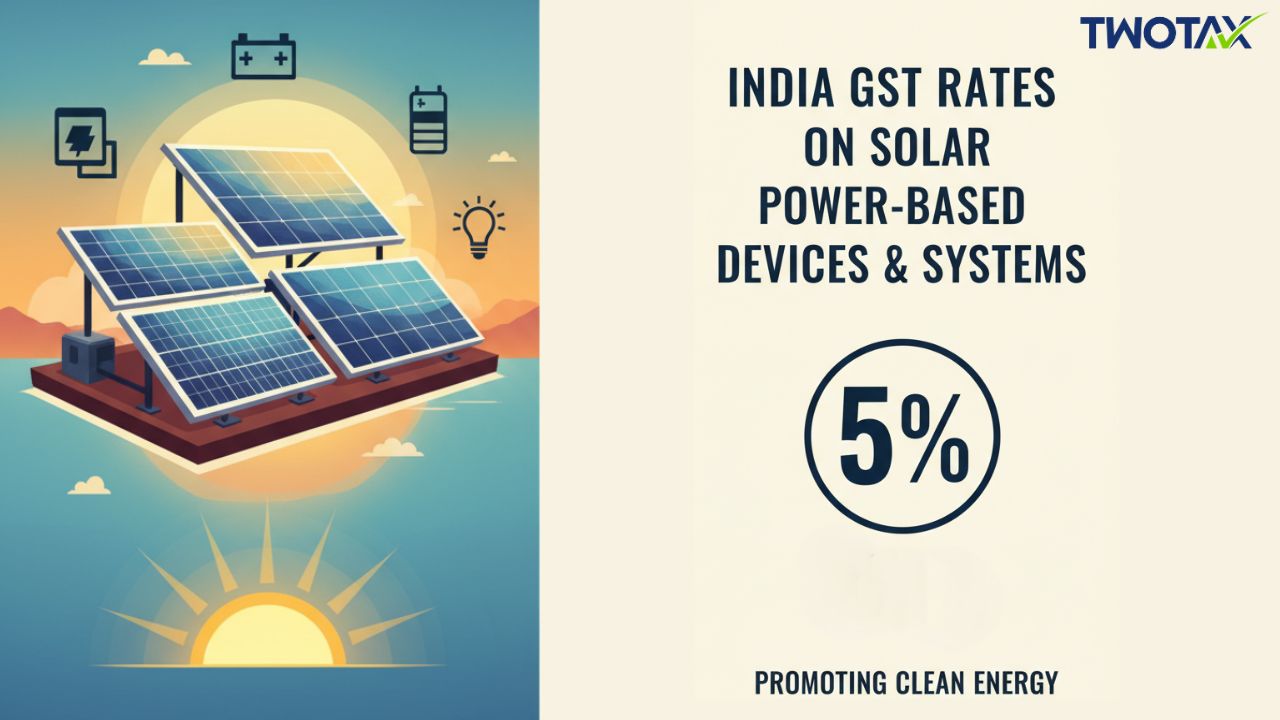
Prior to the amendment, most solar equipment and systems attracted a GST rate of 12 percent, with certain components, when sold individually, taxed at even higher rates (up to 18 percent). This created a pricing disparity between standalone components and integrated solar systems. Under the GST 2.0 amendments, a uniform GST rate of 5 percent was introduced on most renewable energy devices and systems, including solar power-based equipment. This change is aimed at enhancing affordability, promoting solar adoption, and furthering India’s clean energy goals.
Under GST law, solar equipment and components fall within specific headings of the tariff schedule, generally under Chapters 84, 85, or 94. These cover electrical machinery, power equipment, and renewable energy devices. The 5 percent rate now applies to “renewable energy devices and parts for their manufacture,” a phrase that encompasses a wide range of solar power-based systems and related products.
The following table summarizes the applicable GST rates on various solar devices and systems as per the latest amendments effective from 22 September 2025:
.png)
It is important to note that the reduced rate applies only when the product or system is clearly identified as a renewable energy device or a component meant for its manufacture. If the same product is sold for a non-renewable purpose, the concessional rate may not be applicable.
Under GST principles, when goods and services are supplied together as part of a single project (for example, a turnkey solar installation contract), such supply is considered a composite supply. In these cases, the principal component determines the applicable tax rate.
For solar power projects, the principal supply is typically the solar power generating system, attracting a 5 percent GST rate under the new regime. This simplifies earlier complexities where goods and services portions were taxed separately previously under a 70:30 ratio for goods and services. Now, under GST 2.0, the entire project is generally subject to a uniform rate of 5 percent, significantly reducing compliance complexities and potential disputes.
The Input Tax Credit mechanism under GST allows registered taxpayers to claim credit for taxes paid on inputs used for business purposes. Businesses installing solar plants or using solar systems for manufacturing or commercial operations can continue to claim ITC on the GST paid for such installations, provided the systems are used for taxable business activities.
However, individuals installing solar panels for residential use are not eligible for ITC, as they are not registered under GST. Nevertheless, the reduction in GST rate from 12 percent to 5 percent directly benefits residential consumers by lowering the upfront installation cost.
The uniform 5 percent GST rate under GST 2.0 has a multi-dimensional impact on the solar industry and the broader renewable energy ecosystem:
Enhanced Affordability:
The reduction in GST has made solar installations more cost-effective for both individuals and organizations. The upfront savings improve the financial feasibility of adopting solar power.
Boost to Domestic Manufacturing:
Lower tax rates encourage demand, which, in turn, supports domestic manufacturers under initiatives such as the Production Linked Incentive (PLI) scheme for solar modules and cells.
Simplification of Tax Compliance:
By eliminating the dual rate structure and standardizing the rate at 5 percent, GST 2.0 reduces litigation risk, administrative burden, and compliance costs for suppliers and project developers.
Support for National Renewable Energy Goals:
The policy aligns with India’s broader commitment to achieving 500 GW of renewable energy capacity by 2030 and net-zero emissions by 2070. Lower taxation accelerates adoption across rural and urban sectors alike.
Encouragement for Agricultural and Rural Deployment:
Solar pumps and off-grid systems now become more affordable for farmers, aiding rural electrification and irrigation projects.
To illustrate, consider a residential rooftop solar system priced at ₹3,00,000 (before tax). Under the earlier 12 percent GST rate, the total payable tax amounted to ₹36,000, bringing the overall cost to ₹3,36,000. Under the revised 5 percent rate, the tax amounts to ₹15,000, reducing the total cost to ₹3,15,000. This translates into an immediate saving of ₹21,000 for the consumer.
While the reduction may seem modest at smaller scales, for industrial projects running into crores of rupees, the cumulative impact is substantial and positively influences the investment climate for renewable energy projects.
For contracts and supply agreements executed before 22 September 2025 but invoiced or supplied thereafter, transitional provisions may apply. Suppliers and developers are advised to carefully assess the date of supply, invoice issuance, and payment to determine the applicable tax rate. Proper documentation and tax planning are crucial to ensure compliance during this transition period.
The introduction of a uniform 5 percent GST rate on solar power-based devices and systems marks a progressive step in India’s renewable energy taxation framework. It not only enhances affordability but also fosters consistency and predictability two critical factors for long-term sectoral growth.
The solar industry is poised to benefit substantially from this reform, with increased investment from both domestic and international stakeholders. As the government continues to streamline GST through the GST 2.0 framework, the renewable energy sector is expected to witness sustained growth, contributing significantly to India’s energy security and environmental objectives.
CA (Dr.) Arpit Yadav, Co-founder of TwoTax, emphasizes that taxation should facilitate, not hinder, sustainable development. The GST 2.0 amendments achieve precisely that by aligning fiscal policy with national energy goals. For individuals and businesses, understanding these provisions can lead to significant cost savings and better compliance outcomes.
At, we assist clients in interpreting and applying such tax reforms efficiently ensuring that every investment in sustainability also remains financially optimized and fully compliant.
Tax Partner is India’s most reliable online business service platform, dedicated to helping you in starting, growing, & flourishing your business with our wide array of expert services at a very affordable cost.