Connect with us for all your queries


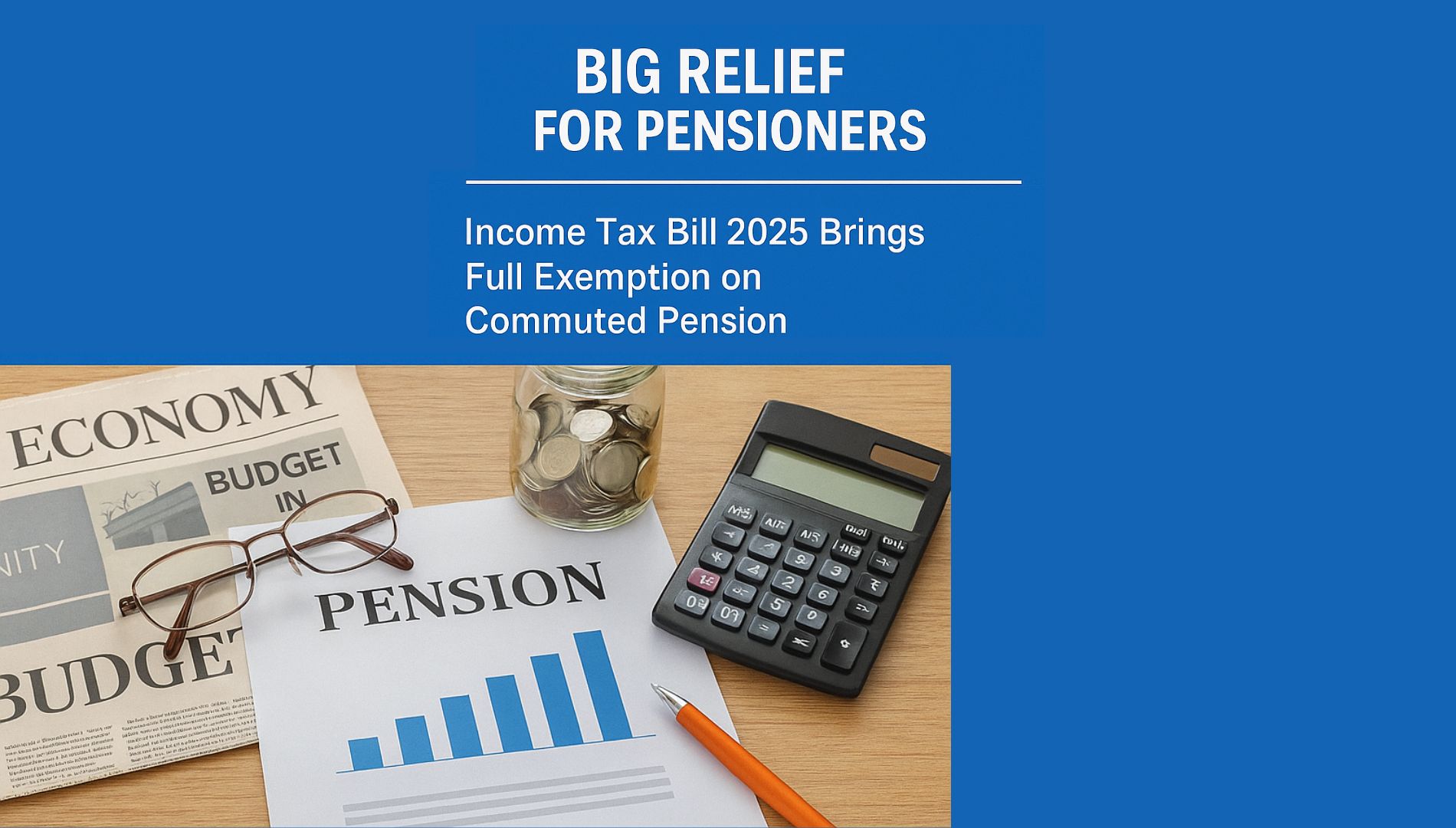
Retirement is a stage of life when financial stability and peace of mind matter the most. For pensioners, their pension acts as a lifeline — a reward for decades of hard work. However, tax laws have often left retired individuals concerned about how much of their pension income is actually theirs to keep. The Income Tax Bill, 2025 has brought welcome news for pensioners by granting a full exemption on commuted pension, ensuring higher post-retirement income and reduced tax burden.
This landmark move is a game-changer for millions of retired individuals, particularly those from government, public sector, and even some private sector backgrounds. It not only simplifies the tax treatment of pensions but also aligns with the government's broader agenda of easing the tax burden on senior citizens.
In this article, we’ll explore:
Before diving into the recent changes, it’s important to understand what a commuted pension is.
A commuted pension is a lump sum payment that a pensioner receives in lieu of a portion of the monthly pension they would otherwise get over their lifetime. This is essentially an advance payout of a part of the pension.
Let’s say your monthly pension entitlement is ₹50,000. If you opt to commute 40% of it, the government or employer calculates the present value of that 40% for a certain number of years and gives it to you as a lump sum. The remaining 60% continues as a monthly pension.
Under the Income Tax Act, 1961, the taxation rules for commuted pensions were different based on the category of employment:
Government Employees (Central/State Government, Defence services, etc.)
Commuted pension was fully exempt from income tax.
Non-Government Employees (Private sector and Public Sector Undertakings, unless under government rules)
This created a disparity private sector retirees often paid tax on a large part of their commuted pension.
The Income Tax Bill, 2025 eliminates this disparity by granting full exemption on commuted pension to all categories of employees — government or non-government, gratuity received or not.
This means whether you are a retired PSU employee, a corporate executive, or a self-managed superannuation scheme member, you can now receive your commuted pension tax-free.
Lump sum pension amounts are often used for major life expenses — buying a home, repaying loans, children’s weddings, or medical needs. With no tax deducted, pensioners have more in hand for these priorities.
The old law favored government employees, leaving private sector retirees at a disadvantage. This change levels the playing field.
Knowing that their commuted pension will be tax-free could encourage more employees to actively contribute to pension plans.
Let’s take two hypothetical cases:
Case 1 – Before Income Tax Bill, 2025
Commuted pension amount: ₹20,00,000
Employee: Private sector, gratuity received.
Exemption: 1/3rd of ₹20,00,000 = ₹6,66,667
Taxable amount: ₹13,33,333 (taxed at applicable slab)
If taxed at 30% slab:
Tax payable = ₹3,99,999 + cess
Case 2 – After Income Tax Bill, 2025
Tax saving: Around ₹4 lakh in this example.
With this change, pensioners can:
“The full tax exemption on commuted pensions is not just a relief — it’s a recognition of the decades of service given by retirees. At TwoTax, we believe this change will significantly boost retirement security for millions. However, while the exemption removes a tax burden, pensioners must still focus on disciplined investment of the lump sum to ensure a steady, inflation-protected income stream for life.”
The Income Tax Bill, 2025 provision on commuted pensions marks a major step toward equitable and senior-friendly taxation. It not only puts more money in the hands of pensioners but also eliminates the bias between public and private sector retirees.
For pensioners, this is the perfect opportunity to rethink retirement strategies and secure their financial independence. And for working professionals nearing retirement, it’s a signal to consider commutation as a viable, tax-smart choice.
At TwoTax, we specialize in:
With our expertise, we ensure you not only save tax but also grow your retirement wealth wisely.
Tax Partner is India’s most reliable online business service platform, dedicated to helping you in starting, growing, & flourishing your business with our wide array of expert services at a very affordable cost.