Connect with us for all your queries


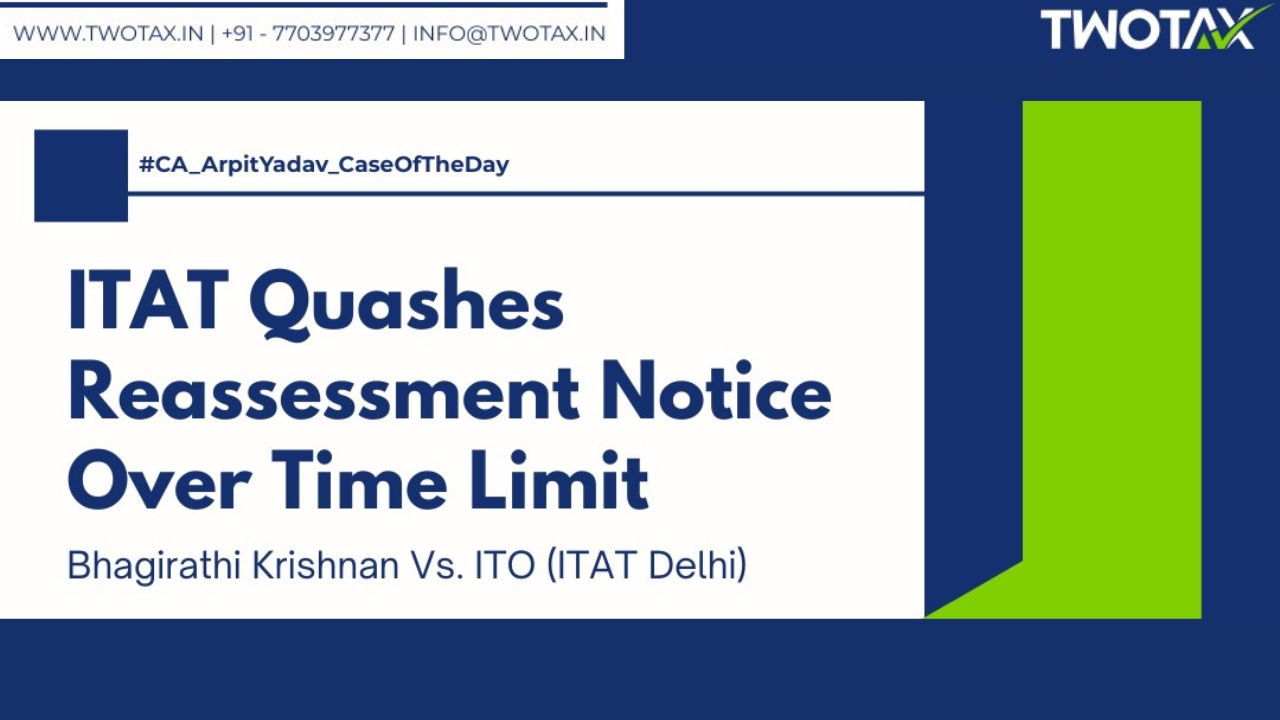
Bhagirathi Krishnan Vs. ITO
Stop! Is That Tax Notice Too Late? A Landmark Decision Every Taxpayer Must Know
Imagine this: You filed your tax return years ago, believing everything was settled. Then, suddenly, you receive a notice from the Income Tax Department saying they want to re-examine your old records. This process is called Reassessment (or "reopening" an assessment), and while the government certainly has the power to do it, that power has strict rules, especially about time.
A recent decision by the Income Tax Appellate Tribunal (ITAT) in Delhi, in the case of Bhagirathi Krishnan Vs. ITO, highlights one of the most powerful shields a taxpayer has against old notices: the Time Limit.
This is a story about how a simple mathematical fact, the amount of alleged escaped income, can completely invalidate a years-old tax notice.
Think of your annual tax filing (called the Assessment) like a final exam. Once you pass and get your results, the chapter is usually closed.
However, the Income Tax Department has the power to re-open that chapter (initiate reassessment under Section 147/148) if they later find new evidence suggesting that some income "escaped assessment." This means you might have underreported your income, claimed wrong deductions, or missed disclosing a high-value transaction.
The law understands that you can't keep old tax matters hanging over your head forever. That’s why there's a deadline for the tax department to issue a notice to reopen your case:
The law does allow the tax department to go back further,up to ten years,but only in very serious cases.
This extended 10-year period can only be invoked if the tax officer has evidence that the income which escaped assessment is or is likely to be ₹50 Lakhs (Fifty Lakh Rupees) or more for that particular year.
In the case decided by the ITAT, the tax officer issued a reassessment notice after the normal 3-year limit had expired. The officer did this because they believed the case fell under the extended 10-year period, assuming the escaped income was more than ₹50 Lakh.
However, the taxpayer (Bhagirathi Krishnan) and her counsel successfully argued a simple but powerful point:
The Tribunal ruled that because the final escaped income was clearly less than the ₹50 Lakh threshold, the extended 10-year time limit could not be legally applied.
Since the notice was issued long after the normal 3-year limit had passed, the entire reassessment proceeding was declared "illegal, bad in law, and time-barred (void-ab-initio)."
This decision is incredibly important because it confirms a major principle:
The time limit is a jurisdictional check.
If a tax officer reopens your case based on the 10-year extended limit, they must be able to prove that the escaped income is indeed ₹50 Lakhs or more. If they start the process claiming a high amount but finish the assessment proving a much smaller amount (below ₹50 Lakh), the entire reopening action is invalid from the very beginning.
In tax law, the rules aren't just about how much you owe; they're about the government's right to ask you for it. And in many cases, that right comes with a strict expiration date.
Tax Partner is India’s most reliable online business service platform, dedicated to helping you in starting, growing, & flourishing your business with our wide array of expert services at a very affordable cost.