Connect with us for all your queries


.jpg)
At TwoTax, our mission goes beyond simply keeping you compliant; it's about empowering you with clarity, confidence, and proactive insight into India’s rapidly evolving tax environment. The July 2025 edition of this newsletter encapsulates the reforms, reliefs, and rulings that truly matter to your business. We take immense pride in helping businesses like yours decode these regulatory shifts and seize opportunities from them. As we move forward into another fiscal quarter, I urge you to lean into professional planning and stay informed with TwoTax.
Dear Readers,
Welcome to the July 2025 edition of the TwoTax Monthly Tax & Regulatory Newsletter. In this edition, we bring you a comprehensive and in-depth analysis of critical updates and developments in the Indian taxation and regulatory landscape across direct taxes, indirect taxes (GST), transfer pricing, FEMA, RBI circulars, judicial decisions, and incentive schemes.
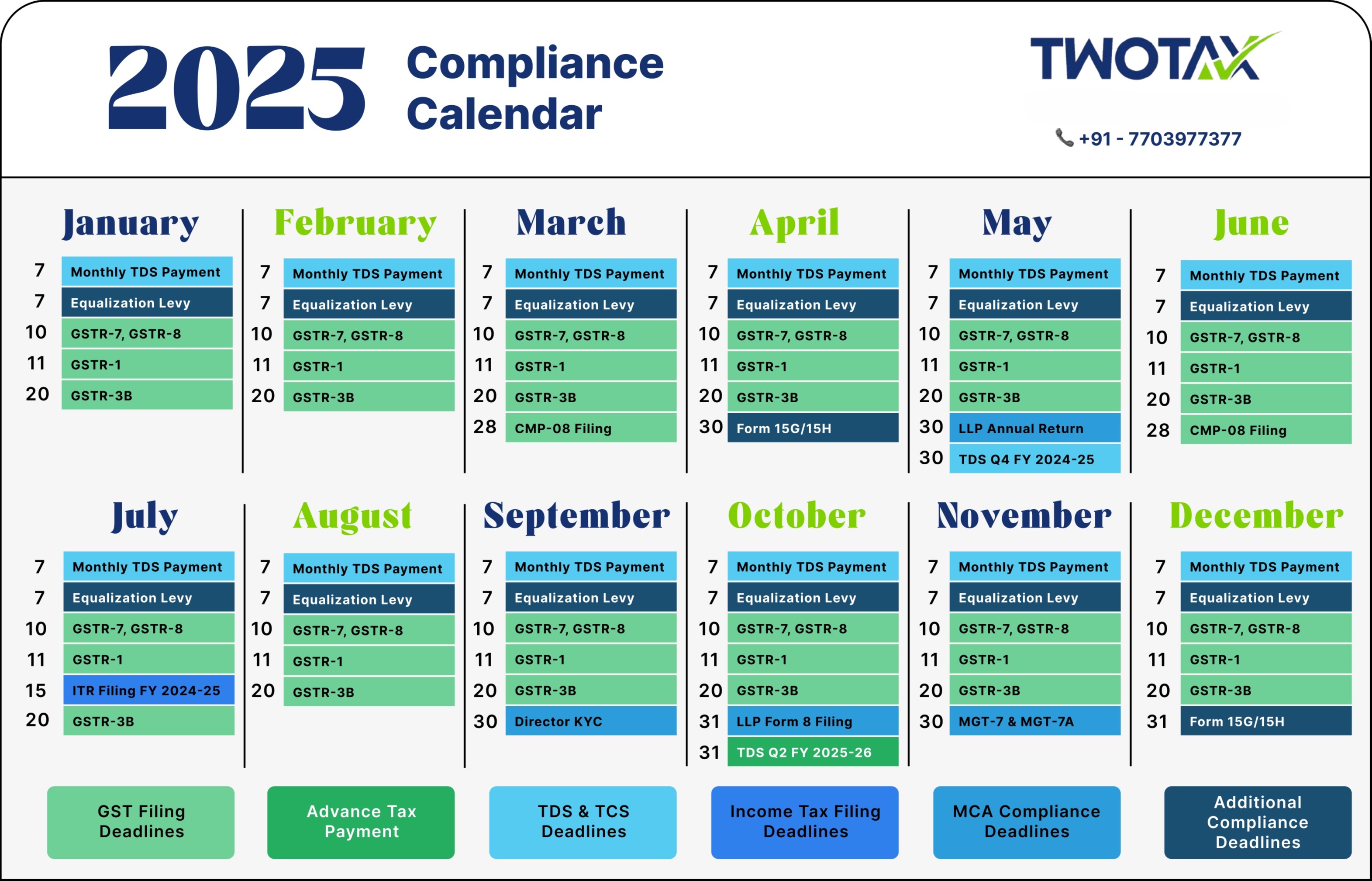
The Central Board of Direct Taxes (CBDT) has extended the due date for furnishing Income Tax Returns (ITRs) for Assessment Year 2025-26 to 15 September 2025, beyond the standard deadline of 31 July. This extension comes as a relief to taxpayers who require more time to adapt to the newly notified ITR forms for AY 2025-26. These revised forms emphasize greater transparency, improved disclosures, and accurate reporting. Moreover, delays in reflecting TDS credits (as per the 31 May TDS statement) further justified the extension.
Taxpayers should use this additional time to ensure proper reconciliation of Form 26AS, Annual Information Statements, and TDS certificates with their returns. Those waiting for clarification on tax positions or dealing with foreign income disclosures must also take advantage of this window.
CBDT has issued a one-time relaxation for processing validly filed ITRs for AY 2023-24 that remained unprocessed beyond the statutory 9-month window under Section 143(1). Now, these returns can be processed, and intimations issued up to 30 November 2025. This move is expected to facilitate refund processing and resolve long-pending return-related issues.
However, the relaxation does not apply to:
Importantly, the CBDT reiterated that non-linkage of PAN with Aadhaar will prevent refunds from being issued, so taxpayers must ensure the linkage is completed.
CBDT has notified fresh parameters for compulsory selection of cases for complete scrutiny. The primary triggers include:
CBDT also detailed cases excluded from this list and clarified the procedural flow of notices under Sections 142(1), 143(2), and reassessment notices.
For reassessment matters involving searches conducted post 1 April 2021, responsibilities have been delineated between Jurisdictional Assessing Officers and Central Charges.
CBDT has issued Notification No. 67/2025 providing that no TDS is required on certain payments made to International Financial Services Centre (IFSC) units, subject to declaration submission in Form 17. The exemption is conditional upon the unit claiming deduction under Section 80LA for the relevant year. Payers must also report such payments in their quarterly TDS returns.
This step is expected to boost the operational efficiency of IFSC entities and aligns with the government’s push to promote GIFT City as a global financial hub.
In a welcome move, the Supreme Court clarified the interpretation of Section 80-IA(9) by holding that it restricts the allowability, not the computation of multiple deductions under Chapter VI-A. The case involved the interplay of Sections 80-IA and 80-HHC.
The judgment emphasized that taxpayers can compute deductions under different sections independently, but the aggregate claim cannot exceed business profits. This resolves long-standing confusion on overlapping deductions and will influence many pending assessments and appeals.
The RBI, via Circular No. 06 (23 May 2025), has clarified that investment vehicles which issued partly paid units to foreign investors before 23 May 2025 may report these under Form InVI within 180 days, without late fees.
For issuances on or after 23 May, the standard 30-day timeline applies. This reporting flexibility will help numerous Alternative Investment Funds (AIFs) and REITs regularize past non-compliance.
The RBI has amended FEMA regulations to require a 3-year track record (earlier 2 years) for businesses to open Diamond Dollar Accounts. This step aligns with a risk-based approach to foreign exchange transactions and aims to bring maturity to such high-value trading entities.
Importers can now remit up to USD 50 million in advance for importing shipping vessels without providing bank guarantees or standby Letters of Credit. This relaxation, subject to conditions in RBI’s Master Directions, is expected to help shipping and logistics operators improve procurement timelines and reduce transaction costs.
In a significant ruling involving an automotive components manufacturer, ITAT Chennai allowed the use of 3-year data due to the industry-wide slowdown in FY 2019-20. The tribunal emphasized equitable comparisons and accepted weighted average analysis, diverging from the Transfer Pricing Officer’s (TPO) single-year approach.
In a case involving Essar Shipping Ltd, ITAT Mumbai upheld the TPO’s benchmarking of corporate guarantees at 1.4% based on bank guarantee comparables, even after considering risk differentials. The tribunal noted that past rates agreed upon in previous years are not binding for future periods.
ITAT Chennai ruled that mere resignation and sale of shares by a common director does not constitute business restructuring. It allowed the taxpayer to re-submit documentation and observed that procedural lapses (e.g., filing an addendum instead of revised Form 3CEB) should not deny substantive justice.
The Mumbai bench of ITAT invalidated a TP adjustment made under Section 80IA(10) for lack of a proven ‘arrangement’ between the assessee and its AE. The tribunal emphasized that high profitability alone does not trigger TP adjustments unless the foundational condition of an arrangement is met.
The CBIC clarified that if a Reference Number (RFN) is generated and verifiable on the GST portal, quoting a Document Identification Number (DIN) is not necessary. This simplifies recordkeeping and compliance.
From July 2025, GSTR-3B will have locked auto-populated liability data, derived from GSTR-1, GSTR-1A, and IFF. Amendments, if needed, must be made in GSTR-1A prior to submission. This change enforces accurate outward supply reporting.
GST returns beyond 3 years from their due date will no longer be accepted post-July 2025. This applies to all returns including GSTR-1, 3B, 4, 5, 6, 7, 8, and 9. Taxpayers should promptly file pending returns to avoid compliance risks.
The upgraded E-Way Bill 2.0 portal offers:
APIs are available for system integration, providing flexibility to logistics operators.
GSTN has introduced a process to rectify inadvertently rejected invoices, debit/credit notes in the Invoice Management System (IMS). Suppliers must re-report via GSTR-1A for the recipient to reclaim ITC in GSTR-2B.
The Sikkim High Court held that businesses that shut down operations are eligible for a refund of unutilised Input Tax Credit (ITC), even though the CGST Act lacks explicit provisions for such refunds. This ruling brings relief to businesses seeking to wrap up operations and exit cleanly, without losing accumulated credits.
The Karnataka High Court ruled that buying support services rendered by Indian entities to overseas affiliates qualify as export services and not intermediary services. The judgment noted the absence of facilitation between two parties and reaffirmed the principal-to-principal nature of contracts.
The Gujarat HC held that the omission of Rule 96(10) in October 2024 extinguished all refund-related proceedings initiated under the rule, including pending appeals and show cause notices. In the absence of a saving clause, the omission acts as a repeal.
The Allahabad HC quashed orders denying ITC to a buyer due to the supplier's non-payment of tax, asserting that buyers fulfilling all statutory requirements should not be penalized for third-party defaults.
6. Developments Under Customs, SEZ, FTP & Incentive Schemes
The Ministry of Heavy Industries launched the Scheme to Promote Manufacturing of Electric Passenger Cars in India (SPMEPCI). Open till 21 October 2025, it offers concessional duty for imported CBUs and mandates a minimum INR 4,150 crore investment with phased domestic value-addition targets.
The Gujarat government introduced a six-year incentive policy to promote electronics component manufacturing in the state. The policy aligns with MeitY's ECMS and offers funding support, workforce training benefits, and incentives in sync with central schemes.
The Supreme Court stayed VAT recovery on satellite transponder rights from 2008 to 2014, granting interim protection till final adjudication.
A Special Leave Petition has been admitted in the SC, challenging Karnataka HC’s decision that STBs provided to customers amount to a 'sale' under VAT laws. The industry awaits clarity on retrospective tax implications.
Bombay HC held that the Customs Act prevails over treaty clauses like Article 24 of AIFTA unless the treaty is explicitly incorporated into Indian law. Customs officers may continue issuing show cause notices even in FTA-related imports.
The Bombay HC ruled that exporters can claim both excise duty rebate and input-duty drawback (under CENVAT-not-availed category), provided CENVAT is reversed pre-export. This clarifies overlapping benefits.
CESTAT Delhi held that Computer Reservation System (CRS) services by foreign providers are not OIDAR services under Service Tax law as they don’t transmit data electronically but only provide access.
In a win for exporters, CESTAT Delhi ruled that recovery of Focus Market Scheme benefits requires prior scrip cancellation by DGFT. Without such cancellation, recovery and penalty proceedings are void.
As the financial landscape continues to evolve with frequent policy tweaks and judicial clarifications, staying updated becomes a competitive advantage. Whether it is a subtle change in compliance timelines or a game-changing court verdict, every detail matters. At TwoTax, we commit to decoding and delivering these insights in a way that is actionable and relevant.
Thank you for trusting us. Let’s keep building compliant and future-ready enterprises.
Warm regards,
Team TwoTax
Tax Partner is India’s most reliable online business service platform, dedicated to helping you in starting, growing, & flourishing your business with our wide array of expert services at a very affordable cost.




.jpg)
1.png)



.jpg)


.jpg)



.jpg)


1.jpg)

1.jpeg)



_page-0001.jpg)





.jpeg)